Rosie The Robot Runs For Real

On the recent 256th episode of the Hackaday podcast, [Kristina] mentioned her favorite fictional robot was Rosie from The Jetsons. [Robert Zollna] must agree since he built a reimagined Rosie and it even caught the notice of mainstream outlet People magazine.

We didn’t find much information outside of the TikTok video (see below; you can use the Guest button if you don’t have an account). However, there were a few clever ideas here. First, the robot mechanism is actually Rosie’s vacuum cleaner. Like a tail wagging a dog, an off-the-shelf floor vac tows the robot body.

Rosie herself is clearly an office chair base with an artistic body. The head rotates, and the mouth appears to open and close, so there’s apparently a little more electronics inside, but that’s nothing you couldn’t throw together with some RC servos and an ESP32.

Some videos cover the build so you might be able to glean more details, but the bite-sized videos aren’t very descriptive even though they are fun to watch. If you thought folks documenting their projects on YouTube was bad, you’re really gonna love the TikTok generation.

We like the look of Rosie, but as a practical matter, we need our robot vac to be smaller, not larger. However, using these off-the-shelf robots as a quick start for a robotics project is reasonable. Especially if you can pick up one cheap. Not that that’s a new idea. They even make stripped-down units with the intent that you don’t want to use them as cleaners.
Continue reading “Rosie The Robot Runs For Real”

Inside America’s Last Morse Code Station

The Titanic famously (or infamously) used Morse code to call out in distress at the end of its final voyage. Ships at sea and the land-based stations that supported them used Morse code for decades, but with the growing use of satellites, maritime Morse code ended in 1999. With one notable exception. [Saahil Desai] writing in the Atlantic tells the story of  America’s last Morse code station, KPH just north of San Francisco.

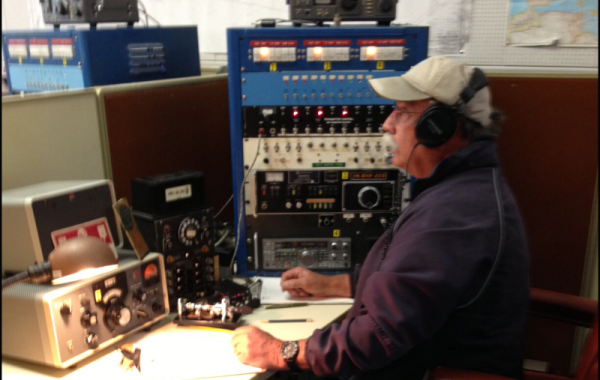
In fact, KPH did shut down in 1997 as part of the wind down of Morse code in ocean vessels. But some radio enthusiasts, including [Tom Horsfall] and [Richard Dillman], have brought the venerable station back to life. The radio squirrels, as they call themselves, dutifully send news and weather every Saturday to anyone interested in listening. They also exchange radio traffic, primarily with the SS Jeremiah O’Brien, a World War II-era ship parked nearby. N2FQ visited the station and operated the station on video, which you can see below. Or, check out the tour in the second video, below.

Continue reading “Inside America’s Last Morse Code Station”

Retro Gadgets: Pay TV In The 1960s

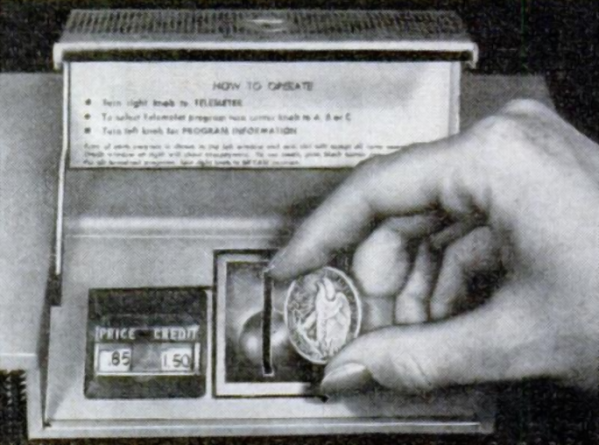
These days, paying for TV programming is a fact of life. You pay your cable company or some streaming service and the only question is do you want Apple TV and Hulu or would you rather switch one out for NetFlix? But back in the 1960s, paying for TV seemed unthinkable and was quite controversial. Cable TV systems were rare, and the airwaves were a public resource, so allowing someone to charge to watch TV on the public airwaves was hard to imagine. That was the backdrop behind the Telemeter — an early attempt to monetize TV programming that was more like a pay phone than a modern streaming service.

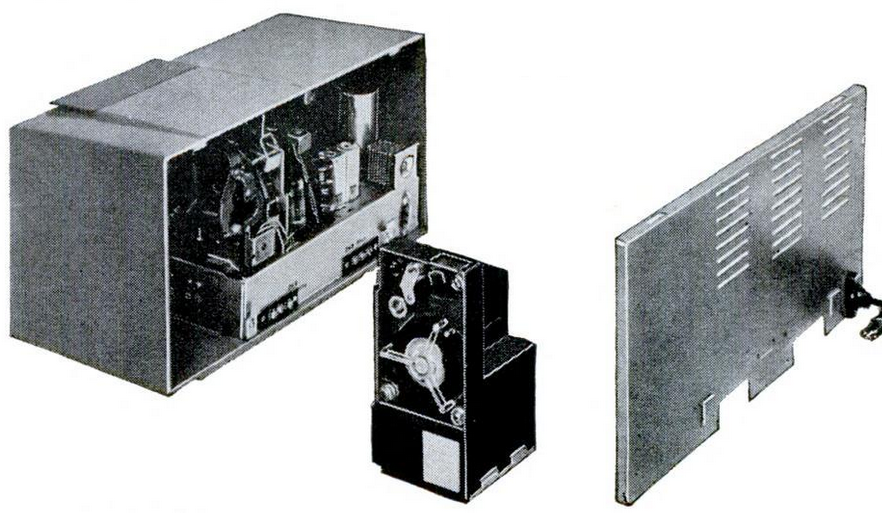
Rear view of the telemeter and coin box

[Lothar Stern] wrote about the device in the November 1959 issue of Popular Mechanics (see page 220). The device looked like a radio that sat on top of your TV. It added a whopping three pay-TV channels, and inside was a coin box, and — no kidding — a tape punch or recorder. These three channels were carried from a Telemeter studio over what appears to be a dedicated cable strung on existing phone poles.

Of course, TVs with coin boxes were nothing new. But those TVs were found in public places, airports, and hotels. The money was simply to turn the TV on for a set amount of time. This was different. A set-top box unscrambled channels delivered over a dedicated cable. Seems like old hat today, but a revolutionary idea in 1959.

Continue reading “Retro Gadgets: Pay TV In The 1960s”

The $16 PCB Robot

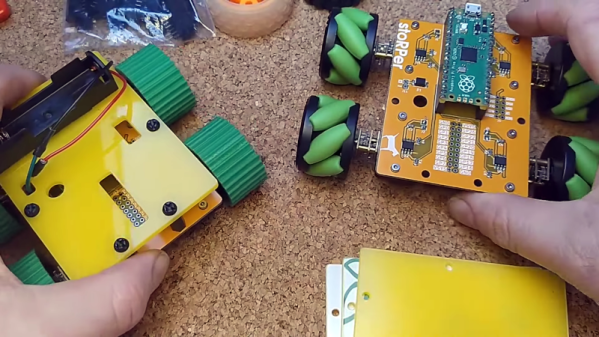
It is a fun project to build a simple robot but, often, the hardest part these days is creating the mechanical base. [Concrete Dog] has a new open source design for stoRPer that uses a PC board as the base. The board has a Raspberry Pi Pico and motor drivers. The modular design allows you to add to it easily and use custom wheels. The video below shows some treaded wheels and some mechanum wheels with gears.

There are mounting holes for sensors and also a way to put another deck above to hold other circuits, power, or whatever you like. There’s lots you could do with this as a starting point.

Continue reading “The $16 PCB Robot”

The 1970s Computer: A Slice Of Computing

What do the HP-1000 and the DEC VAX 11/730 have in common with the video games Tempest and Battlezone? More than you might think. All of those machines, along with many others from that time period, used AM2900-family bit slice CPUs.

The bit slice CPU was a very successful product that could only have existed in the 1970s. Today, if you need a computer system, there are many CPUs and even entire systems on a chip to choose from. You can also get many small board-level systems that would probably do anything you want. In the 1960s, you had no choices at all. You built circuit boards with gates on the using transistors, tubes, relays, or — maybe — small-scale IC gates. Then you wired the boards up.

It didn’t take a genius to realize that it would be great to offer people a CPU chip like you can get today. The problem is the semiconductor technology of the day wouldn’t allow it — at least, not with any significant amount of resources. For example, the Motorola MC14500B from 1977 was a one-bit microprocessor, and while that had its uses, it wasn’t for everyone or everything.

The Answer

The answer was to produce as much of a CPU as possible in a chip and make provisions to use multiple chips together to build the CPU. That’s exactly what AMD did with the AM2900 family. If you think about it, what is a CPU? Sure, there are variations, but at the core, there’s a place to store instructions, a place to store data, some way to pick instructions, and a way to operate on data (like an ALU — arithmetic logic unit). Instructions move data from one place to another and set the state of things like I/O devices, ALU operations, and the like.

Continue reading “The 1970s Computer: A Slice Of Computing”

What’s A Transfluxor?

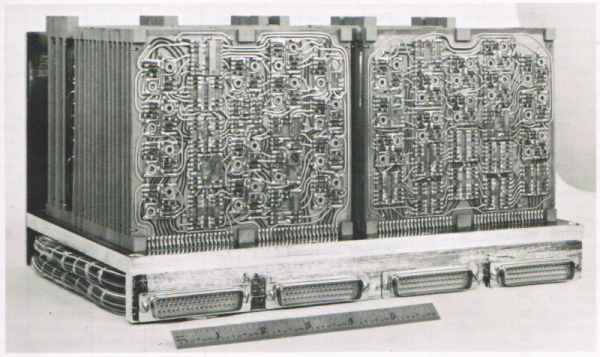
In the 1967 movie The Graduate, a wise older man gives some advice to the title character: plastics. Indeed, plastics would become big business. In 1962, though, a computer-savvy character might have offered a different word: transfluxor. What’s a transfluxor? Well, according to computer history sleuth [Ken Shirriff], it was the heart of a 20-pound transistor computer from Arma. Of course, plastics turned out to be a better bet, but in 1962, the transfluxor seemed to be the wave of the future.

In 1962, most computers were room-sized, but the Arma was “micro” taking up just 0.4 cubic feet — less than an Apple II. It would eventually spawn computers used in ships at sea and airplanes ranging from the Concorde to Air Force One.

Continue reading “What’s A Transfluxor?”

Blast From The Past: Schematic Templates

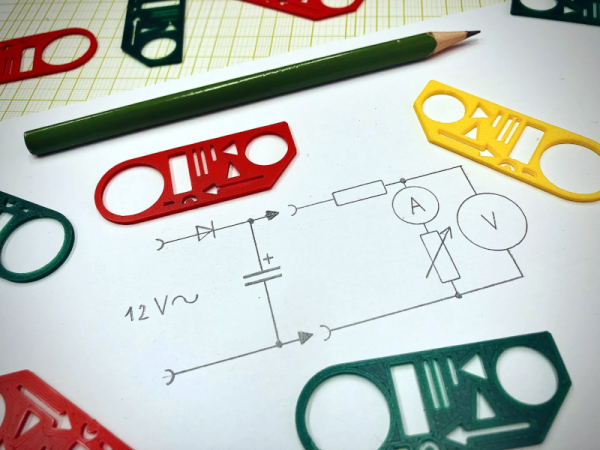
If you want to draw schematics today, you probably sit down at your computer. Why not? There are a ton of programs made to do the work easily, and the results look great. Back in the day, you might sit at a drafting table with a full set of T-squares, triangles, and maybe a Leroy. But what about when inspiration struck at the coffee shop (no, not a Starbucks in those days)? Well, you probably had a schematic drawing template. We were surprised you can still buy these at high prices. Or you can 3D print your own, thanks to [Jan Stech].

Templates of all kinds used to be very common. There were several for schematics, logic symbols, furniture, and even geometric shapes and curves. They were almost always green and transparent. A quick search on Amazon for “drafting template” shows you can still get the generic templates, but schematic ones are still expensive.

Continue reading “Blast From The Past: Schematic Templates”