Linux Fu: UEFI Booting

Unless your computer is pretty old, it probably uses UEFI (Unified Extensible Firmware Interface) to boot. The idea is that a bootloader picks up files from an EFI partition and uses them to start your operating system. If you use Windows, you get Windows. If you use Linux, there’s a good chance you’ll use Grub which may or may not show you a menu. The problem with Grub is you have to do a lot of configuration to get it to do different things. Granted, distros like Ubuntu have tools that go through and do much of the work for you and if you are satisfied with that, there’s no harm in using Grub to boot and manage multiple operating systems.

An alternative would be rEFInd, which is a nice modern UEFI boot manager. If you are still booting through normal (legacy) BIOS, the installation might be a hassle. But, in general, rEFInd, once installed, just automatically picks up most things, including Windows, Mac, and Linux operating systems and kernels. The biggest reasons you might change the configuration is if you want to hide some things you don’t care about or change the visual theme.
Continue reading “Linux Fu: UEFI Booting” →

Frequency Tells Absolute Temperature

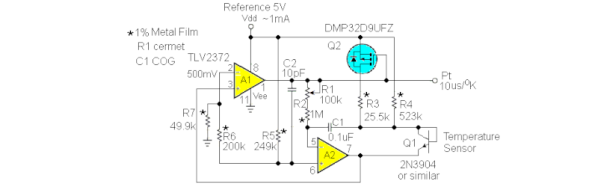
It is no secret that semiconductor junctions change their behavior with temperature, and you can use this fact to make a temperature sensor. The problem is that you have to calibrate each device for any particular transistor you want to use as a sensor, even if they have the same part number. Back in 2011  1991, the famous [Jim Williams] noted that while the voltage wasn’t known, the difference between two readings at different current levels would track with temperature in a known way. He exploited this in an application note and, recently, [Stephen Woodward] used the same principle in an oscillator that can read the temperature.

The circuit uses an integrator and a comparator. A FET switches between two values of collector current. A comparator drives the FET and also serves as the output.  Rather than try to puzzle out the circuit just from the schematic, you can easily simulate it with LT Spice or Falstad. The Falstad simulator doesn’t have a way to change the temperature, but you can see it operating. The model isn’t good enough to really read a temperature, but you can see how the oscillation works

You can think of this as a temperature-to-frequency converter. It would be easy to read with, say, a microcontroller and convert the period to temperature.  Every 10 microseconds is equal to a degree Kelvin. Not bad for something you don’t have to calibrate.

Thermistors are another way to measure temperature. Sometimes, you don’t need a sensor at all.

Retro Gadgets: Tired Of The Beatles On 8 Track? Try The Police

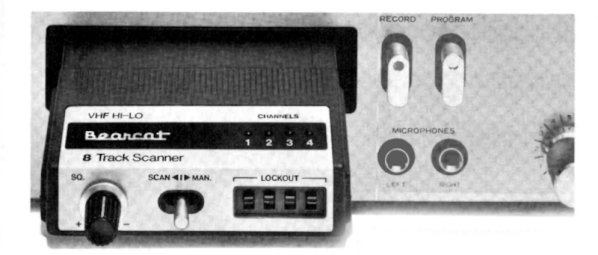
In the 1970s, 8-track audio players were very popular, especially in cars. For a couple of bucks, you could have the latest album, and you didn’t have to flip the tape in the middle of a drive like you did with a cassette. We’ve seen plenty of 8-tracks and most of us a certain age have even owned a few players. But we couldn’t find anyone who would admit to owning the Bearcat 8 Track Scanner, as seen in the 1979 Popular Electronics ad below.

Continue reading “Retro Gadgets: Tired Of The Beatles On 8 Track? Try The Police” →

Turns Out, Lightning Can Strike Twice, With A Little Help

Few things are more impressive than a lighting strike. Lightning can carry millions of volts and while it can be amazing to watch, it is somewhat less amazing to be hit by lightning. Rockets and antennas often have complex lightning protection systems to try to coax the electricity to avoid striking where you don’t want it. However, a European consortium has announced they’ve used a very strong laser to redirect lightning in Switzerland. You can see a video below, but you might want to turn on the English closed captions.

Lightning accounts for as many as 24,000 deaths a year worldwide and untold amounts of property and equipment damage. Traditionally, your best bet for protection was not to be the tallest thing around. If the tallest thing around is a pointy metal rod in the ground, that’s even better. But this new technique could guide lightning to a specific ground point to have it avoid causing problems. Since lightning rods protect a circular area roughly the radius of their height, having a laser that can redirect beams to the area of a lightning rod would allow shorter rods to protect larger areas.

Continue reading “Turns Out, Lightning Can Strike Twice, With A Little Help” →

Flappy Bird Drone Edition

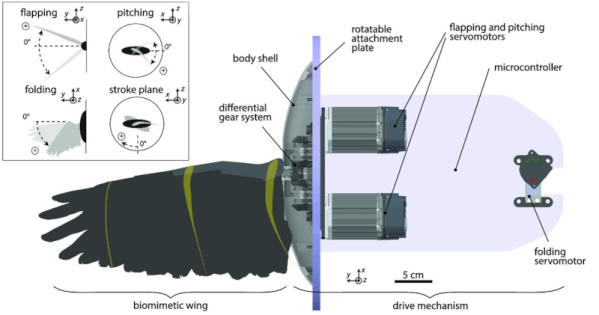
Ornithopters have been — mostly — the realm of science fiction. However, a paper in Advanced Intelligent Systems by researchers at Lund University proposes that flapping wings may well power the drones of the future. The wing even has mock feathers.

Birds, after all, do a great job of flying, and researchers think that part of it is because birds fold their wings during the upstroke. Mimicking this action in a robot wing has advantages. For example, changing the angle of a flapping wing can help a bird or a drone fly more slowly.

Continue reading “Flappy Bird Drone Edition” →

Inside The Atari 2600

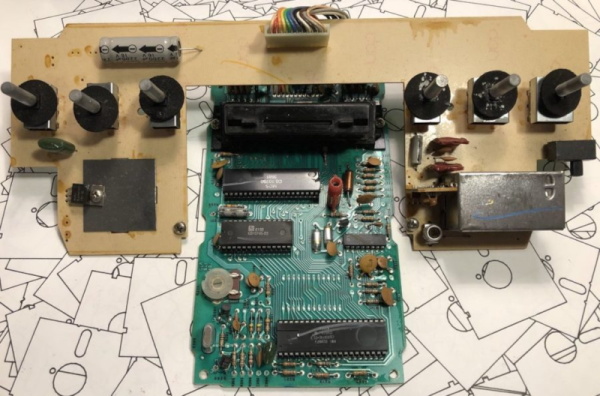
The Atari 2600 was an extremely popular yet very simple game console back in the 1970s. They sold, apparently, over 30 million of them, and, of course, these things broke. We’d get calls from friends and — remember, back then normal people weren’t computer savvy — nine times out of ten, we’d ask them to swap the controllers to show them it was a bad controller, and problem solved. But if you did have to open one up, it was surprising how little there was inside, as [Steve] notes in his recent teardown.

The bulk of the circuit board was switches, the power supply, and a TV modulator if you remember those. The circuit board was a tiny thing with a shrunk-down 6502, a 6532 RIOT chip, and a custom chip called a TIA. If you are familiar with those chips, you might wonder if the TIA had any memory in it. It didn’t. Nearly all the ROM and RAM for the game lived in the cartridge itself. Sure, the RIOT has 128 bytes of memory, but that’s not much.

Continue reading “Inside The Atari 2600” →

Microsoft Returns To The Altair

The Altair 8800 arguably launched Microsoft. Now [Dave Glover] from Microsoft offers an emulated and potentially cloud-based Altair emulation with CP/M and Microsoft Basic. You can see a video of the project below. One thing that makes it a bit odd compared to other Altair clones we’ve seen is that the emulator runs in a Docker environment and is fully cloud-enabled. You can interact with it via a PCB front panel, or a terminal running in a web browser.

The core emulator is MIT-licensed and seems like it would run nearly everywhere. We were a little surprised there wasn’t an instance in the Azure cloud that you could spin up to test drive. Surely a few hundred Altairs running at once wouldn’t even make a dent in a modern CPU.

Continue reading “Microsoft Returns To The Altair” →