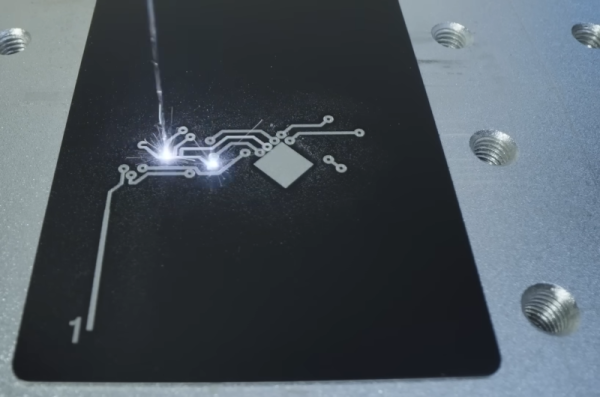
Laser Engraving, Up Close

You know you aren’t supposed to watch your laser while it is cutting or engraving. But [Alex] hosted Wired in his studio and showed them how lasers engrave metal with a fiber laser. You can see the video below.

If you haven’t used a fiber laser, you might be surprised that while a 60 W model can burn metal, it does absolutely nothing to [Alex’s] hand. We wouldn’t try that, by the way, with the common diode lasers you see in most hacker’s labs these days. The video isn’t terribly technical, but it is interesting to see different metals succumb to the powerful laser. There are a few tips about marking different metals in different ways and how to deal with thermal expansion and other effects.

Fiber lasers aren’t as common as diode engravers in private shops, but we assume it is just a matter of time before they get cheaper. Not to mention their widespread use commercially means surplus units might become available, too.

If you are interested in lasers, [Alex’s] YouTube channel has quite a few interesting videos to check out. If you need more power, how’s 200 kW? Then again, even 20 W will get you something useful.

Continue reading “Laser Engraving, Up Close”

Publish Or Perish: Data Storage And Civilization

Who do you think of when you think of ancient civilizations? Romans? Greeks? Chinese? India? Egyptians?  What about the Scythians, the Muisca, Gana, or the Kerma? You might not recognize that second group as readily because they all didn’t have writing systems. The same goes, to a lesser extent, for the Etruscans, the Minoans, or the inhabitants of Easter Island where they wrote, but no one remembers how to read their writing. Even the Egyptians were mysterious until the discovery of the Rosetta stone. We imagine that an author writing in Etruscan didn’t think that no one would be able to read the writing in the future–they probably thought they were recording their thoughts for all eternity. Hubris? Maybe, but what about our documents that are increasingly stored as bits somewhere?

Continue reading “Publish Or Perish: Data Storage And Civilization”

Tiny Thin Client Is Small But Compatible

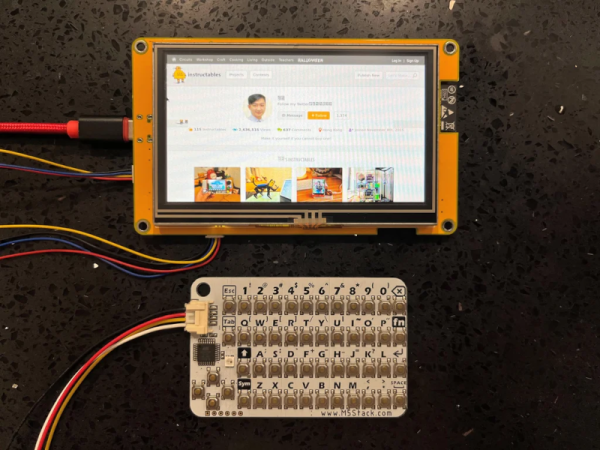
We were impressed with [moononournation’s] tiny thin client project. It claims to use an Arduino, but as you might guess it is using the Arduino software along with a network-enabled microcontroller like an ESP32. The impressive part is that it is standards-compliant and implements VNC’s RFB protocol.

The original coding for RFB on Arduino is from [Links2004] and armed with that, the thin client is probably easier to create than you would guess. However, this project wanted to use a larger screen and found that it led to certain problems. In particular, the original code had a 320×240 display. This project was to use an 800×480 display, but with the limits on the ESP32, the frame rate possible would be under 7 frames per second. The answer was to combine a 16-bit parallel interface with better compression back to the VNC server.

The little keyboard is probably not very practical, but it is compact. That would be another easy thing to modify. Currently, the keyboard uses I2C, but it would be straightforward to change things up. This would be a worthy base to build a bigger project on top. A 3D printed enclosure would be nice, too.

We’ve seen a number of projects built around commercial thin clients. Some from defunct businesses are good sources for obscure parts, too.

Continue reading “Tiny Thin Client Is Small But Compatible”

Watermelon CNC Uses Lazy Susan

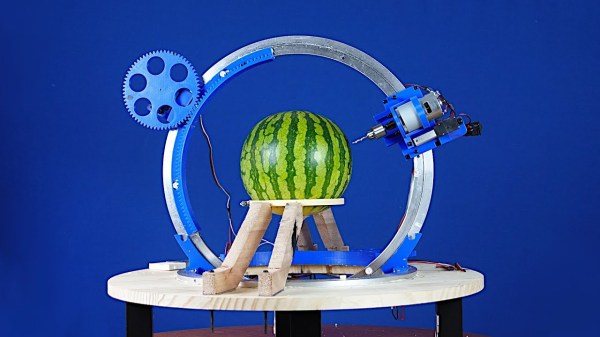
It is the time of year when a lot of people in certain parts of the world carve pumpkins. [Gonkee] is carving a watermelon, which we assume is similar. He decided to make a CNC machine to do the carving for him. The unusual part is the use of two lazy Susans to make a rotary carving machine. You can see the result in the video below.

The hardware is clever and there is software that lets you do drawings, although we were hoping for something that would process gcode or slice STL. That would be a worthy add-on project. There were a few iterations required before the Melon Carver 3000 worked satisfactorily. Seeing a carving tool operating on two circles gives us a lot of ideas. We aren’t sure how sturdy the mounts are, so don’t plan on carving aluminum without some changes, but we suspect it is possible.

Then again, a laser head mounted on the frame would have probably made short work of the melon, and wouldn’t require much mechanical stiffness. It would, however, take a little effort to keep it in focus. So many ideas to try!

Watermelon is a popular hacking medium, apparently. There’s even one that holds a GameBoy.

ARM Programming By Example

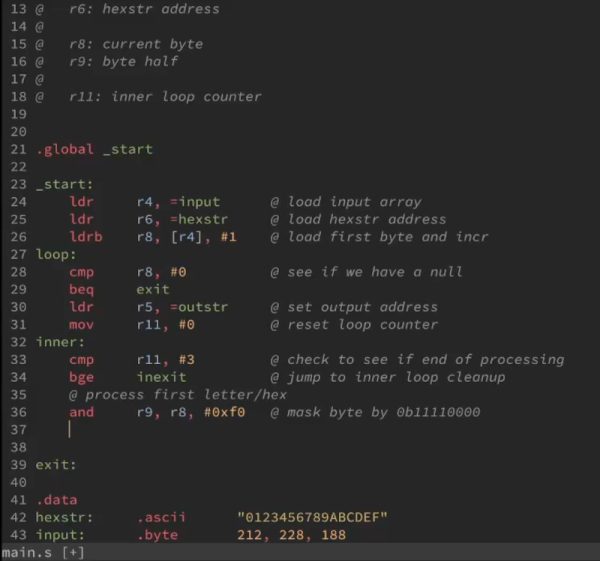
The ARM processor is popping up everywhere. From Raspberry Pis, to phones, to Blue Pill Arduino-like boards, you don’t have to go far to find an ARM processor these days. If you program in C, you probably don’t care much or even think about it. But do you know ARM assembly language? Well, if you look at it one way, it can’t be too hard. The CPU only has about 30 distinct operations — that’s why it is called RISC. Of course, sometimes fewer instructions actually make things more difficult. But you can get a great starting tutorial with the 21 programs on the ARM Assembly by Example website.

You need a 32-bit ARMv6 or better — so Raspberry Pi will work here. The compiler, of course, is gcc and all the associated tools. if you have the right hardware, there are sections on using the floating point unit and the NEON co-processor, too.

Continue reading “ARM Programming By Example”

Hacking Google With Plasma

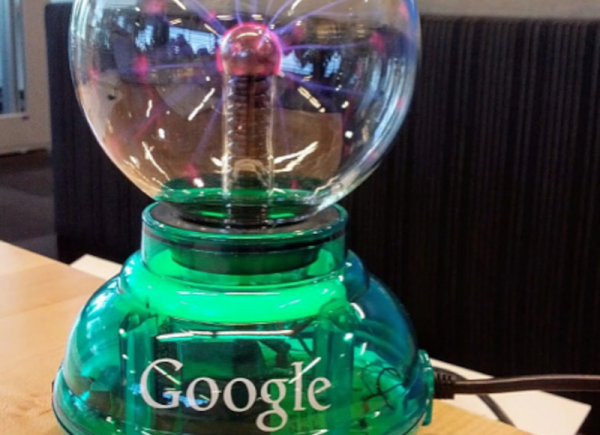
Google recently made some videos to highlight cybersecurity. The video below is episode three, and it tells an interesting story about the first crash test dummy. However, the really interesting part is the story about a USB plasma globe built to hack into computers. One of the people who built that globe tells the story of its insides in a recent blog post that has a bit more technical detail.

The attack in question was in 2012, when people were starting to get the idea that inserting random USB drives into their computers wasn’t a great idea. However, what harm could there be in a cute little plasma globe that just draws power from the port?

Continue reading “Hacking Google With Plasma”

Power Loss Recovery Might Make 3D-Printed Blobs

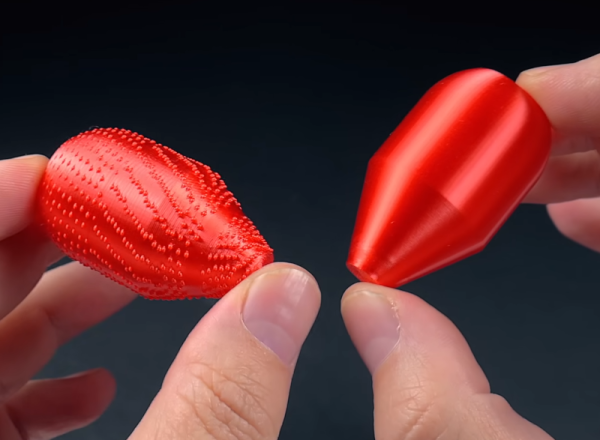
[Geek Detour] had a mystery to solve. A round part he was printing had a distinct pattern of blobs. If you’ve been 3D printing for any length of time, you know that pauses in printing can cause blobs like this. He also showed a perfectly-printed version of the same part and claimed it was from the same printer with the same material and even slicer settings. So what was causing the blobs? You can find the answer in the video below.

As you might guess from the title, however, the issue was the power loss recovery feature built into the printer. While there’s a lot going on in the video, you can break it down to a few items, all of which you can fix in one way or another including the simple fix: turn off power loss recovery.

Continue reading “Power Loss Recovery Might Make 3D-Printed Blobs”