Simple CNC Gear Production With Arduino

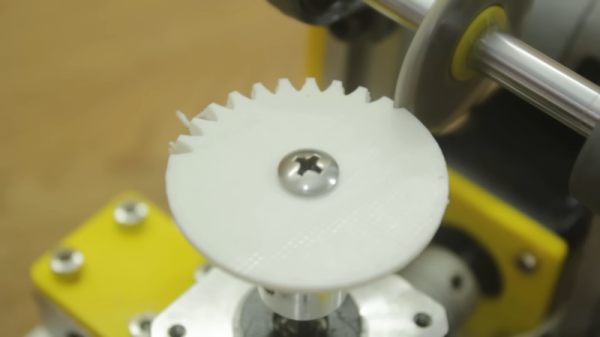
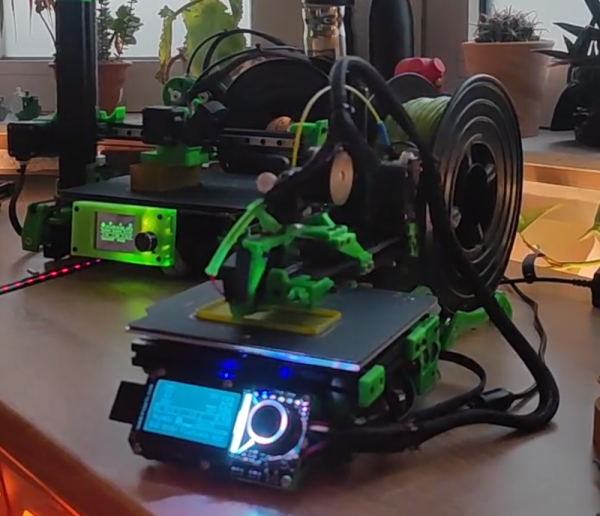
We’ve seen plenty of people 3D printing custom gears over the years, but [Mr Innovative] decided against an additive process for his bespoke component. He ended up using a simple CNC machine that makes use of several components that were either salvaged from a 3D printer or produced on one. Using a small saw blade, the machine cuts gear teeth into some plastic material and — presumably — could cut gears into anything the saw blade was able to slice into, especially if you added a little lubrication, cooling, and dust removal.

If you’ve built a 3D printer, you’ll see a lot of familiar parts. Stepper motors, aluminum extrusion, straight rods, bearing blocks, and rod holders are all used in the build. There’s also a lead screw and the associated components you usually see in a printer’s Z-axis. Naturally, an Arduino drives the whole affair.

The saw blade was custom-made from a washer, grinding an edge and using a 3D printed template to cut teeth in it. We might have been more inclined to use a cut-off wheel from a rotary tool, but this certainly did the trick. An LCD accepts the gear diameter and number of teeth. The stepper rotates the correct number of degrees and another stepper lowers the cutting head which is spinning with a common DC motor.

As impressive as this machine is, the fact remains that a 3D printer can produce more complex designs. For example, a herringbone pattern can help with alignment issues. It has been done many times. You can even use a resin printer, although you might prefer to stick with FDM.
Continue reading “Simple CNC Gear Production With Arduino”

TRX-Duo Is A Red Pitaya Clone For Software Defined Radio

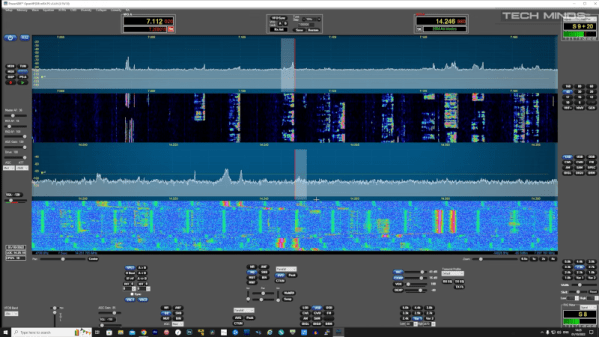
If you’ve noticed the TRX-DUO software-defined radio transceiver, you might have wondered how it stacks up to other choices like Red Pitaya or HackRF.  [Tech Minds] obliges with a review of the Red device in the video below.

While this unit isn’t inexpensive, it also isn’t as expensive as some of its competitors. Sure, you can pick up an RTL-SDR dongle for a fraction of the price, but then you miss out on transmitting. The device is pretty powerful compared to a cheap software defined radio:

  • Frequency: 10 kHz to 60 MHz
  • CPU: Zynq SoC with a dual-core ARM Cortex A9
  • RAM: 512 MB
  • OS: Linux
  • Connectivity: Ethernet and USB connectivity (WiFi with a dongle)
  • ADC: 16-bit at 125 MS/s (2 channels)
  • DAC: 14-bit at 125 MS/s (2 channels)

The board boots off an SD card and there are several to choose from. The video shows two different images. One has a number of applications that run on the device and will also run on a Red Pitaya. The device shows a browser menu with various options and the result is quite impressive. Using the box as a WSPR beacon, it was heard fairly well given the low output power. It was, however, able to hear the world easily.

You can get a less capable Red Pitaya model for about $100 less than the going price. However, for something comparable, you will pay more for the Red Pitaya and — depending on capabilities — perhaps a lot more, although you do get more capability for the increased price.

You can do a lot more with a transmitting SDR — having both transmit and receive opens up many new projects. Of course, canned applications are great, but if you get one of these, you are going to want to try GNU Radio.

Continue reading “TRX-Duo Is A Red Pitaya Clone For Software Defined Radio”

Have 3D Printer, Will Travel

We keep hearing that the desktop computer is dying — everyone wants a mobile device like a laptop, a tablet, or a big horkin’ phone. We suppose [eponra] wants the same thing for 3D printers, since he’s provided plans for “flatpack” a portable 3D printer that can fit in a spool box.

As you might imagine, this isn’t going to give you maximum build volume. The printer’s folded down dimensions are 220x210x75mm. The build plate is fairly small at 120x114x144mm. However, it does have a heated bed and an LCD display. One note, though: you do need an external power supply that does not fit in the box. However, [eponra] notes that with an AC-powered bed, it would be possible to get everything in the box.

Continue reading “Have 3D Printer, Will Travel”

Robot Blade Runner Turns In World Record Time

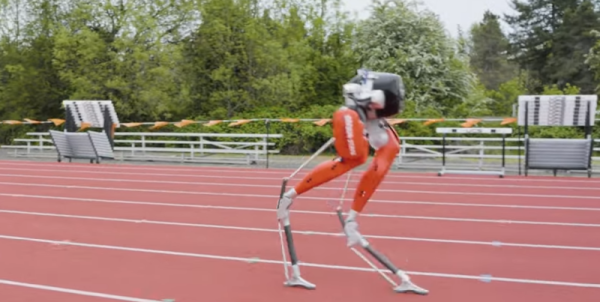
While we wish colleges and universities competed more on academics, we can’t deny that more people are interested in their athletics programs. Oregon State, however, has done a little of both since their bipedal robot, Cassie, became the world’s fastest bipedal robot according to the Guinness Book of World Records. You can see a video of the 100 meter run below, but don’t blink. The robot turned in a time of around 25 seconds.

Impressive, but still not on par with Usan Bolt’s time of under 10 seconds for the same distance. If you want to see what that would be like, try running the long way across a football field and see how far you get in 25 seconds. There isn’t a lot of technical detail about the robot, but you can intuit some things from watching it go. You can also find a little more information on the robot and some of its siblings on the University’s website.

If you think robots won’t ever run as well as humans, we used to think the same thing about playing chess. This doesn’t look like we normally envision a bipedal robot. Then again, there isn’t any reason robots have to look, or move, like we do.

Continue reading “Robot Blade Runner Turns In World Record Time”

Ugliest Airplane Ever Built Predicted The Future

The airplane that many called “the flying barrel” is also widely considered the ugliest plane ever built. However, [Dark Skies] in the video you can see below argues that the Stipa-Caproni was the direct predecessor of the turbofan engine. Either way, it is an interesting and unique part of aviation history.

The plane was built in the days when inventors were experimenting with many different ways to improve aircraft utility and performance. In this case, the inventor built an “intubated propellor” which used a prop to draw air through a venturi tube in an effort to improve engine efficiency. The 570kg vehicle had a wingspan of just over 14 meters and was a bit more than 6 meters long. It could reach about 72 knots and climb to over 3 km.

Continue reading “Ugliest Airplane Ever Built Predicted The Future”

$60 Laser Makes The Cut With New Controller

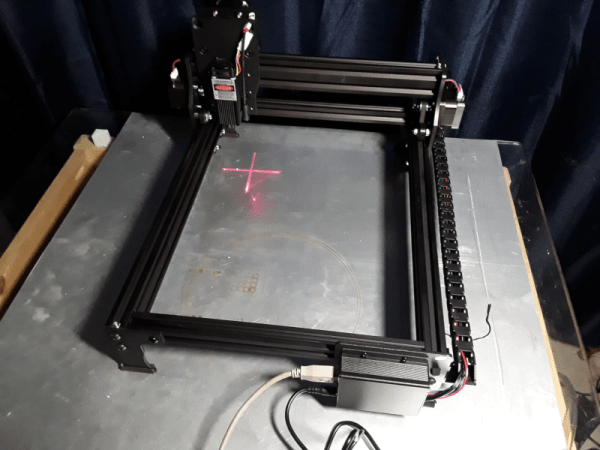
If you are reading the Lightburn forums, you probably already have a laser cutter of some kind.  But, if you are like most of us, you can always be tempted into another “deal.” [Dkj4linux] has a post where he bought a $79 laser engraver  (now selling for between $59 and $65, we noticed). Like most of these cheap engravers, the machine takes a proprietary controller with Windows-only software. No surprise that [Dkj4linux] would want to use…um… Linux. The answer? Rip the board out and replace it with an old spare.

The machine looks well constructed, as you can see in the video below. For that price, you get a 3-watt laser head (that is likely way less than that in terms of optical power), and a build area of 220x290mm. The controller was in a small metal enclosure, and it was easy to simply unplug the two axis and the laser control cable.

Continue reading “$60 Laser Makes The Cut With New Controller”

You Can’t Be Too Rich Or Too Thin — A 2mm Thick Computer

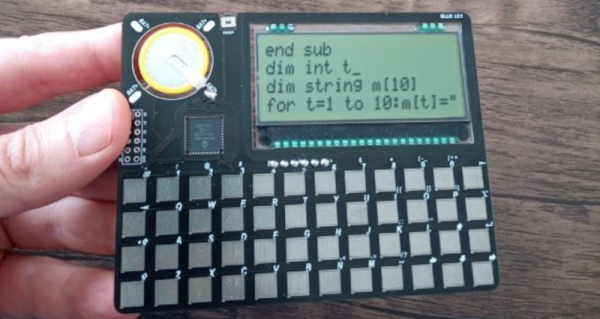
We’ve seen credit card-sized computers before, but [Kn/vD] shows us a PIC18-based computer with 9 components that is only 2 mm thick! With 13 K of RAM and 128 K of flash, you can’t do much with it, but a built-in BASIC interpreter can use half the flash like a disk drive and operate with the 20×4 LCD display and the PCB touch-panel keyboard.

The whole thing only has eleven parts, but that’s only because it needed ancillary components like decoupling capacitors and the battery along with a physical reset switch. All the real functions are in the CPU and the LCD display. The schematic is online, but we didn’t see the files for the PCB or the interpreter yet, but it sounds like they are forthcoming. Meanwhile, we wonder if anyone is up to the challenge of going even thinner.

[Kn/Vd] loves small computers. There are plans for a few other versions of the board with AVR and PIC24 processors. The last time we saw a tiny module from [Kn/vD] it ran C. If you check out other Hackaday.io projects on the account, there are several tiny computers there. If you want a business card that can run Linux, you might need to go a little bit thicker.