Move Over Silicon, A New Semiconductor Is In Town

Silicon has had a long run as the king of semiconductors, and why not? It’s plentiful and works well. However, working well and working ideally are two different things. In particular, electrons flow better than holes through the material. Silicon also is a poor heat conductor as we’ve all noticed when working with high-speed or high-power electronics. Researchers at MIT, the University of Houston, and other institutions are proposing cubic boron arsenide to overcome these limitations.

According to researchers, this material is a superior semiconductor and, possibly, the best possible semiconductor. Unfortunately, the material isn’t nearly as common as silicon. Labs have created small amounts of the material and there is still a problem with fabricating uniform samples.

Early experiments show the material has very high mobility for electrons and holes along with thermal conductivity almost ten times greater than that of silicon. It also has a good bandgap, making it very attractive as a semiconductor material. In fact, only diamond and isotopically enriched cubic boron nitride have better thermal conductivity.

However, there are still unknowns about how to use the material in practical devices. Long-term stability tests are as lacking. So maybe it will wipe out silicon or maybe it won’t. Time will tell.

We are always on the lookout for the next big semiconductor material. However, we suspect this tech will be out of reach to the home semiconductor fab, at least for a little while.


Hack Your Brain: Bionic Reading — Panacea Or Placebo?

In the Star Trek episode Space Seed, [Khan] famously said, “Improve a mechanical device, and you may double productivity. But improve man, you gain a thousandfold.” Most of our hacks center on the mechanical or electromechanical kind, but we do have an interest in safely improving ourselves. The problem is that most of us don’t want to mess with our DNA or have surgery, so it sort of limits our options.

We are always interested in less invasive hacks, so we certainly took note of Bionic Reading. However, a recent paper claims to debunk the claims of benefits. The company promoting the technology claims a Swiss University study showed that while the results were not clear, “the majority had a positive effect.” They also claim, anecdotally, that the technique can help those with dyslexia. What’s the truth? We don’t know, but it is an interesting discussion to follow.

If you haven’t seen it before, Bionic Reading — which, by the way, may not be free to use — is a way of using a dark font to emphasize certain key parts of words. For example, you can read this article using Bionic Reading. [Daniel Doyon] analyzed reading by 2,074 testers and found that participants actually read slower when using the Bionic Reading technique.

Continue reading “Hack Your Brain: Bionic Reading — Panacea Or Placebo?”

Color Us Impressed: Redbean Runs A Web Server On Six Operating Systems

The holy grail of computing is to have some way to distribute a program to any computer. This is one of those totally unachievable goals, but many have tried with varying degrees of success.  People naturally think of Java, but even before that there was UCSD’s P-code and many other attempts to pull off the same trick. We were impressed, though, with Redbean 2.0 which uses a single executable file to run a webserver — or possibly other things — on six different operating systems. If the six operating systems were all flavors of Linux or Windows that wouldn’t be very interesting. But thanks to APE — the Actually Portable Executable — format, you can run under Windows, Linux, MacOS, OpenBSD, NetBSD, and FreeBSD.

This is quite a feat when you realize that most of these take wildly different file formats. There is one small problem: you can’t use much of anything on the host operating system. However, if you look at Redbean, you’ll see there is quite a lot you can do.

Continue reading “Color Us Impressed: Redbean Runs A Web Server On Six Operating Systems”

Homebrew Curve Tracer Competes With The Big Guns

When we first saw the VBA curve tracer, we thought it might have something to do with Visual Basic for Applications. But it turns out it is a mash up of the names of the creators: [Paul Versteeg], [Bud Bennett], and [Mark Allie]. [Paul] designed an original prototype back in 2017. Since then, the project has grown and lessons were learned. The final curve tracer is pretty impressive in more ways than one.

If you’ve never used a curve tracer, they allow you to characterize components using their characteristic curve of voltage versus current. You use an oscilloscope as an output device. This instrument is often used by engineers trying to understand or match devices like diodes, transistors, or — in some cases — even tubes. So if you want to measure the collector-emitter breakdown voltage, for example, or the collector cutoff current, this is your go-to device. You can also match gains in circuits where that matters (for example, a push-pull circuit where two transistors amplify different parts of the same signal).

If you want to understand more about how it works, there are a series of blog posts covering the evolution of the device. You can also find the design files on GitHub. There is also a handy post showing many types of measurements you might want to make.

This is a good-looking project. We’ve seen it done on the cheap, but slowly. Or spend $15 and do better. We doubt any of these have high enough voltages to do most tubes, but they made the same basic instrument for tubes back in the 1950s.

Ask Hackaday: Resin Printer Build Plates

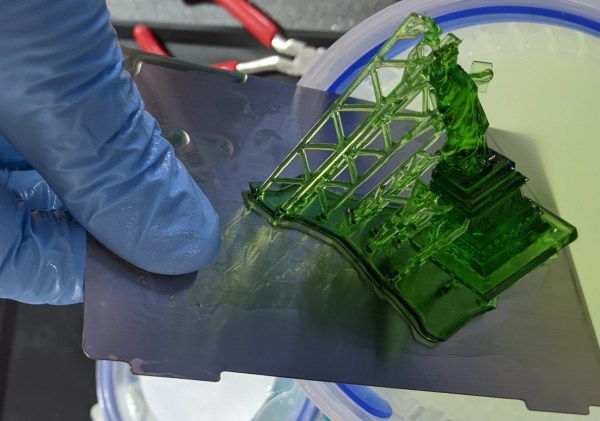
The early days of FDM 3D printing were wild and wooly. Getting plastic to stick to your build plate was a challenge. Blue tape and hairspray-coated glass were kings for a long time. Over time, better coatings have appeared and many people use spring steel covered in some kind of PEI. There seem to be fewer choices when it comes to resin printers, though. We recently had a chance to try three different build surfaces on two different printers: a Nova3D Bene4 and an Anycubic Photon M3. We learned a lot.

Resin Printing Review

If you haven’t figuratively dipped your toe into resin yet — which would literally be quite messy — the printers are simple enough. There is a tank or vat of liquid resin with a clear film on the bottom. The vat rests on an LCD screen and there is a UV source beneath that.

Continue reading “Ask Hackaday: Resin Printer Build Plates”

Down The Intel Microcode Rabbit Hole

The aptly-named [chip-red-pill] team is offering you a chance to go down the Intel rabbit hole. If you learned how to build CPUs back in the 1970s, you would learn that your instruction decoder would, for example, note a register to register move and then light up one register to write to a common bus and another register to read from the common bus. These days, it isn’t that simple. In addition to compiling to an underlying instruction set, processors rarely encode instructions in hardware anymore. Instead, each instruction has microcode that causes the right things to happen at the right time. But Intel encrypts their microcode. Of course, what can be encrypted can also be decrypted.

Using vulnerabilities, you can activate an undocumented debugging mode called red unlock. This allows a microcode dump and the decryption keys are inside. The team did a paper for OffensiveCon22 on this technique and you can see a video about it, below.

Continue reading “Down The Intel Microcode Rabbit Hole”

Tech In Plain Sight: Fire Hydrants

You probably see them so often that you don’t even notice they are there. Fire hydrants are one of those things that aren’t interesting until you need them, but then they are of paramount importance. You sometimes hear them called fireplugs and it made us wonder what was a plug about it. Perhaps it was because that’s where you plug in your hose? Turns out, no. The real story is much stranger. Not to mention, did you know that there are even “dry” fire hydrants?

Apparently, in the 16th century, water mains were made of wood. When there was a fire, a team would dig the cobblestones out to expose the wooden mains and cut a hole to make an ad hoc well to fill buckets or to pump. Of course, after the fire, you had to repair the mains and that was done with a plug. The city would keep a record of plugs so that if a fire was nearby in the future, you could just “pull the plug” instead of making a new hole.

Continue reading “Tech In Plain Sight: Fire Hydrants”