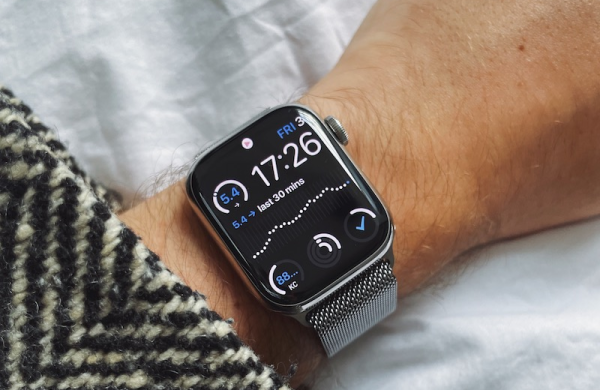
Live Glucose Monitoring With The Apple Watch

There has been a rumor that Apple is working on a glucose monitoring solution for the Apple watch. [Harley] decided not to wait and managed to interface an Abbot FreeStyle Libre sensor with the Apple watch. The sensor doesn’t directly read glucose continuously, but it does allow for more frequent reading which can help diabetic patients manage their blood sugar levels. However, as part of the hack, [Harley] effectively converts the meter to a continuous-reading device, another bonus.

The trick is to add a Bluetooth transmitter to the NFC sensor. Using a device called a MiaoMiao, the task seems pretty simple. The MiaoMaio is small, waterproof, and lasts two weeks on a charge, which is longer than the sensor’s life. Honestly, this is the hack since once you have the data flowing over Bluetooth, you can process it in any number of ways including using an app on the Apple watch.

It isn’t perfect. There’s a slight lag with readings due to the way the sensor works. However, you usually don’t care as much about the absolute value of your glucose (unless it is very high or very low). You are usually more interested in the slope of the change. This data is more than good enough for that.

In fact, the most complex part of this seems to be the watch app. It might be less work to feed the data to a machine learning model and let AI guide your insulin injections. Something to think about.

We have a keen interest in glucose monitoring around here and we know why it is so darn hard. Honestly, the idea of pushing glucose meter data to a watch isn’t new, but this is a well-done implementation with a lot of possibilities.
This $4 Desalination Device Provides Drinking Water For The Whole Family

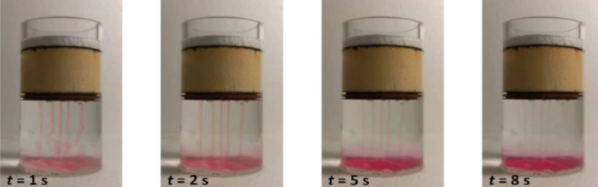
Researchers at MIT and in China have improved the old-fashioned solar still with a new inexpensive device that harnesses the sun to remove salt from water. Traditionally, these kinds of systems use a wick to draw water, but once the wick becomes fouled with salt, the device needs cleaning or other maintenance. Not exactly what you want in a survival situation. You can read the paper in Nature if you want more details.

The key to this new technique is black paint and polyurethane with 2.5-millimeter holes drilled in it. The idea is that warmer water above the insulating medium causes the salt to concentrate in the cooler water beneath the insulator allowing efficient vaporization of the water.  As the water evaporates, it causes the salt concentration at the top to rise, which then sinks due to the higher density and lower-concentration salt water rises to the top to evaporate.

Because the materials are commonplace, the team says a one-meter-square system costs about $4 to produce. A system that size could provide a family’s daily drinking water.

So far, the prototype system has worked in the lab for at least a week without accumulating salt. The next challenge is to scale it to something more practical, but due to the low cost and simplicity of the system, it seems it would be easy enough to make that happen or to reproduce the device for your own testing.

Desalination is a problem you can approach from many different angles. You can also harvest clean water from fog, something else that started at MIT.

Quantum Computing: The First Taste Is Free

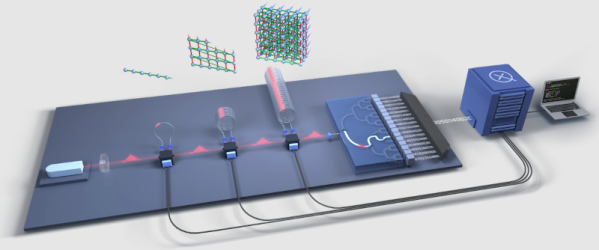
There are a few ways to access real quantum computers — often for free — over the Internet. However, most of these are previous-generation machines that have limited capabilities. Great for learning, perhaps, but not something you could do anything practical with.  Xanadu, however, has announced what they claim to be a computer capable of reaching quantum advantage that is free for anyone to use, within limits. Borealis — the computer in question — uses photonic states and has the capability of working with over 216 squeezed-state qubits.

The company is selling time on the computer, but the free tier includes 5 million free shots on Borealis and 10 million shots on an earlier series of quantum computers. You can also buy pay-as-you go service for about $100 per million shots on Borealis.

While a few million shots may sound like a lot, we noticed that the quickstart demo consumes 10,000 shots and that’s presumably something simple. That’s still about 500 runs of that on Borealis — not bad for free on a state-of-the-art quantum computer. You will be wanting to debug with a simulator, though.

We presume the developers are Beatles fans given that you use software called Penny Lane and Strawberry Fields to access the machines. Your job is controlled by Python and there is a cloud simulator to save your shots.

We won’t pretend to understand all there is about squeezed light qubits and the Borealis architecture. But you can get some general practice in our series on quantum computing. Or there are a few lectures around including one that aims at different levels of experience.

Continue reading “Quantum Computing: The First Taste Is Free”

That’s No Asteroid…Oh, Actually It Is

How important is it to identify killer asteroids before they strike your planet? Ask any dinosaurs. Oh, wait… Granted you also need a way to redirect them, but interest in finding them has picked up lately including a new privately funded program called the Asteroid Institute.

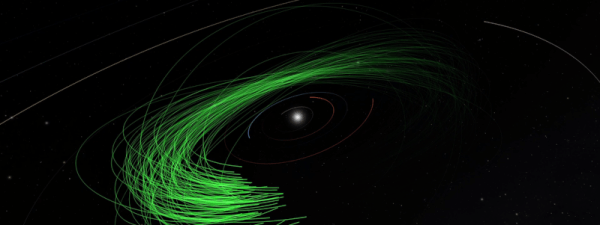
Using an open-source cloud platform known as ADAM — Asteroid  Discovery Analysis and Mapping — the program,  affiliated with B612 program along with others including the University of Washington, has already discovered 104 new asteroids and plotted their orbits.

What’s interesting is that the Institute doesn’t acquire any images itself. Instead, it uses new techniques to search through existing optical records to identify previously unnoticed asteroids and compute their trajectories.

You have to wonder how many other data sets are floating around that hold unknown discoveries waiting for the right algorithm and computing power. Of course, once you find the next extinction asteroid, you have to decide what to do about it. Laser? Bomb? A gentle push at a distance? Or hope for an alien obelisk to produce a deflector ray? How would you do it?

NASA is experimenting with moving asteroids. If you want to find some on your own, you might want to check out the atlas of existing ones.

Continue reading “That’s No Asteroid…Oh, Actually It Is”

A Home Payphone

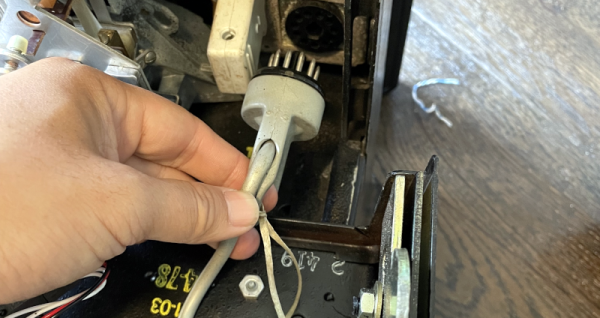
We can’t condone what [Bertrand] did as a kid to make him a fan of payphones, but we get his desire to have one of his own in his home. Even if you don’t want one yourself, he’s got some good shots of the insides of a real phone that came from a casino in Vegas.

As you might expect, these phones were built like tanks. They obviously took a lot of abuse. We had to wonder how much each one cost to produce back in the day. Cleaning up an old phone and getting it to work doesn’t seem like a big effort, but there’s one thing we didn’t think about. Turns out there is a backplate that holds the 50-pound phone up and you need special studs that screw into the phone to hold it up while you put screws through both pieces.

He did connect the phone successfully to a regular phone jack, but his goal was to let his 5-year-old use the phone so he decided to actually wire it to a phone line simulator that just provides a connection between two phones.

New York City recently ripped out its last payphones. They were replaced with multipurpose kiosks, but there are still privately-owned payphones in the city. Of course, you can always use an old payphone as a platform for a different project.

Sorry, Your Internet Connection Is Slow

How fast is your Internet connection? The days of 56K modems are — thankfully — long gone for most of us. But before you get too smug with your gigabit fiber connection, have a look at what researchers from the Network Research Institute in Japan have accomplished. Using a standard diameter fiber, they’ve moved data at a rate of 1 petabit per second.

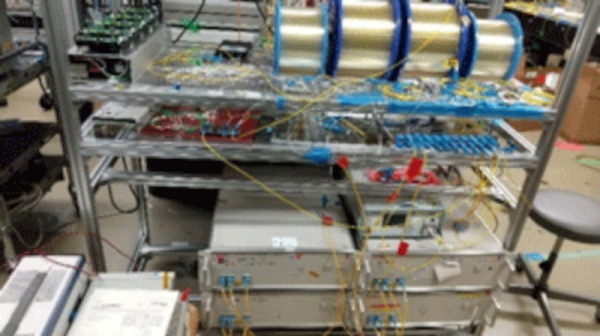
The standard fiber has four spatial channels in one cladding. Using wavelength division multiplexing, the researchers deployed a total of 801 channels with a bandwidth over 20 THz. The fiber distance was over 50 km, so this wasn’t just from one side of a lab to another. Well if you look at the pictures perhaps it was, but with big spools of fiber between the two lab benches. The project uses three distinct bands for data transmission with 335 channels in the S-band, 200 channels in the C-band, and 266 channels in the L-band.

To put this into perspective, a petabit — in theory — could carry a million gigabit Ethernet connections if you ignore overhead and other losses. But even if that’s off by a factor of 10 it is still impressive. We can’t imagine this will be in people’s homes anytime soon but it is easy to see the use for major backhaul networks that carry lots of traffic.

We are still amazed that we’ve gone from ALOHA to 2.5-gigabit connections. Although the Raspberry Pi can’t handle even a fraction of the bandwidth, you can fit it with a 10-gigabit network card.

Optimizing Linux Pipes

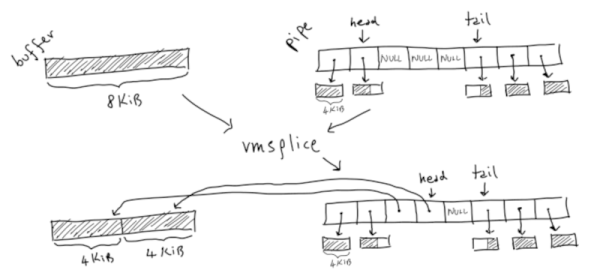
In CPU design, there is Ahmdal’s law. Simply put, it means that if some process is contributing to 10% of your execution, optimizing it can’t improve things by more than 10%. Common sense, really, but it illustrates the importance of knowing how fast or slow various parts of your system are. So how fast are Linux pipes? That’s a good question and one that [Mazzo] sets out to answer.

The inspiration was a highly-optimized fizzbuzz program that clocked in at over 36GB/s on his laptop. Is that a common speed? Nope. A simple program using pipes on the same machine turned in not quite 4 GB/s. What accounts for the difference?

Continue reading “Optimizing Linux Pipes”