Iron Becomes SMD Hot Plate

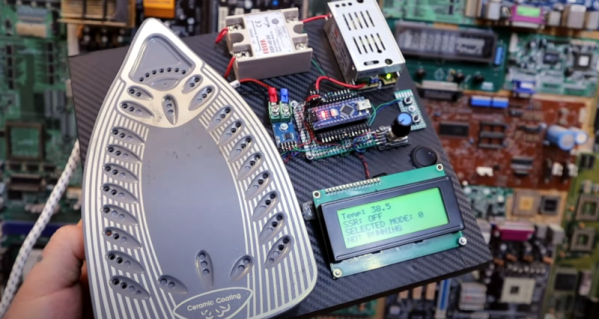
Few things have changed our workshops more than surface mount components. In 1980 it would have been strange to see a hobby bench with a microscope, hot air equipment, tweezers, and all the other accouterments that are a necessity today. [Electronoobs] wanted a reflow hot plate and decided that he could repurpose a consumer laundry iron for the job. You can see the results in the video below.

Opening the iron revealed surprisingly simple circuitry, so the build has some additional parts along with a controller and an LCD, of course. The power requirement for the heating element is significant — 13 amps — so the plate uses a solid state relay to turn things on and off.
Continue reading “Iron Becomes SMD Hot Plate”

Machine Extrudes Filament

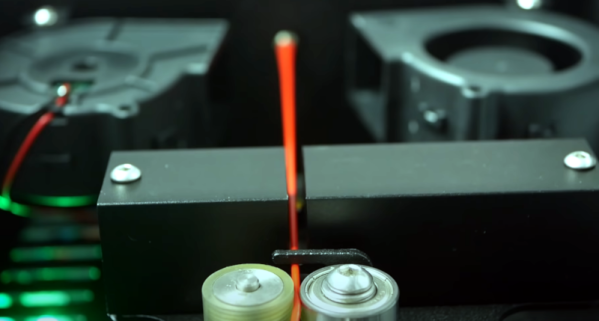
We’ve seen a lot of homebrew filament extruders, but [Stefan] at CNC Kitchen shows off a commercial desktop filament extruder in his latest video, which you can see below. The 3DEVO extruder is pretty slick but at around $7,000-$8,000 we probably won’t rush out and buy one. We might, though, get some ideas from it for our next attempt to build something similar.

In concept, any machine that creates filament is pretty straightforward. Melt pellets and push them out of a nozzle. Cool the filament and wind it up. Easy, right? But, of course, the problems are all in the details. Die swell, for example, means you can’t just assume the nozzle’s hole size will give you the right size filament. Continue reading “Machine Extrudes Filament”

This Arduino Isn’t Color Blind

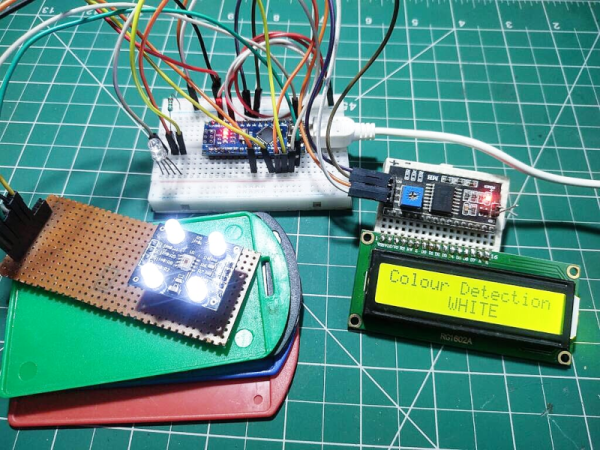
You can sense a lot of things with the right sensor, and [Nikhil Nailwal] is here to show us how to sense colors using a TCS230. The project is a simple demo. It displays the color and lights up an LED to correspond to the detected color.

If you haven’t seen the TCS230 before, it is a chip with an array of photosensors, for different light wavelengths. The controlling chip — an Arduino, in this case — can read the intensity of the selected color.

Continue reading “This Arduino Isn’t Color Blind”

Internet Chess On A Real Chessboard

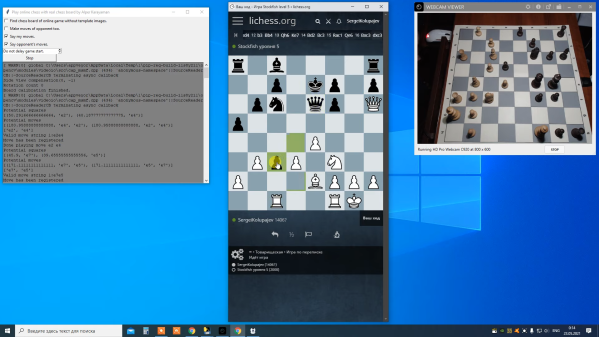
The Internet teaches us that we can accept stand-ins for the real world. We have an avatar that looks like us. We have virtual mailboxes to read messages out of make-believe envelopes. If you want to play chess, you can play with anyone in the world, but on a virtual board. Or, you can use [karayaman’s] software to play virtual games on real boards.

The Python program uses a webcam. You point it at an empty board and calibrate. After that, the program will track your moves on the real board in the online world. You can see a video of a test game below.

Continue reading “Internet Chess On A Real Chessboard”

Social Engineering And Menus

If you follow cybersecurity hacker methods — or just watch Mr. Robot — you probably know that the best way to get someone’s password is to ask for it. Sure, you probably can’t just say “Hi, I’m a bad guy. Can I have your password?” But there are all sorts of tricks you can use like pretending to be in the person’s IT department, someone in management, or by making up a crisis to overcome their better judgement with a sense. But of course, as wise computer people, we are immune to such things, right? We also don’t need those kinds of tricks in our arsenal.

Is that true? It is amazing how many subtle things influence what we think are rational decisions, no matter who we are. Consider going to eat in a restaurant. Simple, right? You look at the menu, pick what you want, and order. No one is influencing you. But they are. According to a BBC article, there’s a whole industry of menu “engineering” that figures out how to get you to order pricey food.

You might not think social engineering for menus is a great skill for us. But maybe your new open source project needs collaborators. Maybe your startup company needs investors. Maybe you’d like someone to look at your resume. Maybe the same tricks that work with diners will work in those cases, too.

Continue reading “Social Engineering And Menus”

Slice Your Next FPGA Design

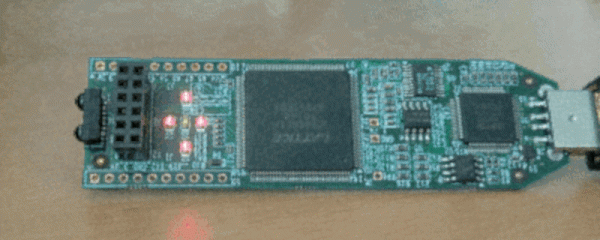
A recent trend has been to convert high-level constructs into FPGA code like Verilog or VHDL. Silice goes the other way: it converts very hardware-specific concepts to Verilog and aims to be a more expressive and easier to use language.

Why Silice? The project’s web page enumerates its design goals:

  • A clean, simple syntax that clearly exposes the flow of operations and where clock cycles are spent.
  • Precise rules regarding flow control (loops, calls) and their clock cycle consumption.
  • Familiar hardware constructs such as always blocks, instantiation, expression tracking (wires).
  • An optional flow-control oriented design style (automatic FSM generation), that naturally integrates within a design: while, break, subroutines.
  • The possibility to easily describe pipelines.
  • Automatically takes care of creating flip-flops for variables, with automatic pruning (e.g. const or bindings).
  • Generic interfaces and grouped IOs for easy reuse and modular designs.
  • Generic circuits that can be instantiated and reused easily.
  • Explicit clock domains and reset signals.
  • Familiar syntax with both C and Verilog inspired elements.
  • Inter-operates with Verilog, allowing to import and reuse existing modules.
  • Powerful LUA-based pre-processor.

Continue reading “Slice Your Next FPGA Design”

AD409 Microscope Review

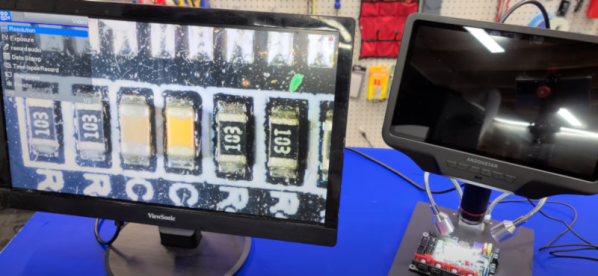
It wasn’t that long ago that if you had an optical microscope in your electronics shop, you had a very well-supplied shop indeed. Today, though, a microscope is almost a necessity since parts have shrunk to flyspeck-size. [Maker Mashup] recently picked up an AD409 and posted a video review of the device that you can see below.

The microscope in question has a 10-inch screen so it is a step up from the usual cheap microscope we’ve seen on a lot of benches. Of course, that size comes at a price. The going rate for a new on is about $400.

Continue reading “AD409 Microscope Review”