A $50 CNC

In theory, there’s isn’t much to building a CNC machine. Hook a bit to a motor and move the motor around with some lead screws and stepper motors. Easy. But, of course, the devil is in the details. [DAZ] made a nice-looking and inexpensive rig that probably isn’t the most precise CNC in the world, but it looks like it does a good enough job and he claims he spent about $50 on it. The video below shows some of the work it has done, and it doesn’t look bad.

This isn’t a rainy afternoon project. You’ll need to cut some wood and 3D print many parts. The drives use M8 threaded rod. Electronics is just an Arduino running standard software.

The steppers looked pretty light duty, and we wondered if it would have been worthwhile to trade them out for beefier ones instead of modifying the ones used for bipolar operation. Still, the results did look good for $50. The 775 spindle is another place you could probably spend a little more and get something better. Non-printed linear rails, and a better screw? The point is that you’ve got a basis to build from.


Continue reading “A $50 CNC”

Measuring An Atom

Do you need a well-equipped lab to measure the size of an atom (German, machine translation)? According to [stoppi], no. You need sunflower oil, some bear moss spores, and a bit of gasoline. You’ll also need some common things like a syringe, a baking sheet, and a jar. You can see the whole process in the video below. The measurement isn’t really for a specific atom, but it is an average for a lipid molecule, which is still impressive.

You essentially measure the diameter of an oil drop spread over water. Since the oil is mostly oleic acid, the height of the layer is known as 167 atoms. After that, it is some simple measurements and math to get the height and find the average atom height.

Continue reading “Measuring An Atom”

Helicopter Is Full Of Compressed Air

[Tom] likes to build little helicopters and decided to build one that runs on compressed air. (Video, embedded below.) Turns out it was a little harder than he thought. Originally, he was trying for a compressed air quadcopter. He’d already worked with an air turbine, but putting on a vehicle that can lift itself into the air turns out to have a lot of hidden gotchas.

[Tom] went through a lot of design considerations to arrive at the helicopter design. He considered counter-rotating props, but there were a host of problems involved. He finally settled on a single prob with a tail rotor that resides on the far end of a long boom to allow the resulting lever arm to reduce the work required of the tail rotor.

Continue reading “Helicopter Is Full Of Compressed Air”

Texture Adds Stiffness To 3D Parts

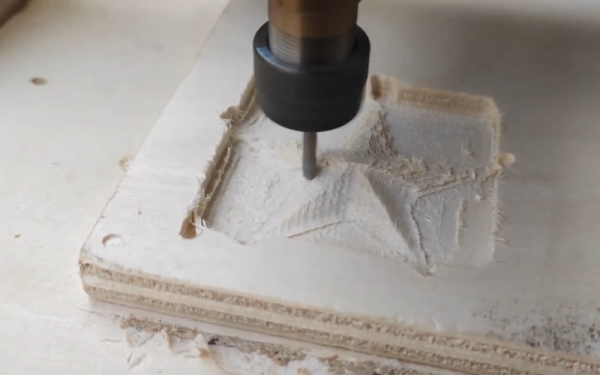
[Stefan] is always looking for a way to make stronger and better 3D prints. His latest experiments involve using a texture on thin plastic parts to increase stiffness. You can see the texture pattern in the banner above and the video below.

While a lot of people looked at IdeaMaker’s new texturing feature as something for cosmetics, [Stefan] thought of sheet metal products that often use bead patterns to increase stiffness and strength. Can patterned plastic be stiffer than ordinary printed plastic? Turns out, the answer is yes.

Continue reading “Texture Adds Stiffness To 3D Parts”

Logic Flows, Literally, In This Water Adder

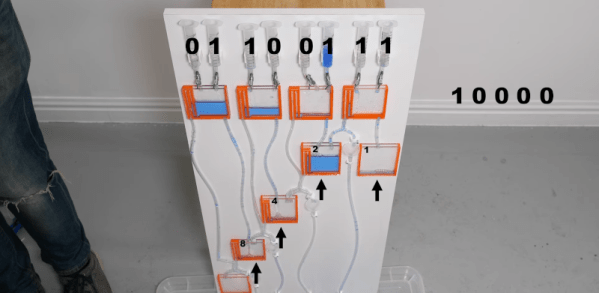
A lot of elementary electronic texts use water as an analogy for electricity. You know, pressure is voltage, flow is current, and pipe diameter is resistance. It is ironic, then, that some people use fluids to build logic gates and, in fact, you can make any logic circuit you like using nothing but water flowing through some structures. Don’t think so? Have a look at the video from [Steve Mould] below.

Fluidic logic isn’t anything new, but it has always been a bit exotic. Usually, replacing electrons with water or even air — which is a kind of fluid — means you are trying to operate in a tough environment or have some other special need. As far as we can tell, [Steve] did it just because he could, and we get that.

Continue reading “Logic Flows, Literally, In This Water Adder”

Retrotechtacular: Renewable Energy, 1948 Edition

If you’ve got 10 minutes, how about a quick break to watch a video about renewable clean electric power? Must be a recent video, right? Nope. The Coronet Instruction Film below is from 1948 and covers using rivers to generate power. Hydropower isn’t a new idea, of course, and the film starts out with an old-fashioned water wheel. That’s not really what they are driving at, though.

The announcer sounds just like the guy who narrated all the film strips you saw in school. There are some good vintage shots of Niagra Falls and some other dams. The video also makes some economic arguments about hydroelectric versus coal and why some rivers aren’t suitable for power generation.

Continue reading “Retrotechtacular: Renewable Energy, 1948 Edition”

Linux Fu: A Little Bit Of (Network) History Repeating Itself

These days, embedded systems often have networks and that can make them significantly more complex. Networks are usually pretty nondeterministic and there are a variety of oddball conditions. For example, when your public-access pick and place machine gets written up on Hackaday and you suddenly get a 50X surge in traffic, how does your network stack handle it? While there’s no silver bullet for network testing, there are some tricks that can make it easier and one of those is the tcpreplay utilities that allow you to record complex network traffic and then play it back in a variety of ways. This has many benefits, especially if you manage to capture that one thing that triggers bad behavior sporadically. Being able to play it back on demand can speed up diagnostics considerably.

General Idea

You probably know that tcpdump allows you to grab packet captures from a network interface and save them to a file. If you prefer a GUI, you probably use Wireshark, which uses the same underlying library (libpcap) to grab the data. In fact, you can capture data using tcpdump and look at it with Wireshark, although there are other tools like tcptrace or Ngrep that can work with the output, also.

While the output of the command can be a little cryptic without tool support, a program called tcpreplay can take that data and feed it back in a variety of ways. Of course, you can modify the file first — there are tools to make that easier and — if you need to — you can craft your own network traffic by hand or using one of a variety of tools. This process is often called “packet crafting.”

Continue reading “Linux Fu: A Little Bit Of (Network) History Repeating Itself”