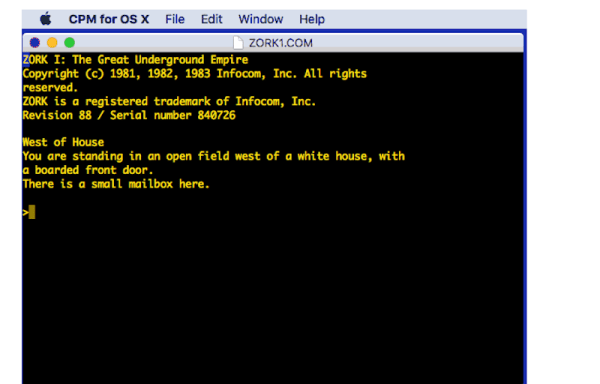
In case you wanted to run WordStar on your Mac, [Tom Harte] offers CP/M for OS/X, and it looks like it would be a lot of fun. Of course you might be happier running Zork or Turbo Pascal, and you can do that, too.
There are plenty of Z80 emulators that can run CP/M, but what we found most interesting about this one is that it is written in Objective C, a language with a deep history in the Mac and NeXT worlds.
Steve Martin was ahead of his time when he told us “Let’s get small!” While you usually think of a nuclear reactor as a big affair, there’s a new trend towards making small microreactors to produce power where needed instead of large centralized generation facilities. The U.S. Department of Energy has a video about the topic, you can watch below.
You probably learned in science class how a basic nuclear fission reactor works. Nuclear fuel produces heat from fission while a moderator like water prevents it from melting down both by cooling the reactor and slowing down neutrons. Control rods further slow down the reaction or — if you pull them out — speed it up. Heat creates steam (either directly or indirectly) and the steam turns a conventional electric generator that is no more high tech than it ever has been.
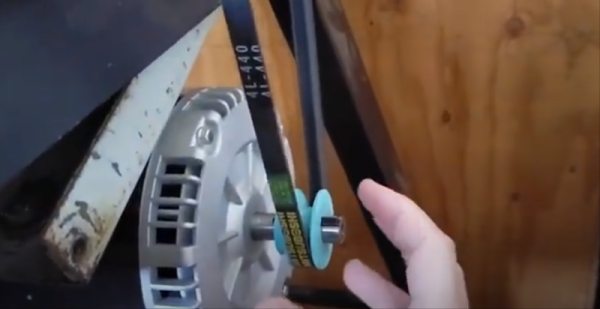
A great addition to a home shop is a bandsaw, but when [Design Prototype Test] got a well-used one, he found it wasn’t in very good shape. The previous owner put in an underpowered motor and made some modifications to accommodate the odd-sized blade. Luckily, 3D printing allowed him to restore the old saw to good working order.
There were several 3D printed additions. A pulley, a strain relief, and even an emergency stop switch. Honestly, none of this stuff was something you couldn’t buy, but as he points out, it was cheaper and faster than shipping things in from China. He did wind up replacing the initial pulley with a commercial variant and he explains why.
After watching [Uncle Jessy’s] video about soy-based 3D printing resin from Elegoo and their miniature air purifiers, we couldn’t decide if the resin doesn’t smell as bad as some other resins or if the air purifier works wonders. Maybe it is a bit of both.
We’ve used Eryone super low odor resin and it has less smell than, say, paint. It sounds like the Elegoo is similar. However, we are always suspicious of claims that any resin is really made with natural ingredients. As [Brent], who apparently has a PhD in chemistry, pointed out, AnyCubic Eco resin makes similar claims but is likely only partially made from soy. Sure, a little less than half is soy-based, but then there’s the other half. Still, we suppose it is better than nothing. That video (also below) is worth watching if you ever wondered why resin solidifies under UV light or what a monomer is.
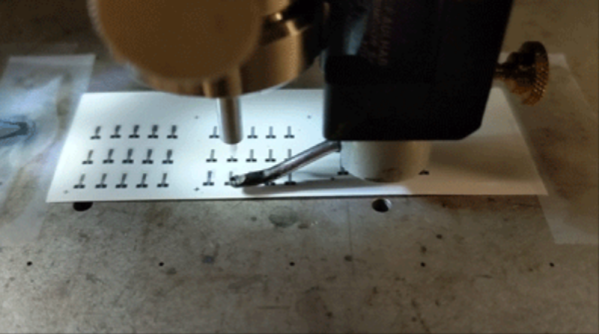
We’ll be honest, we were more excited by Duke University’s announcement that they’d used carbon-based inks to 3D print a transistor than we were by their assertion that it was recyclable. Not that recyclability is a bad thing, of course. But we would imagine that any carbon ink on a paper-like substrate will fit in the same category. In this case, the team developed an ink from wood called nanocelluose.
As a material, nanocellulose is nothing new. The breakthrough was preparing it in an ink formulation. The researchers developed a method for suspending crystals of nanocellulose that can work as an insulator in the printed transistors. Using the three inks at room temperature, an inkjet-like printer can produce transistors that were functioning six months after printing.
Your airplane has crashed at sea. You are perched in a lifeboat and you need to call for help. Today you might reach for a satellite phone, but in World War II you would more likely turn a crank on a special survival radio.
These radios originated in Germany but were soon copied by the British and the United States. In addition to just being a bit of history, we can learn a few lessons from these radios. The designers clearly thought about the challenges stranded personnel would face and came up with novel solutions. For example, how do you loft a 300-foot wire up to use as an antenna? Would you believe a kite or even a balloon?
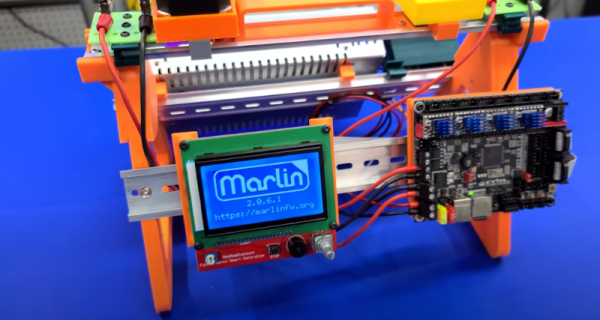
One of the great things about the Internet is it lets people find out what other people are doing even if they normally wouldn’t have much exposure to each other. For example, in some businesses DIN rails are a part of everyday life. But for a long time, they were not very common in hobby electronics. Although rails are cheap, boxes for rails aren’t always easy or cheap to obtain, but 3D printing offers a solution for that.
So while the industrial world has been using these handy rails for decades, we are starting to see hobby projects incorporate them more often and people like [Makers Mashup] are discovering them and finding ways to use them in projects and demonstrating them in this video, also embedded below.
If you haven’t encountered them yet, DIN rails are a strip of metal, bent into a particular shape with the purpose of mounting equipment like circuit breakers. A typical rail is 35 mm wide and has a hat-like cross-section which leads to the name “top hat” rail. A 25 mm channel lets you hide wiring and the surface has holes to allow you to mount the rail to a wall or a cabinet. These are sometimes called type O or type Ω rails or sections.
There are other profiles, too. A C-rail is shaped like a letter C and you can guess what a G section looks like, too. Rails do come in different heights, as well, but the 35 mm is overwhelmingly common. However, there are 15 mm rails and 75 mm rails, too.