NASA Needs Help From Gamers And Citizen Scientists

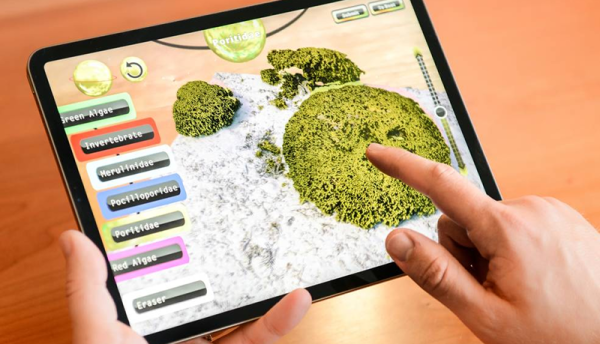
NASA would like you to help them explore — not space — but the bottom of the ocean. For now, you’ll need an Apple device, although an Android version is in the works. While it might seem strange for the space agency to look underwater, the images they need to process are from fluid-lensing cameras that use techniques originally meant to remove distortion from the atmosphere from pictures of outer space. Turns out they can also unravel distortion caused by the ocean and clearly image coral reefs.

The phone app is in the form of a game and, according to NASA, even a first grader could play it. In the game, you are in command of an ocean research vessel, theĀ Nautilus. You dive to examine coral and identify what you see. The game generates training data for a supercomputer at the Ames Research Center so it can recognize coral types even when taken with more conventional cameras.

Continue reading “NASA Needs Help From Gamers And Citizen Scientists”
Hams Cross The Atlantic On UHF

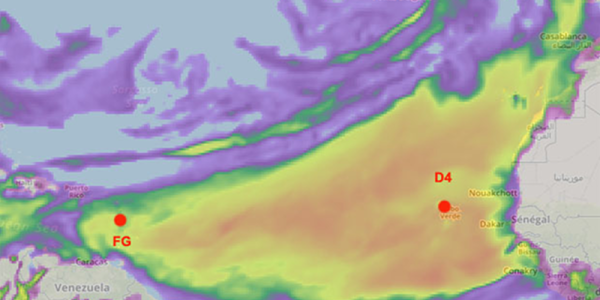
We often think of ham radio operators talking to exotic faraway lands, and that’s true for hams using the HF bands (below 30 MHz), especially if they have nice antennas. Modern living has made it much harder to have those big antenna farms, and today’s ham is more likely talking on VHF or UHF frequencies with very limited range under normal circumstances. Sure, you can use a repeater or bounce your signal from a satellite or the moon, but normal direct communication is normally going to be less than a typical commercial FM radio station. But on April 7th, two hams communicated across the Atlantic on 432 MHz — a UHF frequency. The distance was almost 4,000 km.

Notice we didn’t say they talked, but they communicated. The contact was via a somewhat controversial mode called FT8 which uses weak signal techniques to allow two computers to send limited amounts of information to each other. However, on April 10, the two stations reported a single sideband voice contact after they noticed the band conditions improving on the FT8 signal.

Continue reading “Hams Cross The Atlantic On UHF”

Plasma Cutter + Sharpie Is Surprisingly Useful

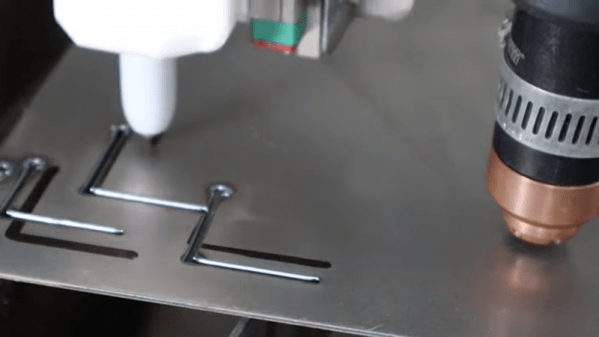
What we want is a Star Trek-style replicator. What we have are a bunch of different machines that can spew out various 2D and 3D shapes. For the foreseeable future, you’ll still need to post-process most of what you build in some way. [Stuff Made Here] had a challenge. He often uses his plasma cutter to create complex sheet metal items. But the cutter is two dimensional so the piece doesn’t look right until you bend it at just the right places. If you are doing a simple box, it is easy to figure out, but getting just the right spot on a complex bend can be a challenge. His answer? Attach a marker to the gantry so the machine can draw the lines right on the sheet metal.

Sounds easy and if you were willing to do a pen pass separately and then remove the pen and do the plasma cutting it would be relatively easy. However, that seems kind of crude. Mounting it permanently requires a way to raise it up when cutting — and it needs to survive the noisy environment near the torch. The pen would also dry out if you left in uncapped. The answer was using a permanent marker with a click retractor and let the mechanism extend and retract the pen point on command.

Continue reading “Plasma Cutter + Sharpie Is Surprisingly Useful”

3D Printing Fishing Lure Molds

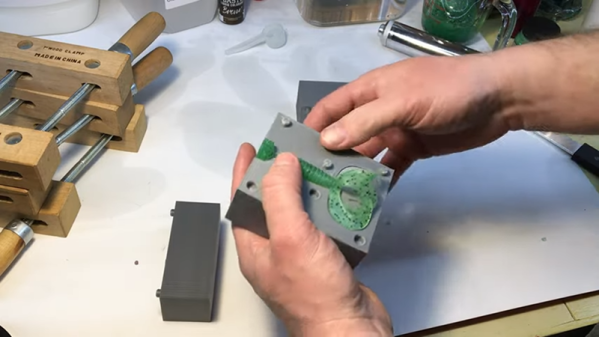
Every fisherman has a secret. A secret spot, a secret technique, or a secret bait. Maybe that’s why tying flies is so popular. [Steve] certainly has is own special lures, although he’s not keeping it a secret. (Video, embedded below.) He designs lures in Simplify3D, 3D prints molds, and then casts them.

The 3D printing part is interesting, but it is also kind of neat to see the lures and the natural prey he uses for inspiration. If you want to catch fish, you have to use bait that looks like real food.

Continue reading “3D Printing Fishing Lure Molds”

The Libre Space Foundation Reviews Software Defined Radios

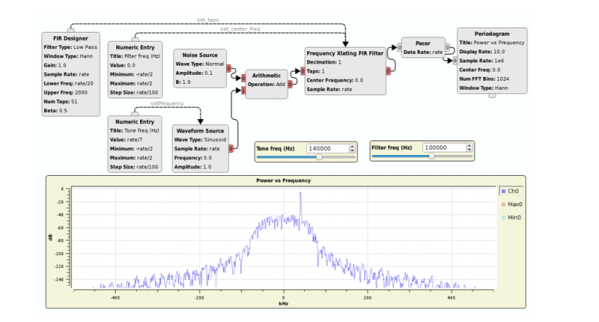
If you want to go to the next level with software defined radio (SDR), there are a lot of choices. The RTL-SDR dongles are fine, but if you get serious you’ll probably want something else. How do you choose? Well, your friends at the European Space Agency Libre Space Foundation have published a paper comparing many common options. True, they are mostly looking at how the receivers work with CubeSats, but it is still a good comparison.

The devices they examine are:

  • RTS-SDR v3
  • Airspy Mini
  • SDRPlay RSPduo
  • LimeSDR Mini
  • BladeRF 2.0 Micro
  • Ettus USRP B210
  • Pluto SDR

They looked at several bands of interest, but not the HF bands — not surprising considering that some of the devices can’t even operate on HF. They did examine VHF, UHF, L band, S band, and C band performance. Some of the SDRs have transmit capabilities, and for those devices, they tested the transmit function as well as receive.

Continue reading “The Libre Space Foundation Reviews Software Defined Radios”

From The MacGyver Files: Using A Stepper Motor As An Encoder

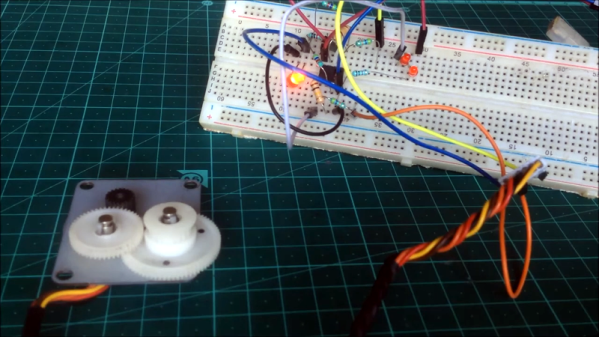
It isn’t hard to imagine a scenario where you are stuck at home all day with nothing to do and certain items are in short supply. Sure, bathroom tissue gets all the press, but try buying some flour or a freezer and see how far you get. Plus online shopping has given up on next day delivery for the duration. Not hard to imagine at all. Now suppose your latest self-quarantine project needs a rotary shaft encoder. Not having one, what do you do? If you are [Tech Build] you go all MacGyver on an old printer and pull out a stepper motor.

How does a stepper motor turn into an encoder? Well, that’s the MacGyver part. We are not big fans of the physical circuit diagrams, but it looks like [Tech Build] borrowed (with credit) from an earlier post and that one has a proper schematic.

Continue reading “From The MacGyver Files: Using A Stepper Motor As An Encoder”

Learn PDP-11 Assembly For Fun But Probably No Profit

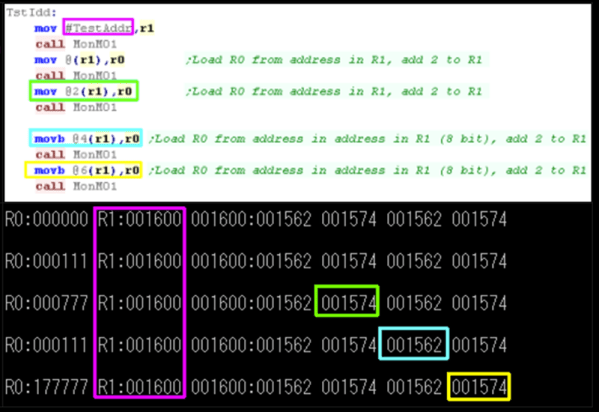
Learning a new skill is fun, especially one that could land you a new job. We don’t think you’ll find too much demand for PDP-11 assembly language programmers, but if it still interests you, check out [ChibiAkumas’s] video that starts a series on that subject for “absolute beginners.”

The PDP-11 is a venerable computer, but you can still find simulators ranging from SIMH to browser-based virtual devices with front panels. If you want real hardware, there is a PDP-11 on a chip that is still around (or you can score the real chips, sometimes) and there are some nice hardware simulations, too.

Continue reading “Learn PDP-11 Assembly For Fun But Probably No Profit”