Casting Concrete With 3D Printed Molds

[Thomas Sanladerer] wanted to create some molds using 3D printing for concrete and plaster. He used a delta printer with flexible filament and documented his process in the video below.

If you’ve printed with flexible filaments before, you know you need an extruder that has a contained path. [Tom] borrowed a printer, but it didn’t have that kind of set up. The first step was to swap extruders with another printer.

Continue reading “Casting Concrete With 3D Printed Molds”

Arduino And The Other Kind Of Homebrew

Usually, when we are talking about homebrew around here, we mean building your own equipment. However, most other people probably mean brewing beer, something that’s become increasingly popular as one goes from microbreweries to home kitchen breweries. People have been making beer for centuries so you can imagine it doesn’t take sophisticated equipment, but a little automation can go a long way to making it easier. When [LeapingLamb] made a batch using only a cooler, a stock pot, and a propane burner, he knew he had to do something better. That’s how Brew|LOGIC was born.

There are many ways to make beer, but Brew|LOGIC focuses on a single vessel process and [LeapingLamb] mentions that the system is akin to a sous vide cooker, keeping the contents of the pot at a specific temperature.

Honestly, though, we think he’s selling himself a bit short. The system has a remote application for control and is well-constructed. This isn’t just a temperature controller thrown into a pot. There’s also a pump for recirculation.

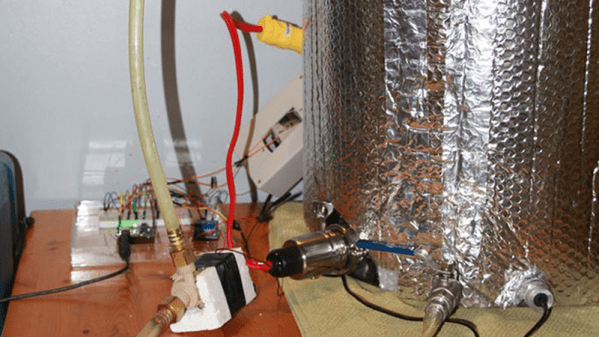
The common stock pot gets some serious modifications to hold the heating element and temperature probe. It also gets some spring-loaded clamps to hold the lid down. Expect to do a lot of drilling.

The electronics uses an Arduino, a Bluetooth board, and some relays (including a solid state relay). The finished system can brew between 5 and 15 gallons of beer at a time. While the system seems pretty good to us, he did list some ideas he has for future expansion, including valves, sensors for water level and specific gravity, and some software changes.

After reading that the system was similar to a sous vide cooker, we wondered if you could use a standard one. Turns out, you can. If you want to make better beer without electronic hacking, there’s always the genetic kind.


Pocket Forth Invades Your TI Calculator

TI certainly have certainly seen off rivals such as HP or Casio to capture the lion’s share of the calculator market. The TI-84 is a real staple, and with as many units as there are out there, hacking them is a given. However, selecting an operating system for the machine can be a hassle. TI-OS is proprietary and doesn’t really want to let you do everything you’d like to. There are alternatives, but many of them won’t let you easily use your calculator to be — well — a calculator.

[Siraben] has zkeme80 which is essentially ANS Forth (mostly) with extensions for the TI hardware. You can easily extend the system, of course, because it is Forth. You can also use the machine for its intended purpose easily.

Continue reading “Pocket Forth Invades Your TI Calculator”

Circuit VR: Redundant Flip Flops And Voting Logic

We are somewhat spoiled because electronics today are very reliable compared to even a few decades ago. Most modern electronics obey the bathtub curve. If they don’t fail right away, they won’t fail for a very long time, in all likelihood. However, there are a few cases where that’s not a good enough answer. One is when something really important is at stake — the control systems of an airplane, for example. The other is when you are in an environment that might cause failures. In those cases — near a nuclear reactor or space, for example, you often are actually dealing with both problems. In this installment of Circuit VR, I’ll show you a few common ways to make digital logic circuits more robust with some examples you can run in the Falstad simulator in your browser.

Continue reading “Circuit VR: Redundant Flip Flops And Voting Logic”

Can You Trust Your C Compiler?

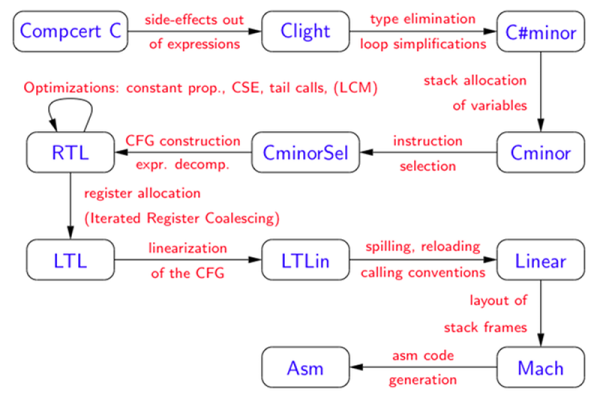
If you are writing a hello world program, you probably aren’t too concerned about how the compiler translates your source code to machine code. However, if your code runs on something that people’s lives depend on, you will want to be a bit pickier and use something like the COMPCERT compiler.  It’s a formally verified compiler, meaning there is a mathematical proof that what you write in C will be correctly translated to machine code. The compiler can generate for PowerPC, ARM, RISC-V, and x86, accepting a subset of ISO C 99 with a few extensions. While it doesn’t produce code that runs as fast as gcc, you can be sure the generated code will do what you asked it to do.

Of course, this still provides no assurance that your code will work. It just means that if you write something such as “x=0;” the generated code will set x to zero and will not do anything else. You can apply formal methods to verify your source code and be assured that the compiler doesn’t introduce possible failures. Cases where code like “x=0;” does extra things or incorrect things are very hard to figure out because the source code is correct and an examination of the generated code would be necessary to find the compiler’s code generation bug.

Continue reading “Can You Trust Your C Compiler?”

Break Your Scope’s Bandwidth Barrier

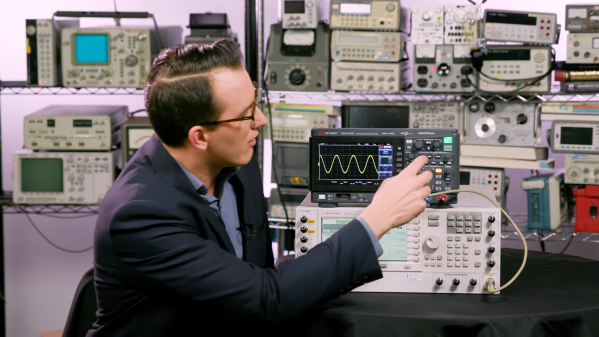
Oscilloscope bandwidth is a tricky thing. A 100 MHz scope will have a defined attenuation (70%) of a 100 MHz sine wave. That’s not really the whole picture, though, because we aren’t always measuring sine waves. A 100 MHz square wave, for example, will have sine wave components at 100 MHz, 300 MHz, and the other odd harmonics. However, it isn’t that a 100 MHz scope won’t show you something at a higher frequency — it just doesn’t get the y-axis right. [Daniel Bogdanoff] from Keysight decided to think outside of the box and made a video about using scopes beyond their bandwidth specification. You can see that video, below.

[Daniel] calls this a “spec hacks” but they aren’t really hacks to the scope. They are just methods that don’t care about the scope’s rated bandwidth. In this particular spec hack, he shows how the frequency counter using a 70 MHz scope’s trigger circuit can actually read up to 410 MHz. A 100 MHz scope was able to read almost 530 MHz.

Continue reading “Break Your Scope’s Bandwidth Barrier”

[Leo] Repairs A MIDI Sequencer

We all have that friend who brings us their sad busted electronics. In [Leo’s] case, he had a MIDI sequencer from a musician friend. It had a dead display and the manufacturer advised that a driver IC was probably bad, even sending a replacement surface mount part.

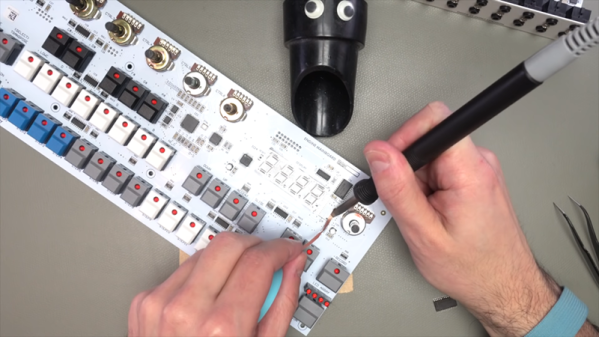
[Leo] wasn’t convinced though. He knew that people were always pushing on the switches that were mounted on the board and he speculated that it might just be a bad solder joint. As you can see in the video below, that didn’t prove out.

The next step was to fire up a hot air gun. Instead of removing the chip, he wanted to reflow the solder anyway. He was a little worried about melting the 7-segment LEDs so he built a little foil shield to protect it. That didn’t get things working, either.

Continue reading “[Leo] Repairs A MIDI Sequencer”