Linux Fu: Easier File Watching

In an earlier installment of Linux Fu, I mentioned how you can use inotifywait to efficiently watch for file system changes. The comments had a lot of alternative ways to do the same job, which is great. But there was one very easy-to-use tool that didn’t show up, so I wanted to talk about it. That tool is entr. It isn’t as versatile, but it is easy to use and covers a lot of common use cases where you want some action to occur when a file changes.

Continue reading “Linux Fu: Easier File Watching”

This 3D Printer Is Soft On Robots

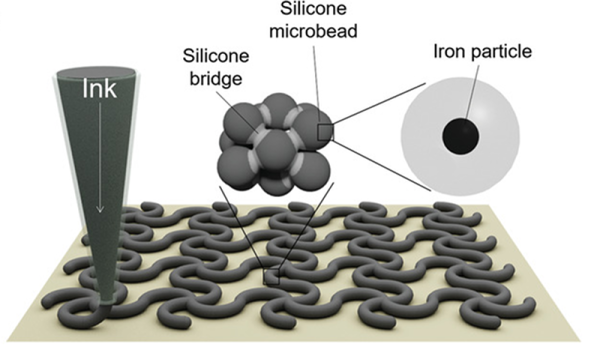
It always seems to us that the best robots mimic things that are alive. For an example look no further than the 3D printed mesh structures from researchers at North Carolina State University. External magnetic fields make the mesh-like “robot” flex and move while floating in water. The mechanism can grab small objects and carry something as delicate as a water droplet.

The key is a viscous toothpaste-like ink made from silicone microbeads, iron carbonyl particles, and liquid silicone. The resulting paste is amenable to 3D printing before being cured in an oven. Of course, the iron is the element that makes the thing sensitive to magnetic fields. You can see several videos of it in action, below.

Continue reading “This 3D Printer Is Soft On Robots”

Build Retro Games With Script-8

A whole generation of programmers learned to program by writing — or at least typing in — game programs for relatively simple computers like a TRS-80, a Commodore 64, or any of a handful of similar machines. These days, games are way more complicated and so are computers. Sure, it is more fun to play Skyrim than Snake, but for learning, you are probably going to get more out of starting with a simple game. If you want to learn programming today — or maybe start someone else on that same journey, you should check out Script-8, a project by [Gabriel Florit]. You can get a taste of how it looks in the video below, or just surf over to the site and play or modify a game (hint: press “a” to launch the ball).

Instead of paraphrasing, here’s the excellent elevator speech from the web site:

SCRIPT-8 is a fantasy computer for making, sharing, and playing tiny retro-looking games (called cassettes). It’s free, browser-based, and open-source. Cassettes are written in JavaScript.

Continue reading “Build Retro Games With Script-8”

Continuous Computing The Analog Way

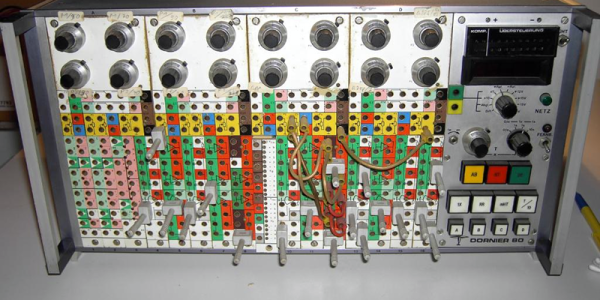
When your only tool is a hammer, everything starts to look like a nail. That’s an old saying and perhaps somewhat obvious, but our tools do color our solutions and sometimes in very subtle ways. For example, using a computer causes our solutions to take a certain shape, especially related to numbers. A digital computer deals with numbers as integers and anything that isn’t is actually some representation with some limit. Sure, an IEEE floating point number has a wide range, but there’s still some discrete step between one and the next nearest that you can’t reduce. Even if you treat numbers as arbitrary text strings or fractions, the digital nature of computers will color your solution. But there are other ways to do computing, and they affect your outcome differently. That’s why [Bill Schweber’s] analog computation series caught our eye.

One great example of analog vs digital methods is reading an arbitrary analog quantity, say a voltage, a temperature, or a shaft position. In the digital domain, there’s some converter that has a certain number of bits. You can get that number of bits to something ridiculous, of course, but it isn’t easy. The fewer bits, the less you can understand the real-world quantity.

For example, you could consider a single comparator to be a one-bit analog to digital converter, but all you can tell then is if the number is above or below a certain value. A two-bit converter would let you break a 0-3V signal into 1V steps. But a cheap and simple potentiometer can divide a 0-3V signal into a virtually infinite number of smaller voltages. Sure there’s some physical limit to the pot, and we suppose at some level many physical values are quantized due to the physics, but those are infinitesimal compared to a dozen or so bits of a converter. On top of that, sampled signals are measured at discrete time points which changes certain things and leads to effects like aliasing, for example.

Continue reading “Continuous Computing The Analog Way”

Solar Power Is Set To Get More Expensive

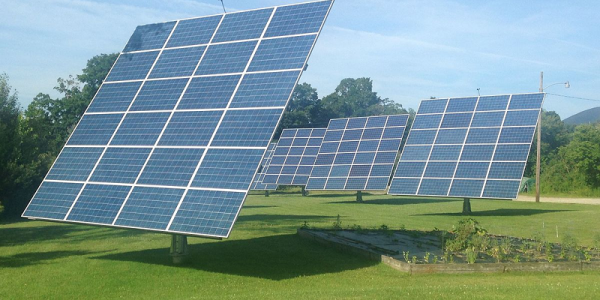
The sun constantly bathes half the planet with energy. The energy may be free, but the methods for converting it to electricity cost money. Last year, the Chinese government cut subsidies to their solar panel manufacturers to shrink the industry which was perceived as bloated. This forced Chinese solar panel makers to cut prices to clear inventory. This drove down prices about 30%, making solar power cheaper than ever.

Reuters is reporting that Eric Luo, president of one of the largest solar panel makers in China, predicts that “the party is definitely over.” Speaking at the World Economic Forum, Luo said that prices have quit dropping and he expected industry consolidation to cause prices to rise by as much as 15% over the next two years.

Continue reading “Solar Power Is Set To Get More Expensive”

Tiny Voltmeter Uses DNA

We use a lot of voltmeters and we bet you do too. We have some big bench meters and some panel meters and even some tiny pocket-sized meters. But biological researchers at the University of Chicago and Northwestern University have even smaller ones. They’ve worked out a way to use a DNA-based fluorescent reporter to indicate the voltage across cellular membranes.

We don’t know much about biology, but apparently measuring the voltage on the membrane around a cell is easy, but measuring the voltages across membranes inside the cell isn’t. Previous work disrupted cells and measured potentials on isolated organelles.

The indicator — called Voltair — can target specific parts of a cell and includes a reference indicator so that a ratiometric measurement is possible. In fact, there are three main parts to the 38-base pair DNA duplex. One module contains a voltage-sensing dye that fluoresces in a way that indicates voltage. The second module is a reference dye that allows researchers to judge the voltage level. The final module identifies where the probe should attach.

Continue reading “Tiny Voltmeter Uses DNA”

Badland Brawler Lets Arduino Tackle Terrain

For an electronics person, building the mechanics of a robot — especially a robust robot — can be somewhat daunting. [Jithin] started with an off-the-shelf 4 wheel drive chassis to build an off-road Arduino robot he calls the Badland Brawler. The kit was a bit over $100, but as you can see in the video below, it is pretty substantial, with an enclosed frame and large mud tires.

The remaining parts include an Arduino, a battery, and a motor driver IC. The Arduino is one with WiFi (an MKR 1000, in fact) and there’s a phone app for controlling the robot.

Honestly, once you have the chassis taken care of, the rest is pretty easy. Of course, the phone app is a bit more effort, but you could replace it in a number of ways. Blynk, comes to mind, for example.

The motor drivers are easy to figure out. This would be a great platform for some sensors to allow for more autonomy. We liked how the frame had mount points for a lot of different boards and sensors and could hold everything, for the most part, inside. That’s probably a good idea for a robot which will be traversing rugged terrain.

If you do decide to roll your own app with Blynk, we’ve done it with a very different kind of robot. Four-wheel drive robots don’t have to be big, as we’ve seen in the past.

Continue reading “Badland Brawler Lets Arduino Tackle Terrain”