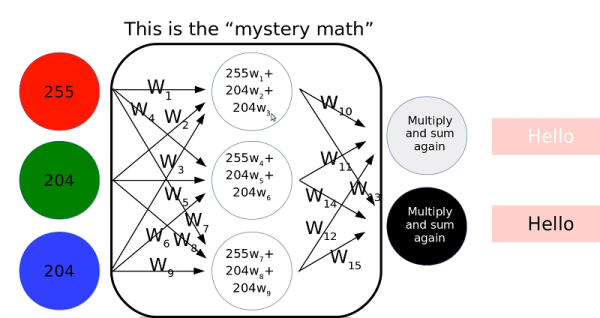
One of the difficulties in learning about neural networks is finding a problem that is complex enough to be instructive but not so complex as to impede learning. [ThomasNield] had an idea: Create a neural network to learn if you should put a light or dark font on a particular colored background. He has a great video explaining it all (see below) and code in Kotlin.
[Thomas] is very interested in optimization, so his approach is very much based on mathematics and algorithms of optimization. One thing that’s handy is that there is already an algorithm for making this determination. He found it on Stack Exchange, but we’re sure it’s in a textbook or paper somewhere. The existing algorithm makes the neural network really impractical, but it makes training easy since you can algorithmically develop a training set of data.
Once trained, the neural network works well. He wrote a small GUI and you can even select among various models.
Don’t let the Kotlin put you off. It is a derivative of Java and uses the same JVM. The code is very similar, other than it infers types and also adds functional program tools. However, the libraries and the principles employed will work with Java and, in many cases, the concepts will apply no matter what you are doing.
If you want to hardware accelerate your neural networks, there’s a stick for that. If you prefer C and you want something lean and mean, try TINN.
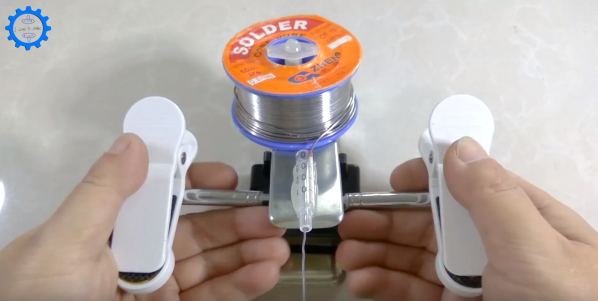
Although [I Love To Make] appears to have text in Chinese, their recent video (see below) is like a wordless workshop so it won’t matter if you are up on your Mandarin or not. The soldering vise looks like it mostly came from a dollar store (or perhaps a yaun store).
As far as we can tell, the assembly is two utility clips like you might use on a cork board or to seal up chips, a Micro SIM cutter, and TV rabbit ears. Oh, and a syringe. The rabbit ears get mostly destroyed in the build process. You have to do some cutting and plastic melting, too (we might have used a drill), but nothing you couldn’t do with some simple hand tools. They don’t show it, but apparently, they drilled a hole in the SIM cutter, so you’ll need a drill anyway.
It used to be any good electronics experimenter had a bag full of crystals because you never knew what frequency you might need. These days, you are likely to have far fewer because you usually just need one reference frequency and derive all the other frequencies from it. But how can you test a crystal? As [Mousa] points out in a recent video, you can’t test it with a multimeter.
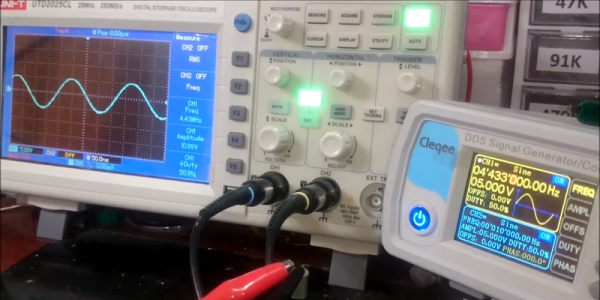
His approach is simple: Monitor a function generator with an oscilloscope, but put the crystal under test in series. Then you move the frequency along until you see the voltage on the oscilloscope peak. That frequency should match the crystal’s operating frequency.
Do you talk to your alarm clock? I do. I was recently in a hotel room, woke up in the middle of the night and said, “Computer. What time is it?” Since my Amazon Echo (which responds to the name Computer) was at home, I was greeted with silence. Isn’t the future great?
Of course, there have been a variety of talking clocks over the years. You used to be able to call a phone number and a voice would tell you the time. But how old do you think the talking clock really is? Would you guess that this year is the 140th anniversary of the world’s first talking clock? In fact, it doesn’t just hold the talking clock record. The experimental talking clock Frank Lambert made is also the oldest surviving recording that can be still be played back on its original device.
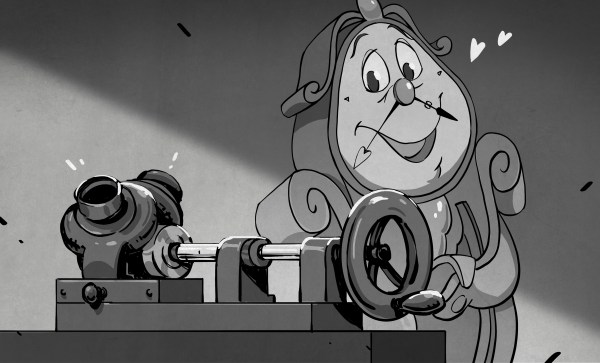
In 1878, the phonograph had just been invented and scratched out sounds on a piece of tin foil. Lambert realized this wouldn’t hold up to multiple playbacks and set out to find a more robust recording medium. What he ended up building was a clock that would announce the time using lead to record the speech instead of tin foil.
It is mind-boggling when you think about the computing power that fits in the palm of your hand these days. It wasn’t long ago when air-conditioned rooms with raised floors hosted computers far less powerful that filled the whole area. Miniaturization is certainly the order of the day. Things are getting smaller every day, too. We were so impressed with the minuscule entries from the first “Square Inch Project” — a contest challenging designers to use 1 inch2 of PCB or less — that we decided bring it back with the Return of the Square Inch Project. The rules really were simple: build something with a PCB that was a square inch.
Grand Prize
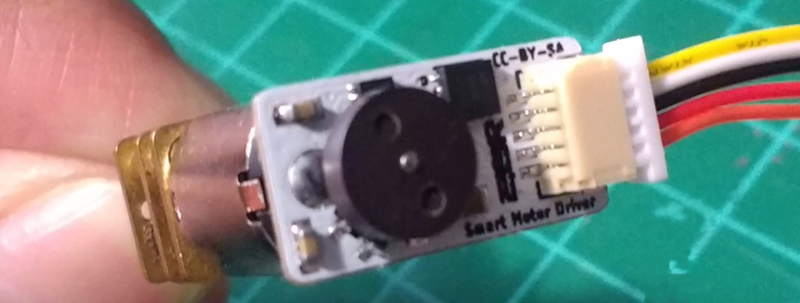
It was hard to pick, but there can only be one grand prize winner. This time around that honor goes to [Danny FR] for a very small smart motor driver for robotics. The little board takes an I2C link to a microcontroller and does PID control with RPM feedback. No need for an H-bridge or any sophisticated control electronics — that’s all onboard.
The board is a great fit for a motor and makes it easy to build moving projects. That was the grand prize, but there were some other great entries that won in specific categories, too.
Best Project
[Drix] likes to know where things are. The Hive Tracker uses laser “lighthouses” that sweep across the room. A special microcontroller with a dedicated hardware block reads the laser light and triangulates its position relative to the lighthouses with a great deal of precision. A picture’s worth a thousand words, so:
The high-speed reading of the lasers uses “Programmable Peripheral Interconnect” — a feature of a Nordic BLE microcontroller that lets the chip read timestamps in hardware without interrupting the processor. The little boards hook up to a hub board which is also pretty small.
We’re hackers, so we think a few bare PCBs connected to another PCB can be artistic. But most people have something different in mind.
Best Artistic Project
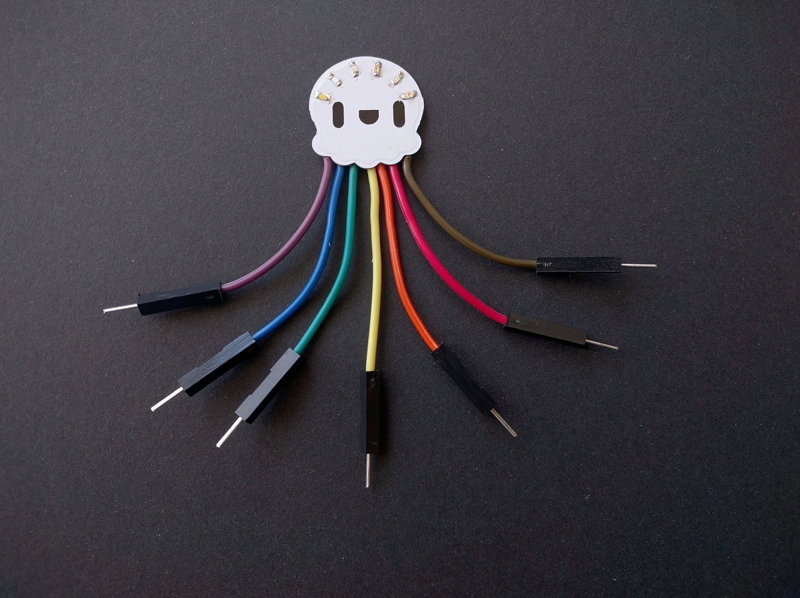
If you hang out at Hackaday.io much, you’ll recognize [ꝺeshipu] and his entry was one of those things that you immediately know you could use, but also brings a little smile to your face when you use it. How often do you need to plug some LEDs into a breadboard? Why not do it with a Rainbow Jellyfish?
The circuit operation should be obvious. We really liked the color-coded wiring. You could probably use at least two of these so they could keep each other company. You could probably even use this as part of a badge.
Best Social Media Award
Speaking of badges, [nwmaker] built a badge that looks like another animal — an owl called PurpleSnowy. Again, the circuit is simple enough, but what caught our eye on this project was how well the social media promotion of it was. Maybe cute owls are just easier to go viral, but we liked it.
Best Documentation
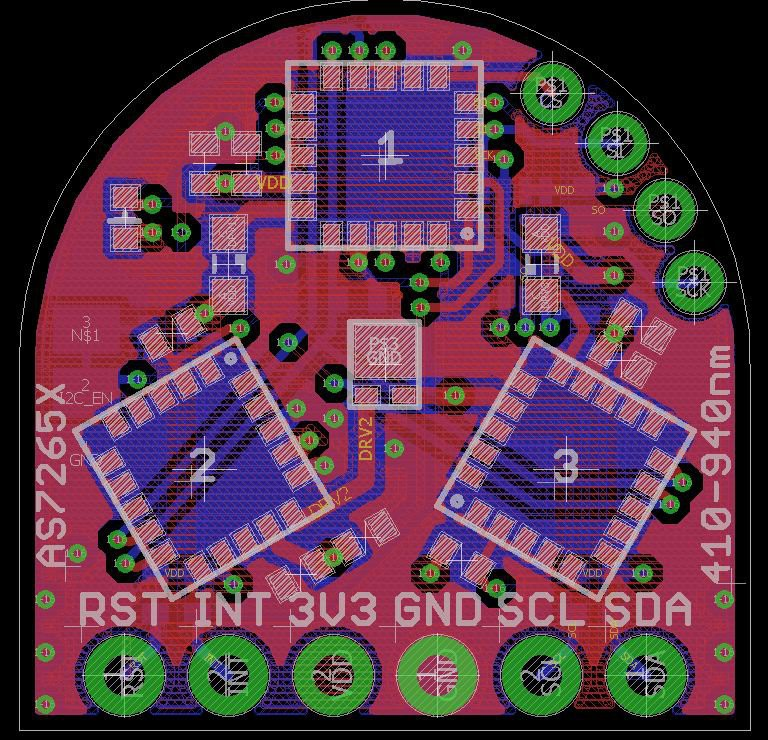
[Kris Winer] (remember that name), built a very high-tech spectrometer project. Not only was it small in size, but at $25 it was also small in price. The project used the AMS AS7265X 3-chip set to provide an 18 channel, 20 nm FWHM spectrometer. The documentation was very well done and we were impressed with the fitment of the chips on the board.
Many Runners-Up
We had so many great entries that it was hard to pick so we named several runners-up.
[Greg Davill’s] Bosun frame grabber that uses an FPGA to capture images from a FLIR Boson camera.
[Kris Winer’s] high-tech $25 spectrometer project (from above) was also runner-up, and [Kris] was also recognized for sensors that can smell and hear.
If you want something less science-related, the Rotovis-Mod1 by [zakqwy] makes it easier to build persistence of vision displays. Of course, as hackers, we love an oscilloscope and [Mark Omo’s] 20 msps scope that fits in one inch caught our imagination for making some really cool instrument panels.
You really should look at all the entries — they were amazing. [Kris] really went all out, taking two runner up slots and the best documentation prize.
Recap:
Speaking of prizes, The grand prize was $500, and the other prizes received $100 Tindie gift certificates. Thanks to OSH Park, the runner ups also got $100 OSH Park gift cards — that’s a lot of one inch PCBs.
Will this be our last inch square contest? The magic 8 ball says probably not, so don’t stop thinking small and look for your chance to enter your design in the next contest.
Science fiction is usually couched in fact, and it’s fun to look at an iconic computer like HAL 9000 and trace the origins of this artificial intelligence gone wrong. You might be surprised to find that you can trace HAL’s origins to a computer built for the US Army in 1952.
If you are a fan of the novel and movie 2001: A Space Oddessy, you may recall that the HAL 9000 computer was “born” in Urbana, Illinois. Why pick such an odd location? Urbana is hardly a household name unless you know the Chicago area well. But Urbana has a place in real-life computer history. As the home of the University of Illinois at Urbana–Champaign, Urbana was known for producing a line of computers known as ILLIAC, several of which had historical significance. In particular, the ILLIAC IV was a dream of a supercomputer that — while not entirely successful — pointed the way for later supercomputers. Sometimes you learn more from failure than you do successes and at least one of the ILLIAC series is the poster child for that.
The Urbana story starts in the early 1950s. This was a time when the 1945 book “First Draft of a Report on the EDVAC” was sweeping through the country from its Princeton origins. This book outlined the design and construction of the Army computer that succeeded ENIAC. In it, Von Neumann proposed changes to EDVAC that would make it a stored program computer — that is, a computer that treats data and instructions the same.
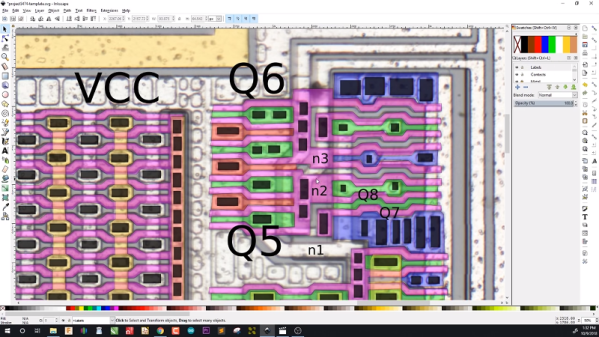
ICs have certainly changed electronics, but how much do you really know about how they are built on the inside? While decapsulating and studying a modern CPU with 14 nanometer geometry is probably not a great first project, a simple 54HC00 logic gate is much larger and much easier to analyze, even at low magnification. [Robert Baruch] took a die image of the chip and worked out what was going on, and shares his analysis in a recent video. You can see that video, below.
The CMOS structures are simple because a MOSFET is so simple to make on an IC die. The single layer of aluminum conductors also makes things simple.