Be The Electronic Chameleon

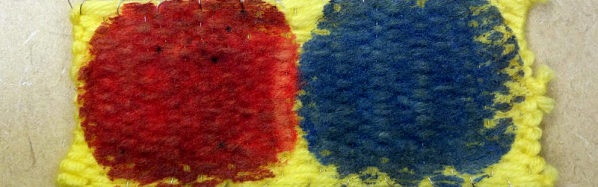
If you want to work with wearables, you have to pay a little more attention to color. It is one thing to have a 3D printer board colored green or purple with lots of different color components onboard. But if it is something people will wear, they are going to be more choosy. [Sdekon] shows us his technique of using Leuco dye to create items that change color electrically. Well, technically, the dye is heat-sensitive, but it is easy to convert electricity to heat. You can see the final result in the video, below.

The electronics here isn’t a big deal — just some nichrome wire. But the textile art processes are well worth a read. Using a piece of pantyhose as a silk screen, he uses ModPodge to mask the screen. Then he weaves nichrome wire with regular yarn to create a heatable fabric. Don’t have a loom for weaving? No problem. Just make one out of cardboard. There’s even a technique called couching, so there’s lots of variety in the textile arts used to create the project.


Continue reading “Be The Electronic Chameleon”

Looking Back At Microsoft Bob

Every industry has at least one. Automobiles had the Edsel. PC Hardware had the IBM PCJr and the Microchannel bus. In the software world, there’s Bob. If you don’t remember him, Bob was Microsoft’s 1995 answer to why computers were so darn hard to use. [LGR] gives us a nostalgic look back at Bob and concludes that we hardly knew him.

Bob altered your desktop to be a house instead of a desk. He also had helpers including the infamous talking paper clip that suffered slings and arrows inside Microsoft Office long after Bob had been put to rest.

Continue reading “Looking Back At Microsoft Bob”

Biologic Additive May Lead To Self-Healing Concrete

If you get a cut or break a bone, your body heals itself. This everyday miracle is what inspired [Congrui Jin] to try to find a way to make concrete self-healing. The answer she and her colleagues are working on might surprise you. They are adding fungus to concrete to enable self-repair.

It isn’t just any fungus. The conditions in concrete are very harsh, and after testing twenty different kinds, they found that one kind — trichoderma reesei — could survive inside concrete as spores. This fungus is widespread in tropical soil and doesn’t pose any threat to humans or the ecology. Mixing nutrients and spores into concrete is easy enough. When cracks form in the concrete, water and oxygen get in and the spores grow. The spores act as a catalyst for calcium carbonate crystals which fill the cracks. When the water is gone, the fungi go back to spores, ready to repair future cracking.

Continue reading “Biologic Additive May Lead To Self-Healing Concrete”

Make Your Own Current Clamp Probe

If you want to measure AC or DC current with an oscilloscope, a current clamp is a great way to do it. The clamp surrounds the wire, so you don’t need to break the connection to take your measurements. These used to be expensive, although we’ve seen some under $100, if you shop. We don’t know if it was cost or principle that motivated [Electronoobs] to build his own current clamp, but he did.

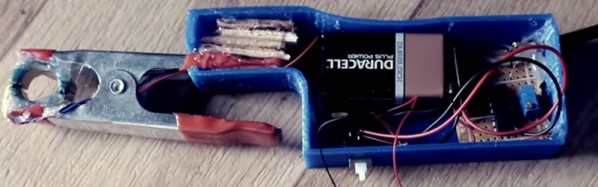
This probe design is little more than a 3D printed case, an old power supply toroid, and a conventional alligator clamp to make the business end. The sensor uses a ferrite core and a hall effect sensor. The ferrite toroid is split in half, one half in each side of the clamp. An opamp circuit provides a gain of 100 to boost the hall effect sensor’s output.

In addition to building a homebrew probe, the video also shows a teardown of a Hantek current probe and explains the theory behind the different kinds of current probes, including some tricks like using a compensation winding to prevent core magnetization.

Does it work? You bet. After calibration, it did just fine. It’s not as pretty as a $100 unit, but beauty is in the eye of the beholder, and we are suckers for homebrew gear so we will say it is certainly more interesting. If you have a fair junk box (and a 3D printer), this probe could be made very inexpensively. The hall effect and a BNC connector are likely to be the most expensive parts. Even if you bought everything and used a non-printed case, we would be hard-pressed to think you’d spend more than $25.

If you want to see how the big boys do it, Keysight had a good break down last year. We’ve seen other homebrew builds for current probes and some of them are very accurate.

Continue reading “Make Your Own Current Clamp Probe”

Arrow’s $30 FPGA Board Reviewed

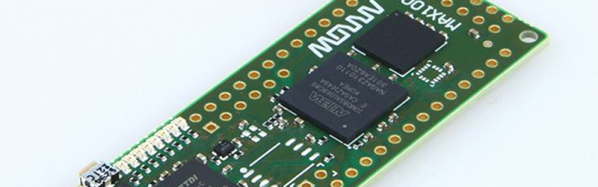
We like cheap FPGA boards. It isn’t just that we’re cheap — although that’s probably true, too — but cheap boards are a good way to get people started on FPGAs and we think more people should be using FPGAs more often. One inexpensive board is the Max-1000 from Trenz and Arrow. At $29, it is practically an impulse buy. [ZipCPU] did a great write up on his experience using the board. He found that some of it was good, some was bad, and some was just plain ugly. Still, for $30, it seems like this might be a nice board for some applications or for getting started.

Billed an IoT Maker Board, the tiny board sports a Intel (formerly Altera) MAX10 device with 8,000 logic elements, a USB programming interface onboard, 8 MB of SDRAM, and both PMOD and Arduino MKR headers. The MAX10 has an analog to digital conversion block (with an analog mux for up to nine channels) and the ability to host a 32-bit soft controller onboard, too.

Continue reading “Arrow’s $30 FPGA Board Reviewed”

Students Hack An Unusual Violin

[Sean Riley] is a violinist who had a problem. He wanted to play one particular piece, but he couldn’t. It wasn’t that he lacked the skill — he a doctoral student at the University of Texas and has two degrees in violin performance from The Julliard School. The problem was that “The Dharma at Big Sur” by [John Adams] is made for an instrument with six strings, while most violins only have four. So he did what any of us would do. He stopped by the local hackerspace and fabricated one. You can hear (and see) [Sean] performing with the instrument in the video, below.

The University of Texas operates “The Foundry” which is a hackerspace with all the usual items: laser cutters, 3D printers, and the like. It is open to all their students and staff. [Sean] needed some help with the engineering, and was lucky to find a mechanical engineering senior, [Daniel Goodwin], working at The Foundry.

Continue reading “Students Hack An Unusual Violin”

Search For Military Satellite Finds One NASA Lost Instead

[Scott Tilley] was searching for radio signals from the Air Force’s top-secret ZUMA satellite. He found something that is — we think — much more interesting. He found NASA’s lost satellite called IMAGE. You are probably wondering why it is interesting that someone listening for one satellite found another one. You see, NASA declared IMAGE dead in 2005. It went silent unexpectedly and did not complete its mission to image the magnetosphere.

NASA did a failure review and concluded that in all likelihood a single event upset caused a power controller to trip. A single event upset, or SEU, is a radiation event and should have been automatically recovered. However, there was a design flaw that failed to report certain types of power controller failures, including this one.

The report mentioned that it might be possible to reset the controller at a specific time in 2007, but given that NASA thought the satellite was out of commission that either never occurred or didn’t work. However, something apparently woke the satellite up from its sleep.

[Scott] did a lot of number crunching to determine that the satellite’s spin rate had only decreased a little from its operational value and that the doppler data matched what he expected. [Scott] can’t read or command the telemetry, so he doesn’t know how healthy the satellite is, but it is at least operational to some degree. It’s really neat to see members of the team that worked on IMAGE leaving comments congratulating [Scott] on the find. They are working to get him data formatting information to see if more sense can be made of the incoming transmissions.

Who knew listening to satellites could be so exciting? If you want to build your own ground station, you might be interested in this antenna mount. If you need to know what’s overhead, this can help.