Graphene Refractions

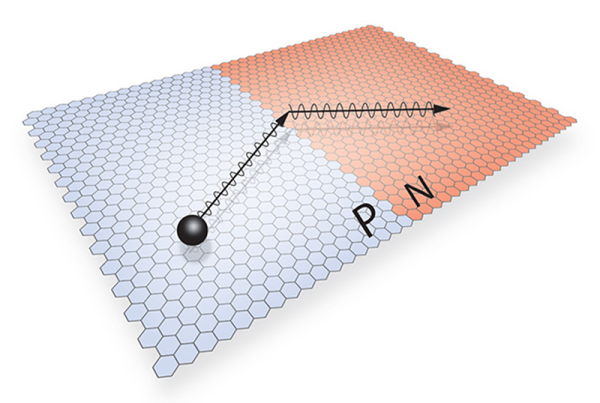
Researchers recently observed negative refraction of electrons in graphene PN junctions. The creation of PN junctions in graphene is quite interesting, itself. Negative refraction isn’t a new idea. It was first proposed in 1968 and occurs when a wave bends–or refracts–the opposite way at an interface compared to what you would usually expect. In optics, for example, this can allow for refocusing divergent waves and has been the basis for some proposed invisibility cloaking devices.

In theory, negative refraction for electrons should be easy to observe at PN junctions, but in practice, the band gap voltage causes most electrons to reflect at the junction instead of refract. However, a graphene PN junction has no band gap voltage, so it should be ideal. However, previous attempts to find negative refraction in graphene were not successful.

Continue reading “Graphene Refractions”

Skynet Takes Over…Academia?

A telescope isn’t an unusual thing to own if you are technically inclined. You might have even made one, at some point. However, despite improvements in optical technology and computer aiming devices, your four to twenty-inch instrument is never going to show you images like you see from big giant telescopes. The problem is, going really big requires a lot of investment in time, money, and sometimes even real estate. The big scopes get buildings constructed for them, and in exotic locations; why would you build a 24-inch scope only to try to see through the light pollution in your backyard?

Here’s an idea: take an astronomy class at a college and use their big telescope. Well, who has the time and money for that? Actually, you do. Skynet is a global network of telescopes headquartered at the University of North Carolina. As part of their mandate, they offer several tuition-free astronomy classes over the Internet. The best part? You also get free time on Skynet’s telescopes to complete your class assignments. There is a small fee (between $45 and $65) to a “benefit corporation” to administer assignments. You do get a certificate upon graduation. If you don’t want to do the assignments and you don’t want a certificate, you can still “take” the classes by simply watching them on YouTube. You can see one of the classes in the video below.

Continue reading “Skynet Takes Over…Academia?”

Honey, They Shrunk The Transistor

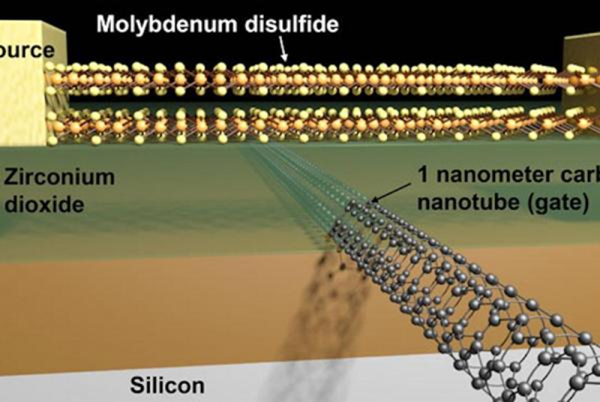
Silicon transistors keep shrinking (current state of the art is about 20 nanometers). However–in theory–once the gate goes to 5 nanometers, the electrons tunnel through the channel making it impossible to turn the transistor off. Berkeley researchers have used a different material to produce a transistor with a 1-nanometer gate. For point of reference, a human hair is about 50,000 nanometers thick.

The secret is to switch away from silicon in favor of another semiconductor. The team’s choice? Molybdenum disulfide. Never heard of it? You can buy it at any auto parts store since it is a common lubricant. Electrons have more effective mass as they travel through molybdenum disulfide than silicon. For a larger transistor, that’s not a good thing, but for a small transistor, it prevents the electron tunneling problem.

Continue reading “Honey, They Shrunk The Transistor”

Raspberry Pi Boots CP/M

Retrocomputing is an enjoyable and educational pursuit and — of course — there are a variety of emulators that can let you use and program a slew of old computers. However, there’s something attractive about avoiding booting a modern operating system and then emulating an older system on top of it. Part of it is just aesthetics, and of course the real retrocomputing happens on retro hardware. However, as a practical matter, retrocomptuters break, and with emulation, you’d assume that CPU cycles spent on the host operating system (and other programs running in the background) will take away from the target retrocomputer.

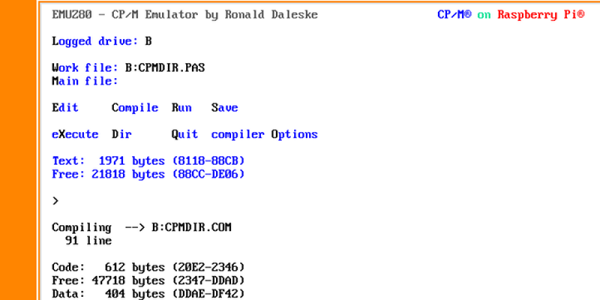
If you want to try booting a “bare metal” Z80 emulator with CP/M on a Raspberry Pi, you can try EMUZ80 RPI. The files reside on an SD card and the Pi directly boots it, avoiding any Linux OS (like Raspian). It’s available for the Raspberry Pi Model B, A+, and the Raspberry Pi 2 Model B. Unlike the significant boot times of the standard Linux distros on the earliest models of Pi, you can boot into CP/M in just five seconds. Just like the old days.

The secret to this development is an open source system known as Ultibo, a framework based on Open Pascal which allows you to create bare metal applications for the Raspberry Pi. The choice of Free Pascal will delight some and annoy others, depending on your predilections. Ultibo is still very much in active development, but the most common functions are already there; you can write to the framebuffer, read USB keyboards, and write to a serial port. That’s all you really need to make your own emulator or write your own Doom clone. You can see a video about Ultibo (the first of a series) below.

Continue reading “Raspberry Pi Boots CP/M”

Beware Common Sense Engineering

I am always torn about the title of “engineer.” When I talk to school kids about engineering, I tell that an engineer is a person who uses science and math to solve or analyze practical problems. However, these days you hear a lot of engineering titles thrown around to anyone who does any sort of technical (and sometimes non-technical) work. “Software engineers” don’t have to be licensed to practice, while civil engineers do. What’s in a name and does any of this matter?

Continue reading “Beware Common Sense Engineering”

TensorFlow Robot Recognizes Objects

Children can do lots of things that robots and computers have trouble with. Climbing stairs, for example, is a tough thing for a robot. Recognizing objects is another area where humans are generally much better than robots. Kids can recognize blocks, shapes, colors, and extrapolate combinations and transformations.

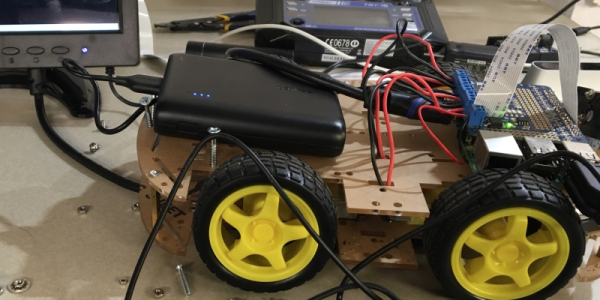
Google’s open-source TensorFlow software can help. It is a machine learning system used in Google’s own speech recognition, search, and other products. It is also used in quite a few non-Google projects. [Lukas Biewald] recently built a robot around some stock pieces (including a Raspberry Pi) and enlisted TensorFlow to allow the robot to recognize objects. You can see a video of the device, below.

Continue reading “TensorFlow Robot Recognizes Objects”