Messages From Hell: Human Signal Processing

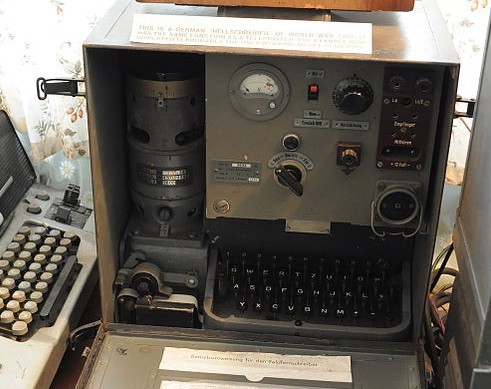
Despite the title, there’s no religious content in this post. The Hell in question is the German inventor [Rudolph Hell]. Although he had an impressive career, what most people remember him for is the Hellschreiber–a device I often mention when I’m trying to illustrate engineering elegance. What’s a Hellschreiber? And why is it elegant?

The first question is easy to answer: the Hellschreiber is almost like a teletype machine. It sends printed messages over the radio, but it works differently than conventional teletype. That’s where the elegance comes into play. To understand how, though, you need a little background.

Continue reading “Messages From Hell: Human Signal Processing”

Pewter Casting With PLA

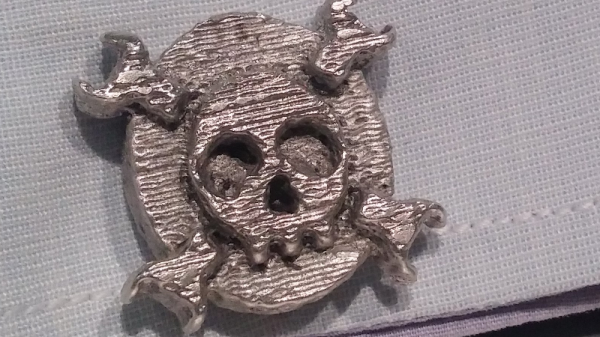
Over on Hackaday.io, [bms.had] is showing his technique for 3D printing molds that he uses to cast (lead-free) pewter objects. The process looks simple enough, and if you have a 3D printer, you only need some lead-free pewter, a cheap toaster oven, and PLA filament. He’s made two videos (below) that do an excellent job of showing the steps required.

Even though the pewter is hot enough to melt the PLA, it doesn’t appear to be a major problem if you quench the piece fast enough. According to [bms.had], a slower quench will melt some PLA although that creates a smoother surface. You can see the 0.31 mm layer lines in the cast, though, although you can use any layer height you like to control that. Creating the mold is simple (the videos use Tinkercad, although anything suitable for creating 3D models would work). You essentially attach a funnel to your part and make the entire part a hole inside an enveloping shape.

Continue reading “Pewter Casting With PLA”

PSoC VGA On A $10 Development Board

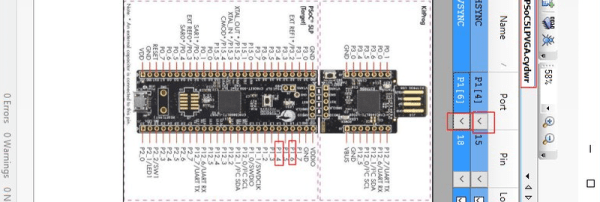
We’ve always found the Cypress PSoC an interesting beast. It’s a CPU with functional blocks that you can configure to build various I/O devices, including incorporating FPGA logic using Verilog. [MiguelVP] has an excellent multi-part project that produces VGA output from a PSoC. So far it just generates a fixed pattern, but a frame buffer is in the works, and there is plenty of detail about how to configure the PSoC for the task.

Although the PSoC has some analog capability, [MiguelVP] uses a cheap R2R DAC and VGA connector to interface to the VGA monitor. You can get the same PSoC board the project uses for about $10. The software, unfortunately, is Windows-only, so be prepared to fire up a virtual machine if you run Linux or Mac. Our own [Bil Herd] did a video introduction to PSoC that you can watch after the break.

Continue reading “PSoC VGA On A $10 Development Board”

Little Helper: Open Source Hardware Hacker Multitool

We love a good multitool. There’s something seductive about knowing that if, for some reason, you need to saw down a tree on a moment’s notice, you have a tiny saw in your pocket. We also like electronic versions of the multitool: gadgets that serve a lot of purposes as you develop and debug hardware. One of the most polished-looking ones we’ve seen is [Phillip Schuster’s] Little Helper.

The open source gadget looks like an iPod (if an iPod had header pins sticking out of it). It has basic analog I/O capability, can generate PWM pulses, sniff I2C traffic, and do lots of other features. It is open source, so you can always add more capabilities if you need them.

Continue reading “Little Helper: Open Source Hardware Hacker Multitool”

You Can Learn A Lot From A Dummy (Load)

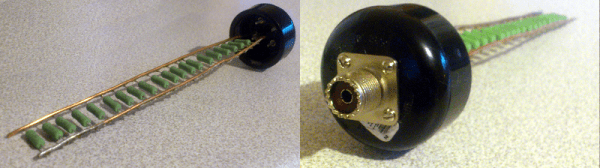
If you work on RF circuits–even if you aren’t a ham radio operator–you ought to have a dummy load. A dummy load is a non-radiative “antenna” with known impedance that you can use to test your RF circuit without radiating. For radio work, you usually just need a 50-ohm resistor that is non-inductive (at least at the frequencies you are interested in) and that can dissipate the amount of power you’ll expect it to handle (at least for a short time). [VO1PWF] wanted a dummy load and built his own.
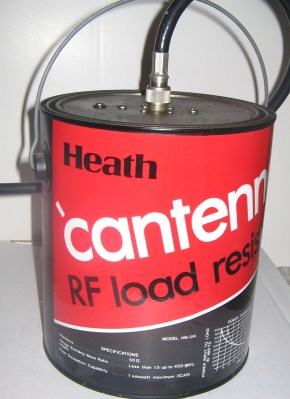
CantennaThe Cantenna (not the Pringle’s kind; see right) was a famous dummy load design when Heathkit was in business. It was a single carbon rod immersed in a paint can full transformer oil (which we now know was full of dangerous PCBs; and we don’t mean printed circuit boards). [VO1PWF’s] design is a little more practical, using some resistors in parallel (20 1K resistors), a plastic pipe housing, and mineral oil to keep it all cool.

The reason for the parallel resistors is to maximize the power handling capability. The resistors are 3W units, so the dummy load–in theory–can handle 60 watts. Often, high power resistors are wire wound and thus have a good bit of parasitic inductance that makes the dummy load reactive (not a good thing since that makes the load impedance vary by frequency). They do make non-inductive wire wound resistors, but these aren’t truly non-inductive. The wire winds in two different directions, so the inductance tends to cancel out. We wouldn’t trust them to be a pure resistance in a high-power dummy load design.

Continue reading “You Can Learn A Lot From A Dummy (Load)”

3D Printed RC Servo To Linear Actuator Conversion

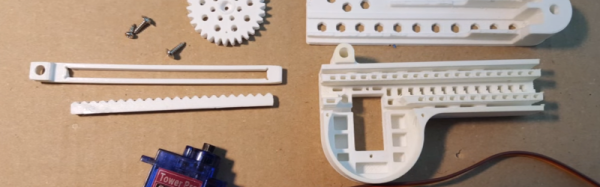
RC servos are handy when you need to rotate something. You can even modify them to rotate continuously if that’s what you need. However, [Roger Rabbit] needed linear motion, but wanted the simple control afforded by an RC servo. The solution? A 3D printed housing that converts a servo’s rotation into linear motion.

The actuator uses five different parts, a few screws, and a common RC servo. The video shows the actuator pushing and pulling a 200g load with a 6V supply. There’s some room for adjustment, so different servos should work.

Continue reading “3D Printed RC Servo To Linear Actuator Conversion”

Electrolytic Capacitor Repair

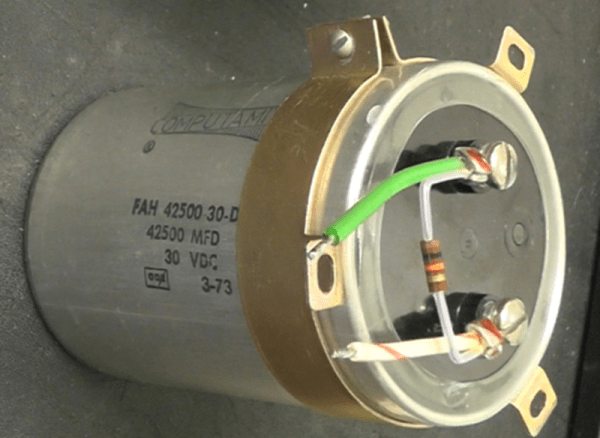
If you’ve ever worked on old gear, you probably know that electrolytic capacitors are prone to failure. [Dexter] undertook a repair of some four-decade-old capacitors in a power supply. He didn’t replace them. He fixed the actual capacitors.

The reason these units are prone to fail is the flip side of what people like about electrolytics: high capacitance in a small package. In a classic parallel plate capacitor, the capacity goes up as the distance between the plates shrinks. In an electrolytic, one plate is a rolled up spiral. The other plate is conductive fluid. The insulator between (the dielectric) is a very thin layer of oxide that forms on the spiral. Over time, the oxide degrades, but this degradation repairs itself when using the capacitor. If the capacitor isn’t powered up for an extended period, the oxide will degrade beyond the point of self-repair.

Continue reading “Electrolytic Capacitor Repair”