Phone Scope Build Uses Old Optical Drive

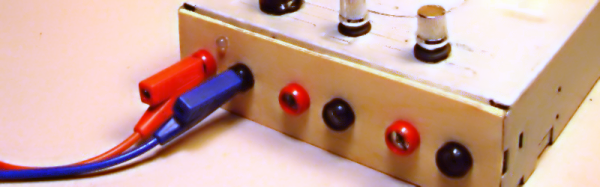
It is hardly news that you can use your smart phone as a really crummy oscilloscope. You can even use it as an audio frequency signal generator. There are also plenty of projects that allow you to buffer signals going in and out of your phone to make these apps more useful and protect your phone’s circuitry to some degree. What caught our eye with [loboat’s] phone oscilloscope project was its construction.

Continue reading “Phone Scope Build Uses Old Optical Drive”

Steal This Ham Radio (Technology)

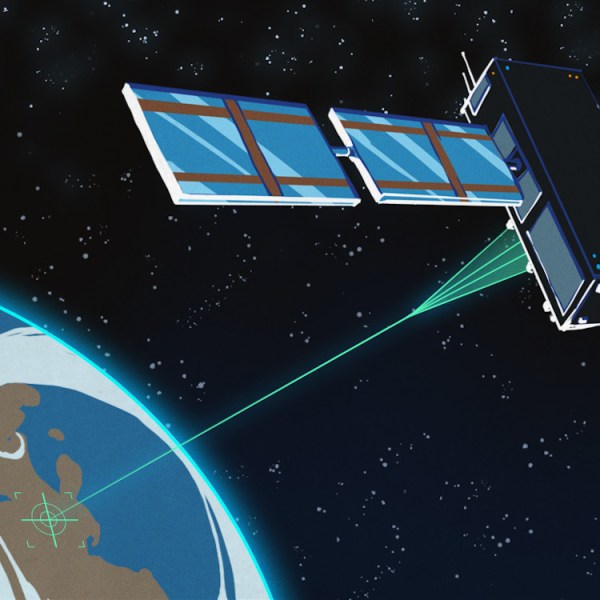
Although I see a lot of wireless projects, I’m always surprised at the lack of diversity in the radio portions of them. I’m a ham radio operator (WD5GNR; I was licensed in 1977) and hams use a variety of radio techniques. If you think hams just use Morse code and voice communications, you are thinking of your grandfather’s ham radio. Modern hams have gone digital and communicate via satellites, video, and many different digital techniques that could easily have applicability to different wireless projects.

Of course, Morse code may have been one of the first digital modes. But hams have used teletype, FAX, and other digital modes for years. Now with PCs and soundcards in common use, hams have been on the forefront of devising sophisticated digital radio techniques.

Continue reading “Steal This Ham Radio (Technology)”

Aerogel Insulation For 3D Printers

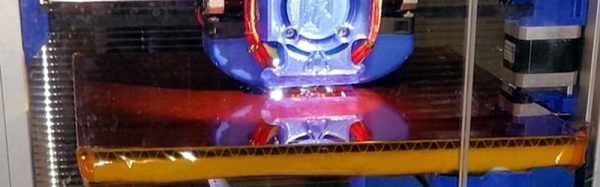
A heated bed is nearly essential for printing with ABS. Without it, it is difficult to keep parts from warping as the plastic cools. However, heating up a large print bed is difficult and time consuming. It is true that the printer easily heats the hot end to 200C or higher and the bed’s temperature is only half of that. However, the hot end is a small insulated spot and the bed is a large flat surface. It takes a lot of power and time to heat the bed up and keep the temperature stable.

We’ve used cork and even Reflectix with pretty good results. However, [Bill Gertz] wasn’t getting the performance he wanted from conventional material, so he got a piece of aerogel and used it as insulation. Aerogel material is a gel where a gas replaces the liquid part of the gel. Due to the Knudsen effect, the insulating properties of an aerogel may be greater than the gas it contains.

Continue reading “Aerogel Insulation For 3D Printers”

Video FPGA With No External A/D

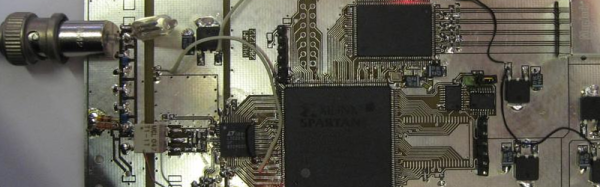
You have an old PC with a nonstandard RGB video out and you need to bring it to a modern PAL TV set. That’s the problem [svofski] had, so he decided to use an Altera-based DE1 board to do the conversion. Normally, you’d expect reading an RGB video signal would take an analog to digital converter, which is not typically present on an FPGA. Instead of adding an external device, [svofski] used a trick to hijack the FPGA’s LVDS receivers and use them as comparators.

Continue reading “Video FPGA With No External A/D”

Pulse Density Modulation

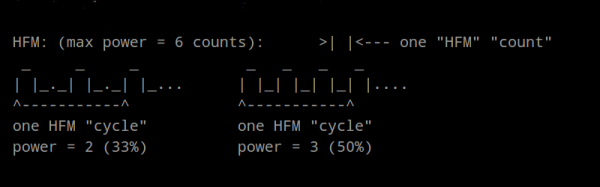
[esot.eric] was trying to drive a motor and naturally thought of using pulse width modulation (PWM) to control the motor speed. However, he found that even with a large capacitor, his underpowered power supply would droop before the PWM cycles were complete. So instead of PWM he decided to experiment with pulse density modulation.

The idea is to use smaller pulses over a longer period of time and make the average power equal to the percentage motor speed desired. With a PWM system, for example, if the time period is T, a 50% PWM drive would have the  drive high for T/2 and low for the other half of the cycle. With pulse density, each pulse might be T/10 (as an example) and then the output would be on for 1/10, off for 1/10, on for 1/10 and so on, until by time T you’d still get to 50%. The advantage is the output capacitor gets a kick more often and has less opportunity to droop.

Continue reading “Pulse Density Modulation”

Understanding Surface Mount

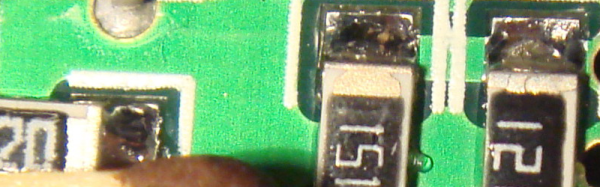
Do you know what a MELF is (and, yes, it is safe for work to Google it)? What’s the difference between a QFP, and LCC, and a PLCC package? Do you need a 0603 resistor or a 1206 resistor?

If you are an old hand at surface mount devices (SMDs) you probably know the answers to most of these questions. But if you’ve done most of your work with through hole, it is a confusing mess of acronyms and numbers. Sure, you can Google and find out that at 0603 resistor is .06 inches by .03 inches. [TopLine] has a great booklet that pulls many common definitions in one place available for download that can help you make sense of different SMD nomenclature.

Continue reading “Understanding Surface Mount”

Managing An Unmanaged Switch

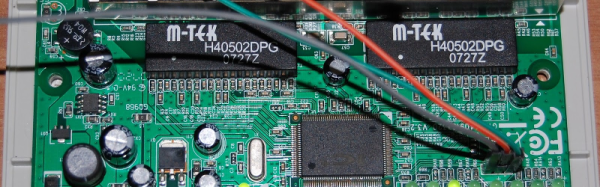
Network switches come in two different flavors: managed, where you have some interface to configure and monitor the equipment, and unmanaged where the device just does what it is supposed to do and you can’t really control it. [Tiziano Bacocco] wanted to manage his cheap unmanaged switch, so he did what any good hacker would do: he opened it up.

Inside the Digicom 10/100 switch he found an IP178CH controller IC and a quick search turned up a data sheet. [Tiziano] noticed there were three ways to configure the switch: Some hardware pins could control very basic functions; an EEPROM (absent on the PCB) could configure the device; or the chip would accept commands via a synchronous serial port.

Since the datasheet covered the protocol required, [Tiziano] commandeered an Arduino Pro Mini and used it to send commands to configure the switch. A few resistors and some quick code allowed him to control VLAN and other functions on the switch via the USB port. Of course, he mentioned you could use a Raspberry Pi if you wanted a network interface–or maybe that’s a good excuse to use one of those Ethernet shields you got on clearance at Radio Shack.

Continue reading “Managing An Unmanaged Switch”