How To Make A Hugo (Base)

A lot of hackers like science fiction. If you aren’t one of them, you might not know that the Hugo is a prestigious science fiction award handed out at the World Science Fiction Convention every year. The statue looks like a rocket ship, but every year the base the rocket ship rests on is different. Kinetic sculptor [gfish] realized the convention would be in Spokane (his hometown and near his current residence) and decided to enter the competition to create the bases. He won, so the 2015 Hugos all have [gfish’s] bases on them and it’s pretty neat that he’s shared the process he used to make them.

Continue reading “How To Make A Hugo (Base)”

Orange Is The New ($15) Pi

When the Raspberry Pi came on the scene it was hard to imagine that you could get a fairly complete Linux system for such a low price. The Pi has gotten bigger, of course, but there are still a few things you miss when you try to put one into a project. Wifi, comes to mind, for example. The first thing you usually do is plug a Wifi dongle in, consuming one of the two USB ports.

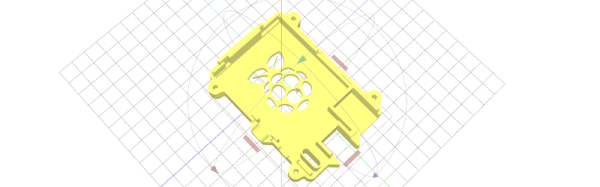
The Orange Pi is a direct competitor and has a few variants. Originally, the board cost about $30 but sports WiFi, a 1.6 GHz processor, 8 GB of flash, and a SATA interface. There’s now a reduced version of the board for about $15 that deletes the flash and SATA along with the WiFi and one of the original’s 4 USB ports. Still, the Raspberry Pi doesn’t have built-in flash. And the $15 Orange Pi PC has the things you’d expect on a Pi (HDMI and Ethernet) along with other extras like an IR receiver and an on-board microphone. Not bad for $15 considering it has a quad-core processor, a GPU and 1GB of RAM. Continue reading “Orange Is The New ($15) Pi”

Better TV Via Hacking

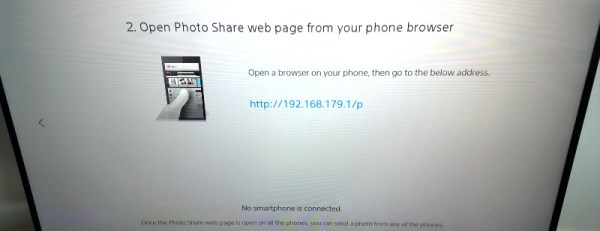
Smart TVs are just dumb TVs with a computer and a network connection, right? In a variation of rule 34, if it has a computer in it, someone will hack it. When [smarttvhacker] bought a Sony 48 inch smart TV, he noticed all the software licenses listed in the manual and realized that was a big leg up into hacking the TV.

We don’t have a comparable Sony model, but [smarttvhacker’s] post is a veritable travel log of his journey from TV viewer to TV ruler. By analyzing everything from network port scans to a dump of a firmware upgrade, he wound up being able to install a telnet server.

Continue reading “Better TV Via Hacking”

Learn 3D Modeling In Your Browser

If you have a 3D printer, it is a good bet you’ve at least seen or heard of Tinkercad. There’s pros and cons to doing your design in a Web browser, but Tinkercad is very easy to use and great for making simple objects. However, there are other 3D object designers you can use in your browser, too. Tinkercad is just the one that everyone seems to know about.

I won’t talk much about Tinkercad, but if you haven’t tried it, it is well worth a look. It has a simple system of drawing things and holes. When you merge holes with things you can make lots of shapes. The alignment tools are good, and since Autodesk acquired them (part of its 123d app suite), it isn’t likely they will go under any time soon (which, as you may remember, almost happened).

If you are designing some great new secret invention you may shy away from cloud-based design programs. But if you are printing out key chains with your coworker’s cat’s name on it, do you really care? Most of these cloud-based programs will work from any computer so you can quickly do a design in a coffee shop and then go home and print it.

Continue reading “Learn 3D Modeling In Your Browser”

Why IoT Will Fail (and How To Save It)

Buzzword technology has two possible fates: they fail and disappear or they succeed and disappear. Remember at one time “multimedia” and “networking” were buzzwords. They succeeded and now they’ve vanished into ubiquity. Of course, there are plenty of failed buzzwords (like telecosm) that you probably don’t even remember. They just vanished into obscurity.

Unless you’ve been living under the CNC mill in your local hackerspace, you’ve probably heard or read about the “Internet of Things” (IoT). Companies big and small have realized that getting in early on The Next Big Thing is good for share prices and, right now, IoT is where everyone is trying to make a play.

There’s two things I’d observe, though: First, IoT is far from new. Connecting embedded systems to the Internet is old hat (I even wrote a book called Embedded Internet Design way back in 2003). Second, the way it is going, IoT–in its current incarnation–is doomed.

Continue reading “Why IoT Will Fail (and How To Save It)”

Hack An Editor: Fonts For Programming

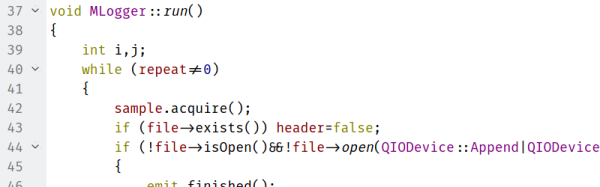
We’ve recently noticed two different fonts aimed at programmers, each with a different approach to editor customization. The first, Fira Code, transparently converts common programming digraphs into single characters. For example, <- becomes an arrow and != (or <>) becomes a proper not equal sign. The other font, Hack (can’t argue with the name), aims to make commonly confused characters distinct. For example, the zero glyph has a very distinct appearance from the letter O.

It is pretty easy to understand how Hack works, but Fira seems a mystery at first. Your C++ compiler expects <- not an arrow, right? Fonts support ligatures–sequences of two symbols that run together (like æ). Clever use of these ligatures means that the compiler still sees -> but the screen displays an arrow.

Continue reading “Hack An Editor: Fonts For Programming”

3D Objects From A Laser Cutter

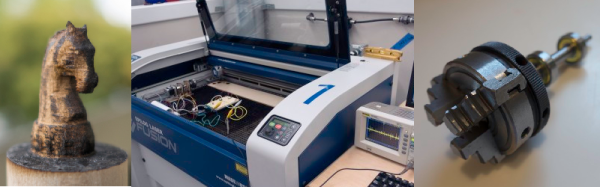
Actors want to be singers and singers want to be actors. The hacker equivalent to this might be that 3D printers want to be laser cutters or CNC machines and laser cutters want to be 3D printers. When [Kurt] and [Lawrence] discovered their tech shop acquired a 120 Watt Epilog Fusion laser cutter, they started thinking if they could coax it into cutting out 3D shapes. That question led them to several experiments that were ultimately successful.

The idea was to cut away material, rotate the work piece, and cut some more in a similar way to how some laser cutters handle engraving cylindrical objects. Unlike 3D printing which is additive, this process is subtractive like a traditional machining process. The developers used wood as the base material. They wanted to use acrylic, but found that the cut away pieces tended to stick, so they continued using wood. However, the wood tends to char as it is cut.

In the end, they not only had to build special jigs and electronics, they also had to port some third party control software to solve some issues with the Epilog Fusion cutter’s built in software. The final refinement was to use the laser’s raster mode to draw surface detail on the part.

The results were better than you’d expect, and fairly distinctive looking. We’ve covered a similar process that made small chess pieces out of acrylic using two passes. This seems like a natural extension of the same idea. Of course, there are very complicated industrial machines that laser cut in three dimensions (see the video below), but they are not in the same category as the typical desktop cutter.

Continue reading “3D Objects From A Laser Cutter”