Furter Burner Cooks The Wieners Just So

Sometimes you’re hungry for two sausages, and not a sausage more. [Wesley] designed his Furter Burner to handle precisely these situations, and it looks to cook up a pair of wieners a treat. (Video, embedded below.)

The process starts with a couple of wooden stunt wieners, and some foam board, with which [Wesley] roughs out a design. From there, a CAD design is drawn up and parts routed out of compressed board to troubleshoot the assembly further. Later moving on to a plywood version, having a wooden prototype quickly reveals plenty of things to improve, from adding handles to the grill surface to air holes to allow combustion.

The design goes through a couple of further iterations in metal before completion. The final result is impressive—resulting in a twin-wiener cooker that burns coals, complete with skewers for easy sausage handling and bearing [Wesley’s] own logo.

The video shows off the benefits of the iterative design process. It also demonstrates why it often makes sense to rough out designs in cheaper materials before going to the heavy stuff, particularly in a case like [Wesley]’s where the metal parts can only be cut off-site. Refining the design in-house first saves a lot of mucking around.

We’ve seen [Wesley]’s work before, too – like this impressive workshop storage solution.

Continue reading “Furter Burner Cooks The Wieners Just So”

Yes, You Can Put Out A Burning Gas Well With A Nuclear Bomb

Nuclear explosives were first developed as weapons of war in the pitched environment of World War II. However, after the war had passed, thoughts turned to alternative uses for this new powerful technology. Scientists and engineers alike dreamed up wild schemes to dig new canals or blast humans into space with the mighty power of the atom.

Few of these ever came to pass, with radiological concerns being the most common reason why. However, the Soviet Union did in fact manage to put nuclear explosions to good use for civilian ends. One of the first examples was using a nuke to plug an out-of-control gas well in the mid 1960s.

Continue reading “Yes, You Can Put Out A Burning Gas Well With A Nuclear Bomb”

Bicycles Are Bad At Towing, Even With Crawler Gears

Gearing can make a huge difference to a cyclist, enabling even the least fit rider to climb a steep hill, albeit slowly. [Berm Peak Express] took that to the next level, creating a super-low geared bicycle capable of actually towing seriously heavy loads.

The build consists of a custom 74-tooth sprocket for the rear wheel, paired with a 24-tooth chain ring for the pedals. The custom sprocket doesn’t have any holes drilled or other lightening measures taken, but given the slow speeds involved, the extra rotating mass probably isn’t much of an issue. With that gearing, 3.08 turns of the pedals will result in just one turn of the rear wheel, with the aim to provide tractor-like torque with the trade-off being incredibly low forward speed.

Installing the giant rear cog required using a 3D-printed guide to keep the chain tensioned, and the rear brakes are entirely absent, but it all came together. Bikes aren’t built for towing, and some issues are faced with dragging a Jeep as the bike struggles with balance and traction. However, with some effort, a grown adult can be towed in a child carriage up a hill, no problems.

The bike proves difficult to ride as the forward speed is so slow that balance is problematic. However, it was interesting to see the experiment run, and the wear marks on the hub from the huge loads put through the rear wheel. If you’re digging the weird bikes, though, check out this hubless design as well. Video after the break.

Continue reading “Bicycles Are Bad At Towing, Even With Crawler Gears”

Some Pleasing Experiments In 8-Bit Video Cards

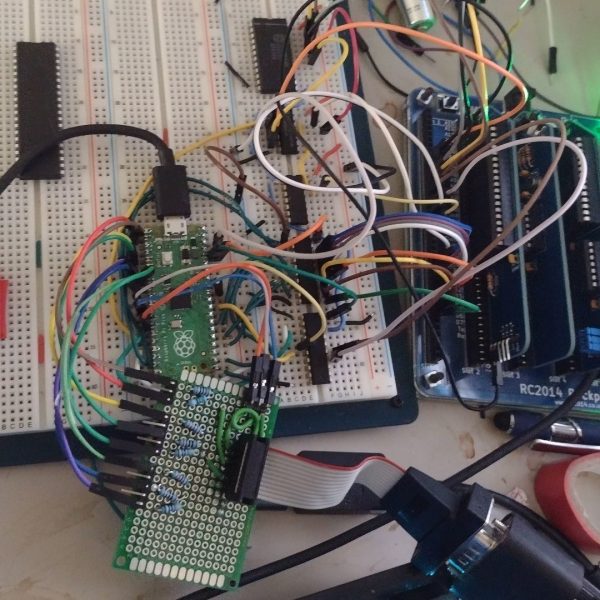
These days, supply chain factors and high demand have made it incredibly difficult to lay one’s hands on a GPU. However, if you’re into older computers, you might find it hard to source old-school video cards too. Fear not, for [Dave’s Dev Lab] has been cooking up some experiments with a goal of eventually producing a new 8-bit ISA video card from scratch.

The long term goal is to recreate the original design of early IBM hardware, namely, the MDA and CGA video cards of decades past. The experiments center around the venerable Motorola 6845 which was widely used in computers in the 1980s. However, [Dave] intends to make them suitable for outputting to modern screens using typical VGA and DVI outputs, as well as those expected by modern TFT LCDs.

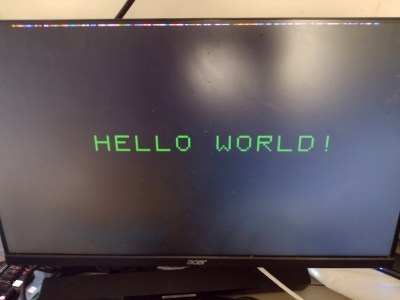
Thus far, [Dave] has achieved successful VGA output in a 40×35 text mode. With an 8×16 font, and the display running at 640×480 resolution at 60 Hz, everything hums along nicely. Similar experiments with a modern 480×272 LCD display have also worked well.

There’s a long way to go before [Dave’s] hardware is playing Commander Keen, but it’s great to see such effort being put into the platform. It could yet serve as a great upgrade for those wishing to use their vintage IBM metal without having to source a tired old CGA monitor.

We’ve seen similar work before too, with the Graphics Gremlin from [Tube Time] achieving a similar task. If you’ve been brewing up your own ISA hardware at home, do drop us a line.

Mouse And Keyboard Controls On The N64

The Nintendo 64 was one of the consoles that properly heralded in the era of 3D gaming. However, its controller is of a design we wouldn’t consider ideal today. For the FPS games that were so popular on the N64, a mouse and keyboard could do much better. [The Hypocaust] set out to make it happen.

The N64 polls the controller and receives button and analog stick data in return. Four bytes are sent by the controller, with 14 bits covering the buttons and 8 bits covering the horizontal and vertical axes of the analog stick, respectively. Thus, if keyboard presses and mouse movements from a PC could be pumped to a microcontroller which reformatted the data into signals the N64 could understand, everything would work nicely.

Initial attempts to get things working with code borrowed from a [James Read] faced an issue of a 3-second lag between keypresses and actions reaching the N64. Upgrading to a faster microcontroller only made things worse, taking the lag out to a full 16 seconds. The problem? The code borrowed for the project was storing keypresses in a buffer that was creating the delay. Once eliminated, the system worked.

An installer for the software is available, but you’ll have to be comfortable with running a strange executable if you want to use it. We’ve seen similar work before too, such as the USB64 project. Video after the break.

Continue reading “Mouse And Keyboard Controls On The N64”

Secret Keychain Safe Looks Just Like A Bolt

While conventional safes can be a good place to put valuables, sometimes it’s even better to hide your things where nobody will even look in the first place. [Wesley Treat] has a build that will allow you to do just that, which secrets away papers, money, or small items within the body of a bolt.

There’s a surprising amount of room inside.

The build starts in a proper hacker fashion, using a power drill to turn an aluminium blank against a power sander creating an ersatz lathing setup. The outside of the blank is then threaded with the aid of a socket wrench and die, to great success. A cavity is created inside and threaded internally, and a separate head is then machined to screw on top. It’s all achieved without the use of a real lathe, with [Wesley]’s power drill doing most of the heavy lifting instead. It’s great stuff.

The end result has the appearance of a socket-head cap screw, while being lighter than a typical example due to the aluminium construction. Inside, there’s room for money, matches, and more, and [Wesley] even put in a small hole so the bolt can be used as an attractive keychain.

It’s a neat build, and one that we’d love to have as part of our own everyday carry. Video after the break.

Continue reading “Secret Keychain Safe Looks Just Like A Bolt”

Flaw In AMD Platform Security Processor Affects Millions Of Computers

Another day, another vulnerability. This time, it’s AMD’s turn, with a broad swathe of its modern CPU lines falling victim to a dangerous driver vulnerability that could leave PCs open to all manner of attacks.

As reported by TechSpot, the flaw is in the driver for AMD Platform Security Processor (PSP), and could leave systems vulnerable by allowing attackers to steal encryption keys, passwords, or other data from memory. Today, we’ll take a look at what the role of the PSP is, and how this vulnerability can be used against affected machines.

Continue reading “Flaw In AMD Platform Security Processor Affects Millions Of Computers”