Force feedback took off in a big way in the late 90s, bringing a sense of realism to flight sticks and racing wheels that hadn’t been there before. Its cheaper haptic cousin was rumble feedback via vibration motors, which does add a little something but it’s more an idea of a feeling than anything relevant to real life. It’s also usually pretty weak, but [teenenggr] has a way around that.
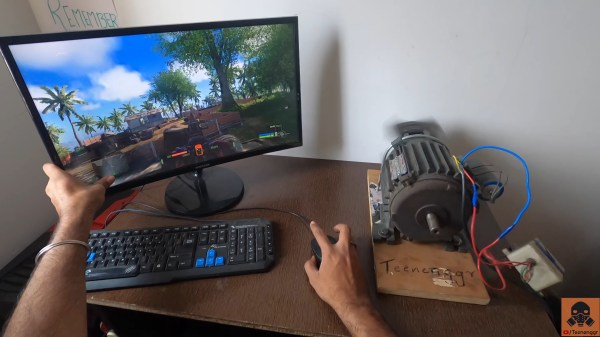
The build takes a regular Playstation controller, and disconnects the internal rumble motors. The controller’s motor output is instead linked to an Arduino Uno’s digital input. When the Arduino detects the rumble motor signal switching on, it turns on a relay, supplying power to a hefty one horsepower induction motor, fitted with an eccentric weight.
What happens next is pure chaos. Essentially equivalent to throwing a brick in a washing machine, the motor shakes the entire desk at the slightest hint of rumble signals from the gain. Sustained vibration commands, such as when firing machine guns in Crysis, flung [teenenggr]’s monitor from the desk. Even with it taped down, game play quickly became impossible as he inadvertently hits ALT-Tab and leaves the game while trying to hang on to the desk for dear life.
Is it a useful hack? No, but it would make an excellent prank if bolted underneath your friend’s gaming rig for a laugh. With that said, the intense vibration probably won’t do any good for mechanical hard drives, anything with edge connectors, or just their computer in general. It’s a big step up from the last [teenenggr] project we featured – a rumble feedback mouse. Video after the break. Continue reading “Gaming With 1 Horsepower Of Rumble Feedback”→
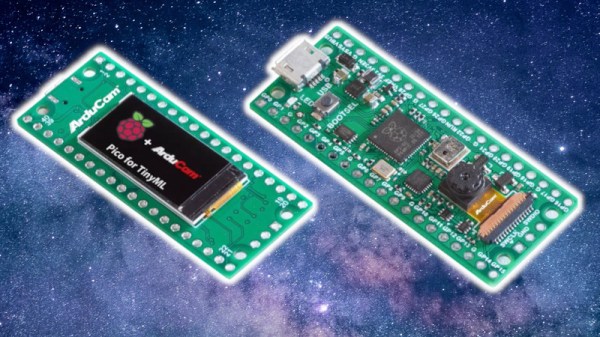
Machine learning (ML) typically conjures up ideas of fancy code requiring oodles of storage and tons of processing power. However, there are some ML models that, once trained, can readily be run on much more spartan hardware – even a microcontroller! The RP2040, star of the Raspberry Pi Pico, is one such chip up to the task, and [Arducam] have announced a board aiming to employ it to those ends – the Pico4ML.
The board goes heavy on the hardware, equipping the RP2040 with plenty of tools useful for machine learning tasks. There’s a QVGA camera on board, as well as a tiny 0.96″ TFT display. The camera feed can even be streamed live to the screen if so desired. There’s also a microphone to capture audio and an IMU, already baked into the board. This puts object, speech, and gesture recognition well within the purview of the Pico4ML.
Running ML models on a board like the Pico4ML isn’t about robust high performance situations. Instead, it’s intended for applications where low power and portability are key. If you’ve got some ideas on what the Pico4ML could do and do well, sound off in the comments. We’d probably hook it up to a network so we could have it automatically place an order when we yell out for pizza. We’ve covered machine learning on microcontrollers before, too – with a great Remoticon talk on how to get started!
The story begins back in 1665, when [Christiaan Huygens] discovered that two pendulum clocks hanging from the same wooden beam would spontaneously synchronise over a period of time. The same principle is then demonstrated with metronomes – an experiment readily recreated in the home. Other systems that show this same eerie coordiation are then explored – from tidally locked moons orbiting around planets (like ours!), to chemical oscillators discovered by Soviet scientists during the cold war. There’s also a great explanation of the problems faced by the London Millennium Bridge, which swayed wildly under heavy foot traffic as it induced pedestrians to walk in sync.
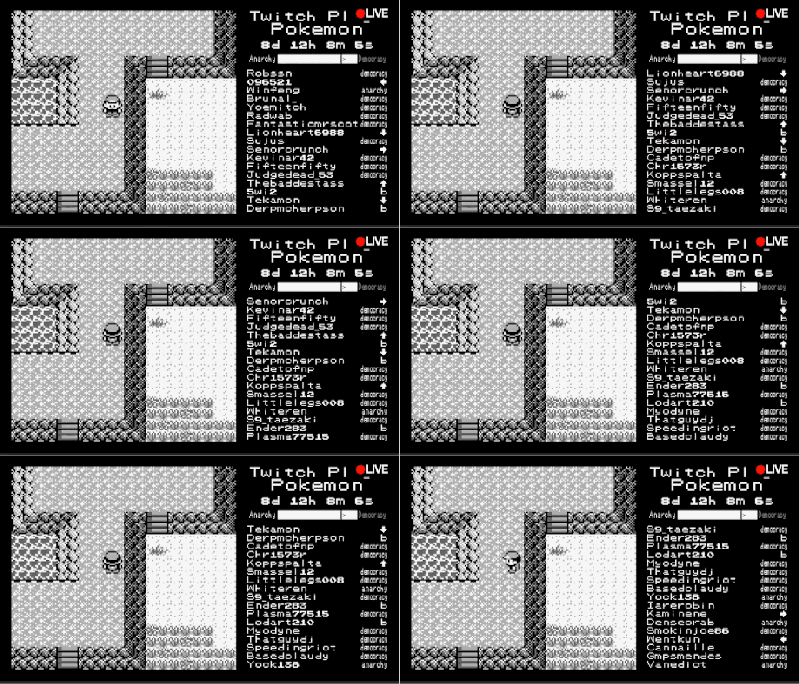
Twitch Plays Pokemon burst onto the then nascent livestreaming scene back in 2014, letting Twitch viewers take command of a Game Boy emulator running Pokemon Red via simple chat commands. Since then, the same concept has been applied to everything under the sun. Other video games, installing Linux, and even trading on the New York Stock Exchange have all been gameified through Twitch chat.
TwitchPlaysPokemon started a craze in crowdsourced control of video games, robots, and just about everything else.
You, thirsty reader, are wondering how you can get a slice of this delicious action. Fear not, for with a bit of ramshackle code, you can let Twitch chat take over pretty much anything in, on, or around your computer.
It’s Just IRC
The great thing about Twitch chat is that it runs on vanilla IRC (Internet Relay Chat). The protocol has been around forever, and libraries exist to make interfacing easy. Just like the original streamer behind Twitch Plays Pokemon, we’re going to use Python because it’s great for fun little experiments like these. With that said, any language will do fine — just apply the same techniques in the relevant syntax.
SimpleTwitchCommander, as I’ve named it on Github, assumes some familiarity with basic Python programming. The code will allow you to take commands from chat in two ways. Commands from chat can be tabulated, and only the one with the most votes executed, or every single command can be acted on directly. Actually getting this code to control your robot, video game, or pet viper is up to you. What we’re doing here is interfacing with Twitch chat and pulling out commands so you can make it do whatever you like. With that said, for this example, we’ve set up the code to parse commands for a simple wheeled robot. Let’s dive in.
In 2014, Formula 1 switched away from V8 engines, electing instead to mandate all teams race with turbocharged V6 engines of 1.6 litres displacement, fitted with advanced energy recovery systems. The aim was to return Formula 1 to having some vague notion of relevance to modern road car technologies, with a strong focus on efficiency. This was achieved by mandating maximum fuel consumption for races, as well as placing a heavy emphasis on hybrid technology.
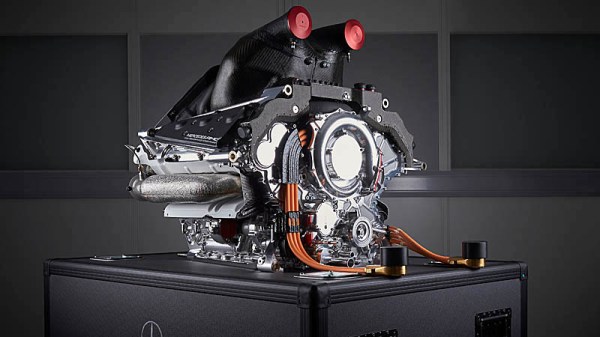
The Mercedes W05 Hybrid was the first of 7 championship-winning F1 cars from the British-based, German-funded team. It quickly showed the value of the team’s split-turbo technology.
Since then, Mercedes have dominated the field in what is now known as the turbo-hybrid era. The German team has taken home every drivers and constructors championship since, often taking home the crown well before the season is over. Much has been made of the team’s engine as a key part of this dominance, widely considered to be more powerful and efficient than the competition at all but a few select races in the last seven years, and much of the credit goes to the company’s innovative split-turbo system. Today, we’ll explore why the innovation was such a game changer in Formula 1.
Around these parts, we see plenty of plotter builds. They’re a great way to learn about CNC machines and you get to have fun making pictures along the way. [Ben Lucy] was undertaking just such a build of his own, but wanted to do something standalone that served a purpose. The result is the impressive Portable Portrait Painter.
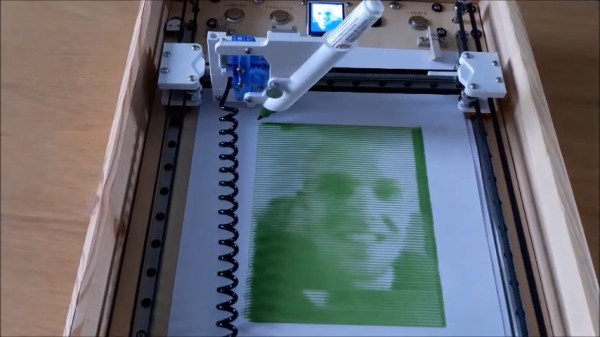
What sets [Ben]’s project apart is how complete it is. Unlike other plotters that simply follow G-code instructions or process external images, the Portable Portrait Painter is a completely standalone machine. Fitted out with an OV7670 camera, hooked up to an Arduino, it’s capable of taking its own photos and then drawing them out as well.
Through some clever code from [Indrek Luuk], the Arduino Mega2560 is able to display a 20fps video preview on a color LCD screen. When the user presses a button, the current frame is captured and sent to the pen plotter. The plotting algorithm is particularly impressive, with images first processed with histogram compensation to maximise contrast. The pen is then drawn across the page line by line, and pressed into the page by varying amounts depending on the color value of each pixel. The darker the pixel, the thicker the stroke made by the pen. This more analog approach produces a much more detailed image than more basic plotters which either leave a mark or don’t.
The portraits produced by the plotter are impressive, and we like the edge-of-page artifacts, which add a little style to the final results. The Portrait Painter would make a great conversation piece at any Maker Faire or hackerspace night.