Charging Pad Flips For Solar Power

Charging pads are now a common, popular way to charge small devices. They have the benefit of reducing wear on connectors and being easier to use. [bcschmi6] decided to build a solar powered charging pad, which should come in handy when out and about.

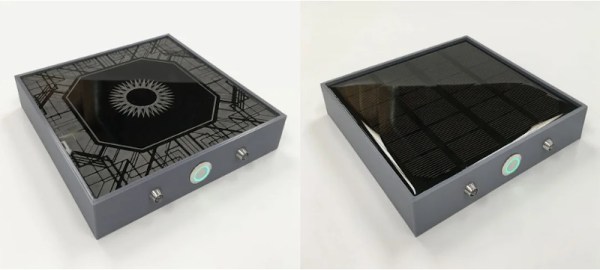
The build uses a 3 W square solar panel, hooked up to an Adafruit solar charging board. This charges a pair of 18650 lithium batteries. The batteries only put out a maximum of 4.2 V, so they’re hooked up to a boost converter to get the output a little higher, up to 5.2 V. The output of the boost converter is then hooked up to a charging pad harvested from an Anker charger, and it’s all wrapped up in a tidy 3D printed frame.

We imagine the device would be great for camping. It could be left charging in the sun during the day, before being flipped over and used as a charging pad at night. It would be easy to build a bigger version for charging several phones at once, too. If you want to build your own charging coils, that’s a thing, too. And if you’ve got your own solar project cooking up as we head into summer, be sure to let us know!

Cellular Tracking Used During COVID-19 Pandemic

As most in the technology community know, nation states have a suite of powerful tools that can be used to trace and monitor mobile phones. By and large, this comes up in discussions of privacy and legislation now and then, before fading out of the public eye once more. In the face of a global pandemic, however, governments are now using these tools in the way many have long feared – for social control. Here’s what’s happening on the ground.

The Current Situation

With COVID-19 sweeping the globe, its high level of contagiousness and rate of hospitalizations has left authorities scrambling to contain the spread. Unprecedented lockdowns have been put in place in an attempt to flatten the curve of new cases to give medical systems the capacity to respond. A key part of this effort is making sure that confirmed cases respect quarantine rules, and isolate themselves to avoid spreading the disease. Rules have also been put in place in several countries where all overseas arrivals must quarantine, regardless of symptoms or status. Continue reading “Cellular Tracking Used During COVID-19 Pandemic” →

Particle Sniffer For Pollution Point Sources

When measuring air quality, particulate matter is an important metric to watch. The PM2.5 rating refers to particulate matter that has a diameter of less than 2.5 micrometers. While it’s often measured by authorities on a city-wide basis, [rabbitcreek] wanted a way to track down point sources indoors.

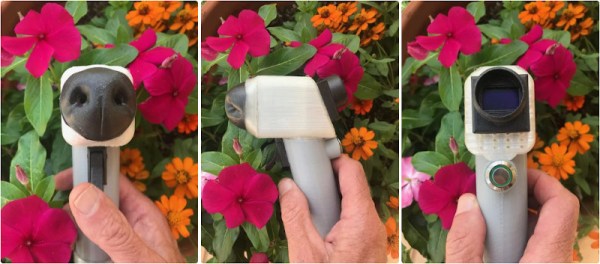
The tool [rabbitcreek] built is in a similar form factor to a typical infrared workshop thermometer. Inside, it packs a Honeywell HPMA115S0-TIR laser particle sensor, hooked up to an ESP32 which runs the show. The sensor chosen makes things easy, with the device already set up with a blower and inlet and outlet ports for taking accurate readings.. Results are displayed on an SSD1306 OLED screen. It’s all wrapped up in a 3D printed case with a trigger grip, and a dog nose on the front which hints at the devices true purpose.

In testing, the device proves capable of detecting point sources of atmospheric particulates like flowers and a toaster. It’s something we’re sure would prove handy to those working in HVAC and environmental assessment industries. We’ve seen other rigs for monitoring particulates before, too. Video after the break.

Continue reading “Particle Sniffer For Pollution Point Sources” →

A Digital Pitch Pipe Gets You In Tune

Some humans are blessed with perfect pitch, an ability that comes in handy when pursuing the musical arts. For many others though, a little help is often appreciated. A pitch pipe is a handy way to find the starting note of a performance, and [Isaac] decided to build his own in the digital realm.

The project is based on the Adafruit Circuit Playground express, which packs in all the peripherals needed right on board. The buttons are used to select the pitch required, with the LEDs used to display the selected note. Blue means flat, green means natural, and red means sharp. A 3D printed outer ring is clipped on to the board to denote the pitches for the user. To play the note, the user simply blows on the pitch pipe. The onboard MEMS microphone detects this and plays the note on the onboard speaker.

It’s a tidy little project that is a great way to get one’s feet wet with embedded programming and working with audio. We’ve seen the Circuit Express pop up before too, such as in this pizza-box DJ mixer. Video after the break.
Continue reading “A Digital Pitch Pipe Gets You In Tune” →

Empanada Becomes Impractical, Delicious Synth

Vegemite is an Australian staple – a rich, protein-filled sandwich spread with a strong salty flavor. It serves as a great way to add a little umami to any dish, which is the hottest open secret in Australian cuisine this decade. It also works as a servicable conductive paint, which [Alex] used to make this baked good into a musical device.

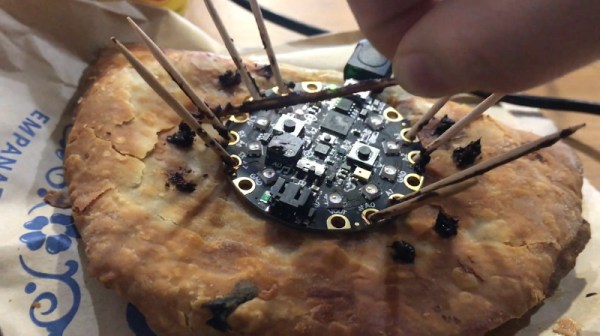
The basis of the device is a basic audio example sketch running on an Adafruit Circuit Playground Express. The code was tweaked to play a 7-note C major scale. The PCB was then attached to the empanada with toothpicks through each pad, with the baked good itself seemingly connected to the ground plane. The toothpicks through the pads were then coated with Vegemite, and another toothpick treated the same way and used as a stylus. By touching the toothpick to the empanada and one of the pads, the circuit is made, and a note is played.

It’s an impractical way to go about musical performance, sure. But it is an effective demonstration of foodstuffs used in electronics. Calvin Harris did much the same back in 2009, albeit with humans substituting for the delicious pastry. Video after the break.

Continue reading “Empanada Becomes Impractical, Delicious Synth” →

Chatty Coaster Agitates, In A Friendly Way

Awkward silences can be highly uncomfortable. Thankfully, they’re a problem that can be solved by technology. Chatty Coaster aims to do just this, detecting pauses in conversation and interjecting with helpful questions to move things along.

The coaster is built around an Arduino Micro, which uses a microphone to detect audio levels in the room. When it detects an extended silence, it then fires off a sound clip using a SparkFun audio breakout board. The questions vary from plain to politically sensitive, so there’s a good chance you could get some spicy conversation as a result. Any talking device runs a risk of being more annoying than helpful, and there’s certainly a risk that Chatty Coaster could fall into this category. Choosing the right content seems key here.

Overall, while this may not be the ultimate solution to boring company, it could get a laugh or two and serves as a good way to learn how to work with audio on microcontrollers. Video after the break.

We’ll admit, when we were reading this one, we thought we had déjà vu. But this one’s a lot less blamey.

Continue reading “Chatty Coaster Agitates, In A Friendly Way” →

DIY Bagpipes Made From Common Household Items

The bagpipes, most commonly seen in their Great Highland form from Scotland, are a loud and imposing musical instrument. Known for being difficult to practice quietly, they’re not the ideal thing to pick up in these times of quarantine and isolation. But, if you must, here’s how you can craft your own at home!

A garbage bag is used as the air bag for this design, readily available and easy to work with. A recorder is then installed into the bag to act as the chanter – the part of the instrument with with pitch is controlled by finger position. A second recorder is then installed as a drone, which produces the continuous harmonizing note typical of bagpipes. A pair of pens are used to create the blowpipe which supplies air to the instrument. Everything is then sealed up with tape and you’re ready to go!

While it’s not a great facsimile of an authentic Scottish bagpipe, it does work in the same way and make some noise. It would be interesting to see a talented player handle such a makeshift piece. Alternatively, consider some of the alternative DIY instruments we’ve featured before. Video after the break.

Continue reading “DIY Bagpipes Made From Common Household Items” →