A Stylish Coffee Table Featuring Conway’s Game Of Life

Coffee tables are a great place to put your hot beverages, but most don’t offer a lot beyond that. For most people this is perfectly acceptable, but hackers often desire a little more. [Andrei Erdei] is one such person, who built Conway’s Game of Life into this handsome piece of furniture.

The build began with an existing coffee table, chosen for its glass top. Unfortunately, the top was painted black on one side, and was completely opaque, negating its use as a diffuser for LEDs. Instead, this was replaced with smoked glass, with frosted window film applied to make the final piece darker. This attention to detail allowed [Andrei] to install the WS2812B LED strips underneath such that they’re invisible when switched off. The LEDs themselves are run by a WEMOS D1 mini, based on the ESP8266. This microcontroller has plenty of grunt, which makes running the LEDs and the Game of Life code a cinch.

If you want to make something attractive and blinky, it’s hard to go wrong with Conway’s Game of Life. You can even use it to make a clock or a synthesizer; or build an entire game of Tetris within it. Video after the break.

Continue reading “A Stylish Coffee Table Featuring Conway’s Game Of Life” →

How To Get Into Cars: Handling Mods

As a budding automotive enthusiast, you finally took the plunge and scored yourself a sweet project car. After going through it from top to toe, you’ve done your basic maintenance and it’s now running like a top. Now you’re getting comfortable, you’ve set your sights on turning your humble ride into a corner carving machine. Here’s a guide to get yourself started.

It’s All About Grip

When it comes to creating a handling monster, the aim is to create a car that sticks to the road like glue, and is controllable when it does break loose. Having a car that handles predictably at the limit is a big help when you’re pushing hard on track, particularly for an inexperienced driver. And, whether you’re hitting the canyons on the weekend or trying to slash your laptimes, it’s always nice to have more grip. Through selecting the right parts and getting the set up right, it’s possible to hone your car’s cornering ability to make it a rewarding experience to drive fast and hard. Continue reading “How To Get Into Cars: Handling Mods” →

A Reminder Not To Touch Your Face

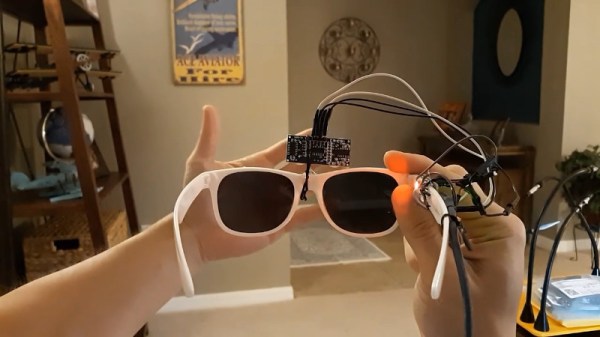
In 2020, the world is focused on the rampant spread of a new virus by the name of COVID-19. Like many infectious diseases, transmission can be reduced by good hygiene practices. To help in the fight, [Nick Bild] threw together a device he calls Sentinel.

The concept is simple. Reduce the user touching their own face by shining a warning light when such behaviour is detected. This is achieved through the use of an Arduino, which controls an LED through feedback from an ultrasonic proximity sensor. The LED is placed in the user’s peripheral vision, glowing when the sensor detects hands (or other objects) approaching the face.

While it’s unlikely to be rolled out en-masse, it’s a project that nevertheless reminds us to practice good self-care routines. And, as the adage goes, prevention is better than cure. As governments and industry grapple with the ongoing problem, consider how your supply chain may be exposed to the crisis. Video after the break.

Continue reading “A Reminder Not To Touch Your Face” →

Homebuilt Onewheel Uses Hoverboard Parts

Since Back To The Future II first screened back in 1989, people have been waiting for hoverboards to become reality. Instead, we got a dangerous two-wheeled contraption going by the same name. Wanting something a little cooler, [Bartek Plonek] decided to convert his to a one-wheel design. (Video, embedded below.)

The hack starts by machining the hub motors of the hoverboard. They’re bolted together, and used as the hub of a single larger wheel. Care is necessary to avoid cracking the motor housing during this process, as [Bartek] found during his first attempt. The wheel is then fitted to the centre of a steel frame, upon which two halves of a skateboard are attached to act as a footplate. The original hoverboard controller is still used; we’d love to know if firmware modification was required to work with the new motor configuration.

It’s a classic garage hack that results in a viable personal electric vehicle. Plus, cornering is far easier, with the DIY onewheel capable of carving back and forth quite well. We’ve seen others aim to commute using similar builds.

Continue reading “Homebuilt Onewheel Uses Hoverboard Parts” →

Smashed Laptop Becomes Stylish All-In-One

Many of us will have broken a laptop at one point or another, destroying the screen or smashing the case. It can be frustrating, as there’s a perfectly usable computer in there, trapped inside a broken husk of a body. [Matthew] saw this not as a problem, but an opportunity – and built a beautiful all-in-one desktop PC. (Video, embedded below.)

With a badly damaged Thinkpad laptop to hand, an ASUS monitor was sourced with a thin body and flat back, perfect for mounting hardware. An MDF base was created, on to which the laptop motherboard was mounted. A USB hub and audio amplifier were then added, along with a USB power isolator and soundcard to avoid problems with groundloops from the onboard headphone output. Speakers were Harman Kardon units salvaged from an old television, providing great quality sound for the build.

There’s plenty of great ideas in the video, from using epoxy for a strong permanent assembly, to a nifty hack to make the power button work. It has us contemplating a build for our own broken laptops in the junkpile. We’ve seen other creative all-in-one builds too, like this one inside a printer.

Continue reading “Smashed Laptop Becomes Stylish All-In-One” →

Using Voice Commands To Start A Jeep

If you’ve got a car built in the last 5 years or so, it’s quite likely it’s started by the push of a button when in the presence of a keyfob. Older vehicles make do with the twist of a key. Of course, starting a car by voice command would be cool, and that’s what [John Forsyth] set out to do.

The build uses a Macbook to handle voice recognition, using its Dictation feature. With a hefty download, it’s capable of doing the task offline, making things easier. The dictated words are passed to a Python script, which searches for words like “start” and “go” as a trigger. When an appropriate command is received, the Python script sends a signal over a USB-serial connection to an attached Arduino. The Arduino then toggles a relay connected to the Jeep’s external starter solenoid, starting the vehicle.

As a fan of recent popular films, [John] programmed the system to respond to the command “Jarvis, let’s get things going!”, causing the vehicle to spring into life. There’s room for future improvement, too – the system could benefit from being a little more compact, and there’s a long delay between finishing the sentence and the vehicle starting. A Raspberry Pi and faster dictation software could likely help in this regard.

We’ve seen voice commands used for everything from chess to finding electronic components. Video after the break.

Continue reading “Using Voice Commands To Start A Jeep” →

Procedurally Generating Marble Runs

Marble runs are somehow incredibly soothing to play with and watch, with the gentle clack of the marbles and the smooth, predictable motion. Sadly for some, they never quite got enough time to enjoy them in school. Luckily, [Fernando Jerez] is here with a way to procedurally generate marble runs you can actually play with!

[Fernando] does a great job of explaining the mathematical process of generating the marble runs, using the method of random space filling curves. A maze is drawn on a grid, with points on the grid acting as walls. Each grid cell is then given a value based on points on its corners, and these values then translate into directions of travel. This creates a path through the maze. Scaling this path along the Z-axis, and then replacing the path with a marble track creates the run. It’s then a simple matter of adding a shaft to the loop with a screw to drive marbles back to the top of the run, and you’re all set!

With both animated explanations and actual 3D printed marble runs, [Fernando] demonstrates the concept well. We’d love to print a few runs of our own, and we can’t help but think there’s other great applications for the mathematics behind this concept. If you’re wise to it, drop it in the comments. Otherwise, check out these exquisite creations we’ve featured before!