Maxing Out Browser Tabs With 2TB Of Memory

Tabbed browsing was a gamechanger, allowing users to effectively browse multiple websites at once without losing context. It proved a better solution than using multiple windows, and was an efficiency boon celebrated by all. Many of us are tab fiends, opening great numbers at a time as a habitual part of our workflow. [Linus] decided to find out just how many he could open on a system armed with a full 2TB of RAM.

As may be obvious, setting up a system with 2TB of RAM is no mean feat. Special server-grade RAM modules were sourced, packing 128GB of RAM each, set up for ECC operation. Packing out 16 slots, there’s a performance penalty to addressing so much RAM with a single CPU, but for memory-intensive work, it’s worthwhile. The CPU in question is an AMD 64-core processor, providing plenty of grunt for the task at hand.

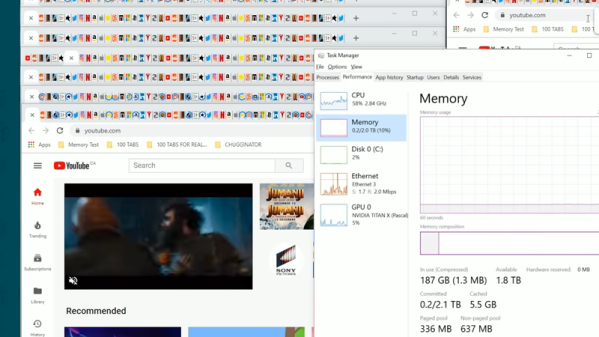
In testing, the machine began to slow down long before the RAM was full. Beyond 5000 tabs, things began to crawl. At 6000 tabs, it was simply impractical to open more, with the machine taking a full 26 seconds to respond to a single click. Memory usage at this point was just 200GB, suggesting that software limitations were getting in the way of opening yet more tabs.

While it’s not a useful measure of anything important, it’s fun to explore the limits nonetheless. We’ve seen their projects before, such as this original Xbox casemod. Video after the break.

Continue reading “Maxing Out Browser Tabs With 2TB Of Memory” →

SOLID Promises A New Approach To How The Web Works

As it stands on the modern Internet, your data is no longer your own. Your emails, photos, and posts all live on servers owned by large corporations. Their policies give them access to your data, which is mined to generate advertising revenue. And if you want your data back, there are innumerable hoops to jump through. Want it deleted entirely? Good luck.

Tim Berners-Lee, original creator of the World Wide Web, is behind the project.

Sir Tim Berners-Lee, as the original creator of what became the Web, has drawn issue with the current state of play. To move the ball on the issue, he’s been working on a design for decentralized internet and the efforts have led to the establishment of the Solid project. The goal is to rectify online privacy and ownership issues and give users greater control over their personal data.

The big question is how do you do that? When SOLID was announced last year there were few if any details on the approach taken by the program. But since then, more details have surface and you can even take an early version of the program for a spin. Let’s take a look.

Continue reading “SOLID Promises A New Approach To How The Web Works” →

Can You Print With Highlighter Ink?

With huge swathes of people either out of work or working from home, many are now attempting all manner of exciting or silly projects in their downtime. [Emily Velasco] is no exception. She decided to explore the feasability of printing with highlighter ink.

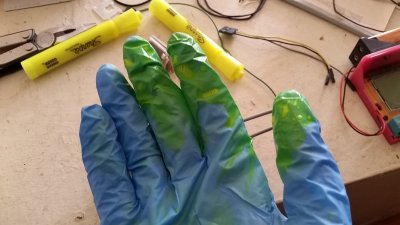
It’s a messy business. Wear gloves.

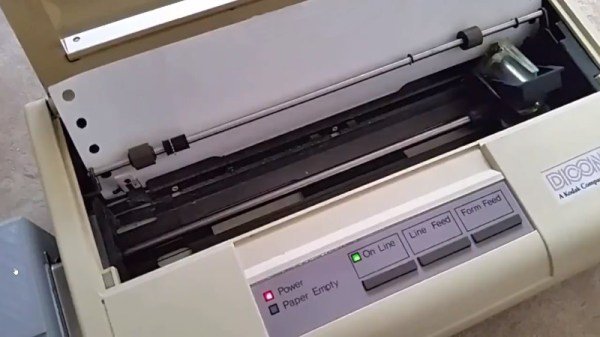
The hack starts with a rather ancient inkjet printer, so old that it works with tractor feed paper. [Emily] set about gutting several highlighter pens and squeezed out the ink reservoirs into a ladle. The printer’s ink cartridge was then filled with the fluid, and a test print was fired off. Upon initial extraction, it appears blank. However, with the aid of a UV light, the printed pattern is revealed. It appears that the inkjet is printing a very faint image, such that the system almost works as an “invisible ink”.

It’s a fun little hack with an old printer, made easier as it lacks the DRM of newer models. It’d probably be quite achievable with a dot-matrix, too. If you’re similarly tinkering in the innards of your peripherals, be sure to let us know. Video after the break.

Continue reading “Can You Print With Highlighter Ink?” →

NIH Approved 3D-Printed Face Shield Design For Hospitals Running Out Of PPE

As the world faces a pandemic of monumental proportions, hospitals have been hit hard. The dual problems of disrupted manufacturing and supply chains and huge spikes in demand have led to many medical centres running out of protective gear. Makers have stepped up to help in many ways by producing equipment, with varying results. [Packy] has shared a link to a 3D-printable face shield that, unlike some designs floating around, is actually approved by the National Institute of Health in the USA.

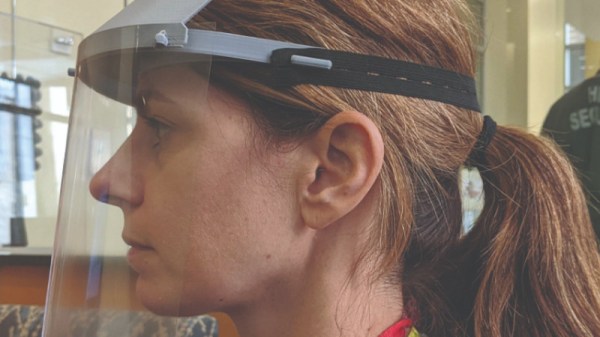
The shield consists of a 3D printed headband, which is then coupled with a transparent piece of plastic for the face shield itself. This can be lasercut, or sourced from a document cover or transparency sheet. The design is printable in PLA or a variety of other common materials, and can be assembled easily with office supplies where necessary.

The design is available from the NIH here. (Update: 4/1/2020 here’s an alternate link as original link seems to be suffering from heavy server load) For those eager to help out, it’s important to do so in an organised fashion that doesn’t unduly take resources away from healthcare professionals trying to get an important job done. We’ve seen other hacks too, such as these 3D printed ventilator components being rushed into service in Italy. 

The New Xbox: Just How Fast Is 12 TeraFLOPS?

Microsoft’s new Xbox Series X, formerly known as Project Scarlet, is slated for release in the holiday period of 2020. Like any new console release, it promises better graphics, more immersive gameplay, and all manner of other superlatives in the press releases. In a sharp change from previous generations, however, suddenly everybody is talking about FLOPS. Let’s dive in and explore what this means, and what bearing it has on performance.

Continue reading “The New Xbox: Just How Fast Is 12 TeraFLOPS?” →

Stylish Mic Is Metal Printing Done Right

[Eric Strebel] wanted a microphone to record voiceovers, and being a designer, wanted something suitably impressive for the task.  Inspired by the classic Unidyne 55, he set about designing his own mic, and used some pretty fancy techniques to get it built.

The mic was built around a ribbon element, providing good dynamic response. The design was created in CAD, and was initially intended to be constructed out of three seperate pieces. However, [Eric] realized that through the use of a binder jetting 3D printer, this wouldn’t be necessary.

Binder jetting is a technique in which a nozzle squirts binder into a powder bed to create a 3D printed part. In this case, a steel powder is used, which is then post-processed in an oven with liquid bronze. The bronze wicks into the finished part, adding strength. It’s a process which creates metal parts with very few limitations; the primary concern being minimum wall thicknesses.

With access to a binder jetting printer, [Eric] was free to design the stylish geometry of the final product. Mashing up hexagons with classic 50s curves, the final result is impressive. [Eric] now uses the microphone regularly to record voiceovers, and the aptly-named Hexavox even made an appearance at NAMM.

If you’re looking for more ways to DIY in your home studio, consider building your own isolation shield. Video after the break.

Continue reading “Stylish Mic Is Metal Printing Done Right” →

Yet More Takata Airbags Are Causing Fatalities Despite Different Propellant Chemistry

Takata Corporation has become well known as a lesson in product safety, thanks to their deadly airbags which were installed in cars worldwide. Despite filing for bankruptcy in 2017, their shadow lingers on as the biggest product recall in history continues to grow ever larger. Over time, the story grows deeper, as investigators find new causes for concern and deaths continue to mount.

In late 2019, another Takata recall was announced — one which caused fresh worry among industry officials familiar with the case. Up to this point, the defective parts produced by Takata were the models based on ammonium nitrate propellants, a chemical that other manufacturers had deemed too dangerous to use. However, there have been reports of other models using different chemistries having fatally injuring motorists, raising the question of whether any Takata airbag could be considered safe.

Continue reading “Yet More Takata Airbags Are Causing Fatalities Despite Different Propellant Chemistry” →