Photochromic Screen Makes For An Interesting Clock

The clock project will always be a hacker staple, giving the builder a great way to build something useful and express their individual flair. [Mosivers] was undertaking a build of their own and decided to go for a twist, creating a timepiece with a photochromic display.

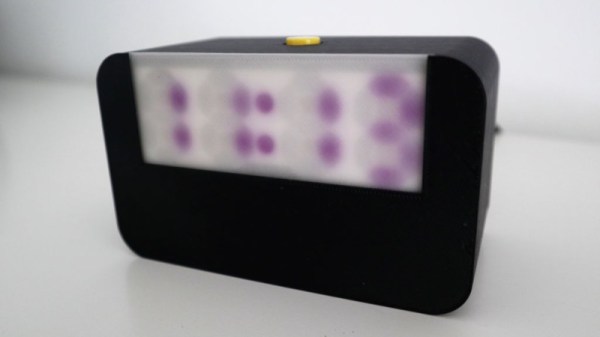
The clock uses an Arduino Nano to run the show, hooked up to a 4-digit, 7-segment display that is custom built on protoboard. By using ultraviolet LEDs and placing them behind a reactive screen, it’s possible to create a unique display. The clock can be used with two different screens: a photochromic display created with UV-reactive PLA filament that turns purple when excited by UV light, and a glow-in-the-dark screen for night use.

It’s a fun twist on a simple clock design, and the purple-on-white digits are sure to raise some eyebrows among curious onlookers. Photochromic materials are fun to play with, and can make eggs and glass much more visually interesting. Video after the break.

Continue reading “Photochromic Screen Makes For An Interesting Clock” →
Handheld Game Console Puts Processing Power In The Cartridge

With the proliferation of cheap screens for use with microcontrollers, we’ve seen a matching proliferation in small handheld gaming projects. Pick your favourite chip, grab a screen off the usual suspects, add some buttons and you’re ready to go. [bobricius] has put a unique spin on this, with an unconventional cartridge-based build.

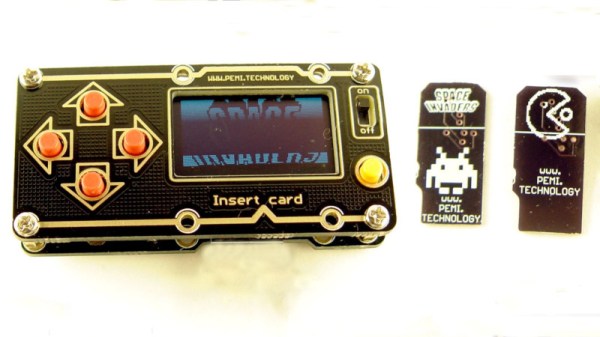
The main body of the handheld is constructed from attractive black and gold PCBs, and features a screen, some controls and an on/off switch. There’s also a microSD socket is on the board, which interfaces with cartridges which carry the microcontroller. Change the cart, and you can change the game.

[bobricius] has developed carts for a variety of common microcontroller platforms, from the Attiny85 to the venerable ATmega328. As the microSD slot is doing little more then sharing pins for the screen and controls, it’s possible to hook up almost any platform to the handheld. There’s even a design for a Raspberry Pi cart, just for fun.

It’s an entertaining take on the microcontroller handheld concept, and we can’t wait to see where it goes next. It reminds us of the Arduboy, which can even do 3D graphics if you really push it. Video after the break.

Continue reading “Handheld Game Console Puts Processing Power In The Cartridge” →

Lessons Learned From An Art Installation Build

Art installations are an interesting business, which more and more often tend to include electronic or mechanical aspects to their creation. Compared to more mainstream engineering, things in this space are often done quite a bit differently. [Jan Enning-Kleinejan] worked on an installation called Prendre la parole, and shared the lessons learned from the experience.

The installation consisted of a series of individual statues, each with an LED light fitted. Additionally, each statue was fitted with a module that was to play a sound when it detected visitors in proximity. Initial designs used mains power, however for this particular install battery power would be required.

Arduinos, USB power banks and ultrasonic rangefinders were all thrown into the mix to get the job done. DFplayer modules were used to run sound, and Grove System parts were used to enable everything to be hooked up quickly and easily. While this would be a strange choice for a production design, it is common for art projects to lean heavily on rapid prototyping tools. They enable inexperienced users to quickly and effectively whip up a project that works well and at low cost.

[Jan] does a great job of explaining some of the pitfalls faced in the project, as well as reporting that the installation functioned near-flawlessly for 6 months, running 8 hours a day. We love to see a good art piece around these parts, and we’ve likely got something to your tastes – whether you’re into harmonicas, fungus, or Markov chains.

Motorized Lens Controller Techs Up Your Webcam

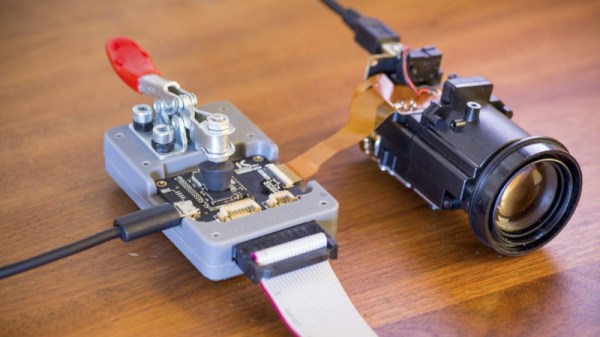
If you’re familiar with the DSLR camera market, you’d know that modern lenses are works of technological art. Crammed full of motors and delicate electronic assemblies, they’re bursting with features such as autofocus, optical stabilization and zoom. [Saulius Lukse] has been experimenting with motorized lenses for webcam applications, and has built a controller to make working with them a snap.

The controller is capable of controlling up to 3 stepper motors, as well as a voice coil, which should be enough for the vast majority of lenses out there. Microstepping is supported, which is key for optical systems in which tiny adjustments can make a big difference. The controller speaks USB and I2C, and is now based on an STM32 chip, having been upgraded from an earlier version which used the venerable ATmega328. The board is designed to be as compact as possible, to enable it to neatly fit inside camera and lens assemblies.

The board has been used to successfully control an 18x zoom lens, among others. Combining such a lens with a webcam and a good pan and tilt mechanism would create a highly capable surveillance package, or an excellent vision system for a robot.

It’s not the first time we’ve seen work from [Kurokesu] in these parts – they’ve done work on pedestrian detection before, too.

This Nerf Gun Is Terrifyingly Huge

Gatling guns were an early attempt at creating a rapid-firing weapon, and were popular amongst armies in the 19th century. Today, the basic design remains in use as a heavy weapon for putting many rounds downrange very quickly. [Ivan Miranda] decided that the Nerf world was missing a piece of the action, and got started on his own design (Youtube link, embedded below).

As per most [Ivan] builds, this one is a glorious pile of 3D printed parts turned into something functional and fun. It’s an ingenious design that’s more a Gatling in spirit than reality as it lacks the multiple barrels of the original, and it uses smart ducting to allow a single electric fan to both fire the foam Nerf balls as well as suck them in to reload the next shot. In testing, it achieved a muzzle velocity of 60 mph, firing at a rate of approximately 10 rounds/second. The presentation is great too, with plenty of cable wrap, meaty switches, and glowing lights to add to the aesthetic. There are even a couple of bright LED lamps on the front to help dazzle your targets into submission.

Once again, [Ivan]’s work is a great example of what is achievable with a 3D printer and smart design. His water jet drive ain’t bad, either. Video after the break.

Continue reading “This Nerf Gun Is Terrifyingly Huge” →

Minimalist Word Clock Does Things Neatly

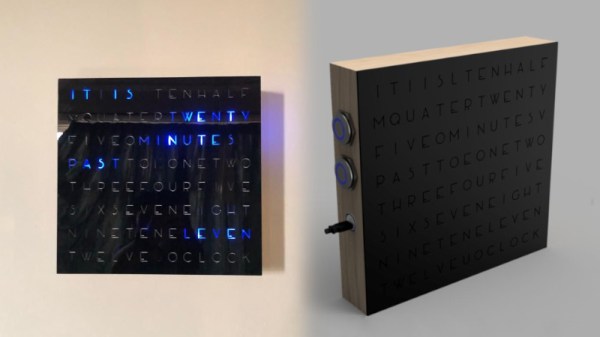
Word clocks are a cool way to tell the time. While they could have probably been built back in the 1960s with a bunch of relays and bulbs, they really only came into their own in the LED-everything era. [Vatsal Agarwal] built one of his own, showcasing his maker credentials.

It’s a build that relies on good woodworking practices from the ground up. Maple wood is used for the frame, cut and prepared on a miter saw for accurate assembly. MDF is used for panels that are out of sight, and teak strips act as light barriers to ensure only the right words are lit at any given time. The front panel is a sleek black acrylic piece, adding to the minimalist look. Neopixels serve as the light source, controlled by an Arduino Uno. As a finishing touch, some glowy stainless steel buttons are mounted on the side to control the clock.

It’s a build that serves as a great introduction to woodwork, as well as more modern skills like CAD design for laser cutting, as well as programming. They’re a great way to get stuck into making, and you can even go pocket-sized if you’re truly brave. Incidentally, if you do take up the challenge of an all-analog relay-based build, make sure you drop us a line.

Old CDs Create A Haunting Rainbow Vortex

The 1960s were, in Western culture, a time of great social and political upheaval, and the dawning of the psychedelia subculture. This resulted in an art style consisting of bright colours in wild, shifting designs. [Afraser-kruck] has built a device capable of generating beautiful rainbow light patterns, which he calls Mesmer-Eyes.

Unnerving, to say the least.

The device uses two CDs, stripped of their reflective coating. This leaves the plastic layer behind, which appears to be acting as a circular diffraction grating. By passing light from a flashlight through a CD, a dazzling rainbow vortex is created, and the effect is even further improved by adding a second disc. The patterns can be moved and shifted by changing the distance between the discs themselves, as well as the flashlight. This is achieved through the use of a sled that slides on PVC pipes, holding each individual element.

It’s a build of a kind we haven’t seen before, and is put to good use as a creepy Halloween decoration, imitating the famous Cheshire Cat. It’s one we can’t wait to tackle ourselves, and we wonder how difficult it would be to turn it into a projection, or a larger scale design.

Creepy eyes remain a Halloween staple; we’ve featured them before. Video after the break.

Continue reading “Old CDs Create A Haunting Rainbow Vortex” →