FlexLED Is A Unique Take On Persistence Of Vision

Many hackers have experimented with the persistence of vision effect. Whip around a bunch of LEDs, flash them at just the right times, and it’s possible to make images to appear to hang in the air. There’s plenty of ways to do this, whether by manually shaking the LEDs by hand, spinning them around, or even putting them on your bike wheels. [Carl Bugeja] went a different route, taking advantage of the possibilities created by flex PCBs.

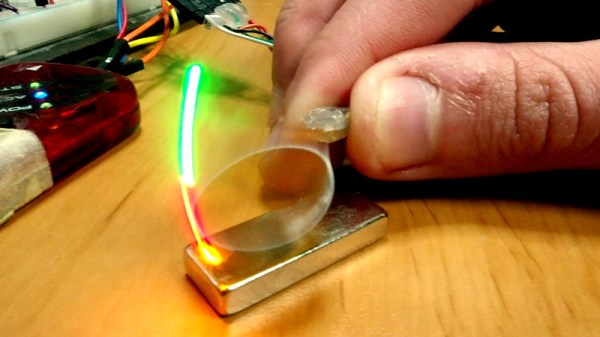
[Carl]’s project goes by the name FlexLED. This aptly describes the build, which, in prototype form, mounts a single LED on the end of a flex PCB. The PCB itself has a pattern of traces creating a coil, which enable it to interact with magnetic fields more strongly. By passing the right current through the coil, the flexible PCB can be made to flap up and down, moving the LED on the end at a rapid rate. By then controlling the flashing of the LED, it’s possible to create a persistence of vision effect.

Currently fitted with only one LED, capable of 3 colors, the visual display of the FlexLED is somewhat limited. However, [Carl] reports the effect is more impressive in person than on camera, and is already working on plans to scale up the project to a multi-LED diplay.

POV technology can do some pretty impressive things – even volumetric displays are possible. If you’re working on something yourself, be sure to let us know. Video after the break.


Continue reading “FlexLED Is A Unique Take On Persistence Of Vision” →

Trap Chess Keeps Players On Their Toes

Chess is a game that originated so long ago, we don’t have concrete information as to its origins. Rules have changed throughout history, and many continue to study and experiment with the game. [Yann Guidon] has a neighbour, [Bob], who is just one such enthusiast, and together, they built a working Trap Chess game.

What is trap chess, you may ask? It’s a variant of chess where pieces randomly fall into traps at the change of turns. This is easy to simulate in a digital game, but that wasn’t enough for [Bob]. Enlisting [Yann] for his electrical skills, the duo built a board with ten trapdoors built in. Whenever the timer is hit, there’s a chance a trapdoor can open, removing a piece from the game.

The build relies on a PIC16F818, an 8-bit microcontroller from Microchip. This helps interface between the timer and servos and generally runs the whole show. The board is built into a table, and we’re impressed by the fit and finish of the final product. From a distance, it’s difficult to notice anything is awry, and it would make a great prank when playing with an unsuspecting mark. Just make sure there’s no money on the table first.

We’ve seen other impressive chess hacks before — like this board that can move the pieces for you. Video after the break. Continue reading “Trap Chess Keeps Players On Their Toes” →

Smart Shelf Hides Some Serious Functionality

Today, it can feel like you’re always connected to the grid. We’re constantly alerted to notifications from smart phones, smart watches, and our houses have begun to swell with all manner of internet-enabled devices. [Jake P] wanted a less connected lifestyle, and built a shelf to help realise that goal.

The idea of [Jake]’s Analog Smart Shelf is to serve as a digital check point in his home. It’s a name that more reflects the ethos of the shelf rather than the components. The shelf contains a Qi wireless charging platform, so smartphones can be placed on the shelf when entering the house and left to charge. The shelf also conceals an Amazon Fire tablet behind woodgrain veneer, which displays the time, weather, and basic notification data. This enables [Jake] to see relevant digital information at a glance, while being able to switch off from the online world by simply walking away.

It’s a well-executed project, which artfully blends wood, concrete, and epoxy to create an attractive final product. It also bears some similarities to smart mirror projects we’ve seen before. It’s a piece we’d be proud to see on our walls, and a great concept for managing one’s digital life, too.

Epoxy LED Cube Looks Sleek, And Flashes To The Beat

If there’s one thing that’s universally popular in these polarizing times, it’s colorful glowing objects. LEDs reign supreme in this area, and we’re accustomed to seeing all manner of fun flashy devices hit the tips line. Today is no different, and we’ve been looking at [Modustrial Maker]’s stylish epoxy LED cube.

The build starts with the casting of a black epoxy cube, with a cutout near the top in which the LEDs will be installed. A melamine form is used, with aluminium foil tape, caulk and paste wax to help seal it up. After releasing the cast from the form, there were some unsightly voids which were swiftly dispatched, by trimming the block down with a table saw. With the block cut to size, LED strips were installed, and the light cavity sealed with hot glue before white epoxy was poured in as a diffuser. All that’s left was a simple matter of polishing the cube and installing electronics.

The cube runs from a single-cell LiPo battery, and there’s a wireless power receiver and charging module to keep the power flowing. The cube can be used on most wireless phone chargers, as well as its own dedicated charging base. The LEDs are controlled by an off-the-shelf module, which offers a variety of flashing displays as well as a music-reactive mode.

While the electronics side is done with off-the-shelf parts, the real art in this piece is in the build of the cube. Its glossy, attractive form would look stunning on any coffee table or bedside shelf.

LED cubes are a great rabbit hole to go down on your lunch break. This OpenGL-enabled build is particularly impressive. Video after the break.

Continue reading “Epoxy LED Cube Looks Sleek, And Flashes To The Beat” →

How To Turn A Chainsaw Into A Chopsaw

If you’re doing a lot of metal working, a chop saw is a great tool to have. It’s an easy and quick way to do a lot of neat, clean accurate cuts. [Making Stuff] wanted to do just that, but didn’t have a chop saw lying around. Instead, an old Stihl chainsaw was placed on the bench, and hacking ensued (Youtube link, embedded below).

To achieve this, it was necessary to source some parts and make some modifications to the chainsaw. The clutch bell was removed, and modified to mount a roller chain sprocket. An arm was then built, which mounted a pair of journal bearings at the far end. Another sprocket was installed at this end, along with a shaft which mounts the cutting wheel. Finally, a guard was fitted over the cutting wheel to give the build a semblance of safety.

[Making Stuff] notes that the chainsaw can readily be converted back to its standard purpose, needing only to refit the original parts and replace the modified clutch bell with a stock one. It’s a great way to get two tools out of one, and we’re sure it will prove useful in future projects.

If you’ve got a taste for wacky chop saws, check out this hard drive build. Video after the break.

Continue reading “How To Turn A Chainsaw Into A Chopsaw” →

Building A Smart Speaker From Scratch

Smart speakers have proliferated since their initial launch earlier this decade. The devices combine voice recognition and assistant functionality with a foreboding sense that paying corporations for the privilege of having your conversations eavesdropped upon could come back to bite one day. For this reason, [Yihui] is attempting to build an open-source smart speaker from scratch.

The initial prototype uses a Raspberry Pi 3B and a ReSpeaker microphone array. In order to try and bring costs down, development plans include replacing these components with a custom microphone array PCB and a NanoPi board, then implementing basic touch controls to help interface with the device.

There’s already been great progress, with the build showing off some nifty features. Particularly impressive is the ability to send WiFi settings to the device using sound, along with the implementation of both online and offline speech recognition capabilities. This is useful if your internet goes down but you still want your digital pal to turn out the lights at bed time.

It’s not the first time we’ve seen a privacy-focused virtual assistant, and we hope it’s not the last. Video after the break.

Continue reading “Building A Smart Speaker From Scratch” →

Neural Network Smartens Up A Security System

It’s all well and good having a security camera recording all the time, but that alone can’t sound the alarm in the event of a crime. Motion sensing is of limited use, often being triggered by unimportant stimuli such as moving shadows or passing traffic. [Tegwyn☠Twmffat] wanted a better security system for the farm, and decided that neural networks would likely do the trick.

The main component of the security system is a Raspberry Pi fitted with a camera and a Movidius Neural Compute Stick. This allows the Raspberry Pi to run real-time object identification on video. The Raspberry Pi is programmed to raise the alarm if it detects humans approaching, but ignores the family dog and other false targets. In the event of a detection, the Raspberry Pi sends a signal over LoRa to a base station, which sounds an alarm. The pitch of the alarm increases the closer the target gets to the camera, thanks to some simple code with bounding boxes.

It’s a nifty way to create an intelligent security system, and all the more impressive for being entirely constructed from off-the-shelf parts and code. Neural networks have become increasingly useful; they can even tell when your cat wants to go outside. Video after the break.

Continue reading “Neural Network Smartens Up A Security System” →