A Raspberry Pi As An Offboard Display Adapter

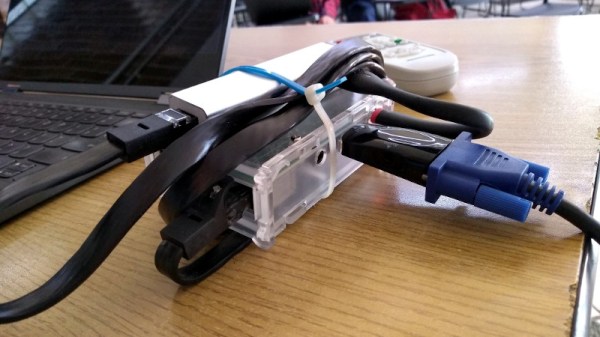
The humble USB-C port has brought us so many advantages over its USB ancestors, one of which is as a handy display output for laptops. Simply add an inexpensive adapter and you can hook up everything from a mobile phone upwards to an HDMI display or projector. There’s a snag though, merely having USB-C is not enough as the device has to support the display feature. It’s a problem [Gunnar Wolf] had to face with a Lenovo ARM laptop, and his solution is unexpected. Instead of an adapter, he’s used a Raspberry Pi 3 and some software tricks.

The obvious route to an off-board Pi mirroring onboard video is to use VNC, which he tried but found wanting due to lagginess. As a user of the Wayland compositor he found he could instead use wf-recorder and send its output to a stream, and thus capture his screen in a way that the Pi could read over the network. It’s not quite as convenient a solution as a pure-hardware adapter, but at least it allowed him to share the screen.

It’s surprising how often we find projects needing to mirror the display of a computer using what hardware is to hand, at least this one is more elegant than some others.

Autogyro Models Are Hard — Even For [Peter Sripol]

Aviation consists of two major groups. Airplane enthusiasts, and helicopter enthusiasts. The two groups rarely get along, each extolling the virtues of their chosen craft. Somewhere in between are autogyro folks. People who like vehicles that blend the best (or worst) of both airplanes and helicopters. Aviation master [Peter Sripol] has dipped his toes into the autogyro world, but not without some trouble.

Autogyros are propelled by a propeller, like a plane. They also have a tail section that works similar to a fixed-wing aircraft. That’s where the similarities end though. Lift for autogyros comes in the form of a rotating set of blades, much like a helicopter. Autogyro rotors aren’t powered during flight. They utilize autorotation. The blades freewheel, spun by the air as the craft moves forward.

[Peter] recently got his hands on a full-scale autogyro. So it made sense to build a model to help learn to fly. This isn’t [Peter’s] first attempt with autogyro models. He’s built a few in the past, with limited success. This time he started from scratch and ran into even more problems!

Continue reading “Autogyro Models Are Hard — Even For [Peter Sripol]”

How A Smartphone Is Made, In Eight “Easy” Blocks

The smartphone represents one of the most significant shifts in our world. In less than thirteen years, we went from some people owning a dumb phone to the majority of the planet having a smartphone (~83.7% as of 2022, according to Statista). There are very few things that a larger percentage of people on this planet have. Not clean water, not housing, not even food.

How does a smartphone work? Most people have no idea; they are insanely complicated devices. However, you can break them down into eight submodules, each of which is merely complex. What makes them work is that each of these components can be made small, at massive economies of scale, and are tightly integrated, allowing easy assembly.

So without further ado, the fundamental eight building blocks of the modern cellphone are: the application processor, the baseband processor, a SIM card, the RF processor, sensors, a display, cameras & lenses, and power management. Let’s have a look at them all, and how they fit together.

Continue reading “How A Smartphone Is Made, In Eight “Easy” Blocks”

Verbot Goes To The Dark Side

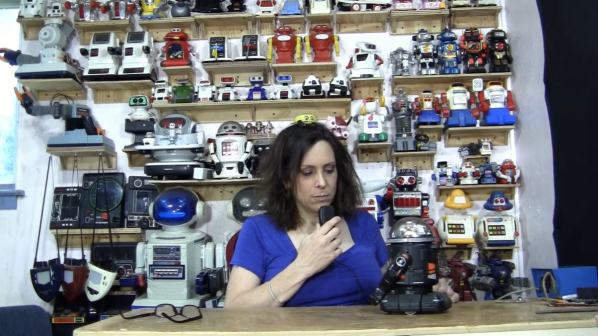
What happens to old, neglected 1980s toy robots? According to the [Randi Rain], they turn to the dark side! Way back in the ’80s, Tomy had an entire line of robots — from keychain wind-up toys to rolling, talking machines almost 2 feet tall. Tucked into the middle of this line was Verbot. Verbot’s claim to fame is that it is a voice-controlled robot. More than that, it was speaker-dependent. Train the robot with commands like “go forward” and then watch as it responds to your every command.

As you might guess, the speech recognition wasn’t great by today’s standards. Recognition was handled by a Microcontroller — a Mitsubishi product that was possibly a mask programmed 8051 variant. Pretty novel for an 80s toy — in fact, there’s a patent for it.

Continue reading “Verbot Goes To The Dark Side”

Will We Ever Shake The Polaroid Picture?

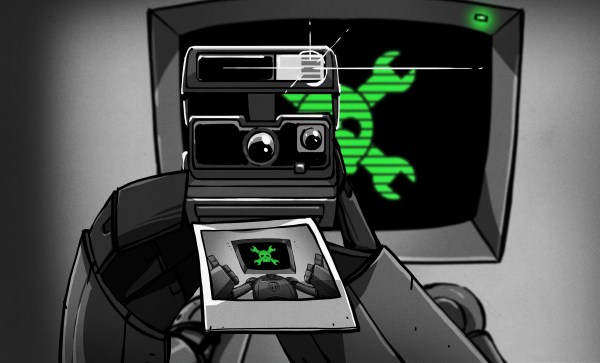
Today, most of us carry supercomputers in our pockets that happen to also take instantly-viewable pictures.This is something that even the dumbest phones do, meaning that we can reasonably draw the conclusion that photographic capability has become a basic feature of everyday carry, a necessity of 21st century life.

Despite the unwashed masses of just-plain-bad photographs clouding the digital landscape, photography itself remains as important as ever so we can retain and disseminate information as history unfolds. In a sense, the more instant, the better — unless it comes at the cost of image quality. The invention of photography is on par with the printing press or with language itself in that all three allow us to communicate within our own time as well as preserve The Way Things Were in frozen silence. And no invention made vivid preservation more convenient than the instant camera.

Continue reading “Will We Ever Shake The Polaroid Picture?”

Looking Forward To EMF Camp: Teasing Us With A Schedule

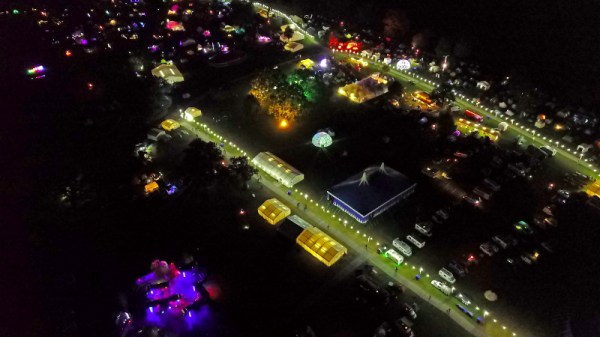
As we gear up for a summer in the field, or more accurately in a series of fields, it’s time to turn our attention towards Eastnor Castle in the Western English county of Herefordshire, venue for the upcoming Electromagnetic Field hacker camp. Sadly we’ve got no badge to tease you with, but they’ve released a list of the talks that will fill their schedule. There are so many to choose from, we can only mention a few in this article.

We’ll certainly be taking the time to watch [Russell Couper] describe his electric motorcycle project. He’s no stranger to unusual bike builds, having given us a diesel machine at EMF 2016. Then of course there’s our own [Dave Rountree], who will be hacking the radio spectrum with GNU Radio. Sure to be an interesting talk.

One feature of this camp we’re very interested in will be CuTEL, a wired copper telephone network on the field. We’ll be taking along our trusty GPO 746 to be part of it of course, but for those without one, there’s [Matthew Harrold]’s talk on building a copper telephone network in a field.

Our cursory scan of the list finishes up with [Alistair MacDonald] on how not to start a hackerspace. We’ve seen our fair share of hackerspace drama over the years, so whether this one causes pain for ex-hackerspace-directors or not, it promises to be informative for anyone in the hackerspace world.

At the time of writing there are still some EMF tickets for sale, so if the beginning of your June is free we can heartily recommend it. To get a flavour of the event, read our 2018 review.

Growing Silver Nanoprisms With Light

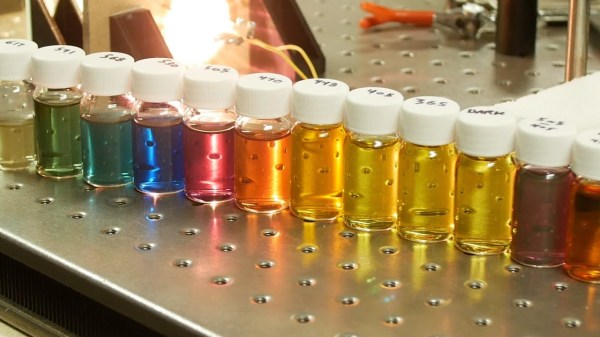
Nanoparticles sound a bit like science fiction to minds of your average hacker — too esoteric and out of reach to be something we might get to work with in our own lairs — but [Ben Krasnow] of [Applied Science] over on YouTube has proven that they most definitely can be made by mere mortals, and importantly they can be tuned. With light. That’s right, nano particle growth appears to be affected very strongly by being illuminated with specific wavelengths, which locks-in their size, and thus defines their light-bending properties. This is the concept of photo mediated synthesis, which causes nanoparticles to clump together into different configurations depending on the wavelength. The idea is to start with a stock solution of Silver Nitrate, which is then reduced to form silver nanospheres which are then converted to larger silver nanoprisms, sized according to the wavelength of the illuminating source.

The process seems simple enough, with a solution of Silver Nitrate and Sodium Citrate being vacuum degassed to remove oxygen, and then purged by bubbling argon or nitrogen. Sodium Borohydride acts as a reducing agent, producing silver metal nanoparticles from the Silver Nitrate solution. The Sodium Citrate coats the silver nanoparticles, as they are produced, preventing them clumping together into a mushy precipitate. PVP (Polyvinylpyrrolidone) is added, acting as a colloiding agent preventing the coated nanoparticles from clumping together, and helping keep the solution stable long enough for the photo mediated synthesis process to complete. Finally, the pH is adjusted up to 11 using sodium hydroxide. The resulting silver nanoparticle stock solution has a pale yellow colour, and is ready for the final particle size selection using the light source.
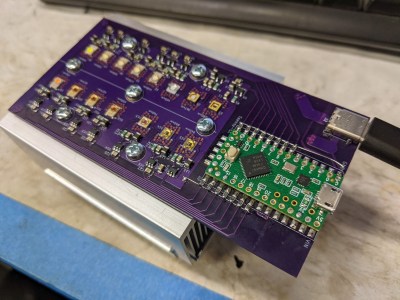
The light source was custom made because [Ben] says he couldn’t find something suitable off the shelf. This is a simple design using a Teensy to drive an array of PAM2804 LED drivers, with each one of those driving its own medium power LED, one for each of the different wavelengths of interest. As [Ben] stresses, the naïve approach of trying to approximate a specific colour with an RGB LED setup would not work, as although the human eye perceives the colour, the actual wavelength peak will be totally wrong, and the reaction will not proceed as intended. The hardware design is available on MultiSpectLED GitHub for your viewing pleasure.

Nanoparticles have all kinds of weird and wonderful properties, such as making the unweldable, weldable, enabling aluminium to be 3D printed, and even enabling the production of one of our favourite liquid toys, ferrofluid.

Continue reading “Growing Silver Nanoprisms With Light”