Driving A PAL TV Over RF Thanks To PWM Harmonics

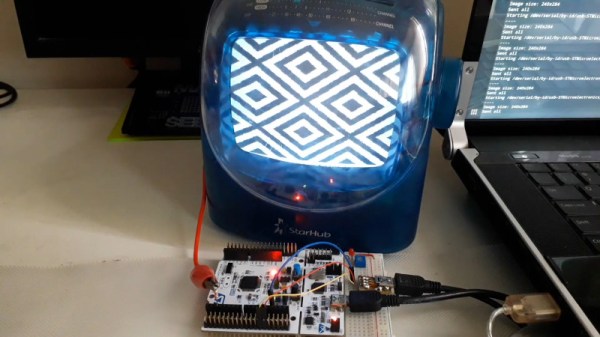
While most analog televisions come with composite video inputs on a yellow RCA jack, the feature is not universal. This problem was even more prevalent in the 1980s, and most home consoles got around the problem by instead feeding video to the television’s tuner with an RF modulator. [Manzel Seet] had just such a television which used the PAL standard. Wanting to display images from a microcontroller, he put together PAL-Streamer.

The aim of the project was to display images on an analog television with minimal investment in hardware over and above what [Manzel] already had on hand. To this end, the project was built using a STM32F411 Nucleo development board. Capable of running at clock speeds up to 100 MHz, there’s plenty of grunt to handle demanding tasks like outputting video signals to a TV.

To achieve the target frequency of VHF Channel 3 (61.25 MHz), [Manzel] elected to rely on the onboard PWM hardware, after being inspired by [CNLohr]’s ATTiny NTSC project. The project takes advantage of the odd harmonics of square waves. Setting the PWM output to operate at 6.86 MHz, the ninth harmonic ends up at around 61.71 MHz, close enough to be tuned in on the TV set. With the hard part done, [Manzel] then implemented a virtual COM port allowing an attached PC to send PNG images or GIF animations to the display.

It’s a fun project that shows it’s possible to drive all kinds of analog displays if you’re willing to be creative about how you do it. Files are available on GitHub for those eager to recreate the work. [Manzel] points out that this method does put out a lot of RF energy in the surrounding bands, but for direct hookup to an antenna input, it works just fine. We love to see creative video projects on microcontrollers, so if you’ve figured out how to get an Arduino Uno to do 1080P over HDMI, be sure to let us know. Video after the break.

Continue reading “Driving A PAL TV Over RF Thanks To PWM Harmonics”

Dealing With A Hacked Brain; Let’s Talk About Depression

This post is different from normal Hackaday fare. I don’t want to presume anything about you, but I’m pretty sure the story I’m about to share resonates with at least some of you.

I’ve been having a tough time, exacerbated by this age of social distancing. This all crept up on me at first, but as I began to look back on my behavior and moods, I began noticing patterns that I hadn’t noticed before. This is certainly a relevant issue in this community, so let’s talk about mental health, beginning with my own journey.

Continue reading “Dealing With A Hacked Brain; Let’s Talk About Depression”

You’ve Never Seen This RetroPie Emulator Console: Watermelon

The Raspberry Pi is a hugely popular platform for emulating older consoles, with the RetroPie framework making it easy to get started in no time at all. Often, these single board computers get built into fun arcade boxes or replica console shells to add to the charm. That’s all been done, so instead, [Cedishappy] decided to go in his own direction – resulting in the wonderful Watermelon Gameboy.

What sounds like a trivial exercise of building a RetroPie rig in a unique enclosure actually comes with some engineering challenges. The basics are all pretty standard – GPIO pins interfacing buttons, a speaker and the screen, emulating a Gameboy Advance. But the mechanical implementation is more complex. The watermelon is first cut open, having its red flesh removed, leaving just the rind. Paper and cardboard templates are then used to make holes for the buttons and screen. Unfortunately, hot glue doesn’t work on watermelon, so instead, toothpicks were used to hold the screen and speaker in place. To protect the electronics from the moist melony environment inside, clear food wrap was applied to the Raspberry Pi and other components where needed.

[Cedishappy] goes above and beyond with the project video charmingly showing the reactions of bystanders to the contextually confusing game system. The combination of electronics with fruit and vegetables is an area we don’t see explored often enough; our own [Mike Szczys] built a magnificent LED Jack-o-Lantern that really looks the business. Video after the break.

Continue reading “You’ve Never Seen This RetroPie Emulator Console: Watermelon”

Art of 3D printer in the middle of printing a Hackaday Jolly Wrencher logo

3D Printering: The World Of Non-Free 3D Models Is Buyer Beware

There are more free 3D models online than one can shake a stick at, but what about paid models? Hosting models somewhere and putting a buy button in front of the download is certainly a solved problem, but after spending some time buying and printing a variety of non-free 3D models online, it’s clear that there are shortcomings in the current system.

What the problems are and how to address them depends a little on the different ways models get sold, but one thing is clear: poorly-designed 3D models are bad for consumers, and bad for the future of pay-to-download in general. Continue reading “3D Printering: The World Of Non-Free 3D Models Is Buyer Beware”

New Arduino JPEG Library Focuses On Speed

Working with graphics on microcontrollers has always meant focusing on making the most of limited resources. Particularly in the 8-bit era, all manner of tricks were used to get low-performance chips to achieve feats beyond their lowly station. However, these days, we’re blessed with 32-bit workhorses with clock speeds in the tens, or even hundreds, of MHz and many kilobytes of RAM to match. It’s these higher performance chips [Larry] had in mind when writing his JPEGDEC library.

As [Larry] discusses in a blog post on the topic, JPEG libraries already exist for the Arduino platform. However, many of these are aimed at 8-bit platforms with tiny amounts of RAM. While it’s possible to decode JPEGs piece by piece with some intelligent code under these conditions, it’s possible to go much faster when you’ve got a little more headroom. [Larry] does a great job of explaining the variety of optimizations he’s developed in the two decades since writing his first JPEG decoder back in 1994. From eliminating unnecessary marker checks to ignoring unneeded data for scaled-down output, it all adds up to get the job done faster. The library targets the Cortex-M0+, or any chip with a minimum of 20K of RAM, as its bare minimum to operate. Faster chips with higher clock rates naturally do better, and [Larry] provides benchmark decoding times for various common hardware using the library.

We’ve featured [Larry]’s GIF decoder for the Arduino platform before, again a useful library that’s optimised for good performance. If you’ve got your own neat tricks for image processing on microcontrollers, you know how to call!

Circle Guitar Creates Wall Of Sound

In the 60s a musical recording technique called the “wall of sound” came to prominence which allowed artists to create complex layers of music resulting in a novel, rich orchestral feeling. While this technique resulted in some landmark albums (Pet Sounds by the Beach Boys for example) it took entire recording studios and many musicians to produce. This guitar, on the other hand, needs only a single musician but can create impressive walls of sound on its own thanks to some clever engineering.

Called the Circle Guitar and created by [Anthony Dickens], the novel instrument features a constantly-rotating wheel around the guitar’s pickups in the body. Various picks can be attached in different ways to the wheel which pluck the strings from behind continuously. This exceeds what a normal guitar player would be able to do on their own, but the guitarist is able to control the sounds by using several switches and pushbuttons which control a hexaphonic humbucker and are able to mute individual strings at will. Of course, this being the 21st century, it also makes extensive use of MIDI and [Anthony] even mentions the use of a Teensy.

While details on this project are admittedly a little fleeting, the videos linked below are well worth a watch for the interesting sounds this guitar is able to produce. Perhaps paired with a classic-sounding guitar amplifier it could produce other impressive walls of sound as well. Either way, we could expect someone like [Brian Wilson] to be interested in one once it is in production.

Thanks to [Mel] for the tip!

Continue reading “Circle Guitar Creates Wall Of Sound”

Sunrise, Sunset, Repeat

Sunrises and sunsets hardly ever disappoint. Still, it’s difficult to justify waking up early enough to catch one, or to stop what you’re doing in the evening just to watch the dying light. If there’s one good thing about CCTV cameras, it’s that some of them are positioned to catch a lovely view of one of the two, and a great many of them aren’t locked down at all.

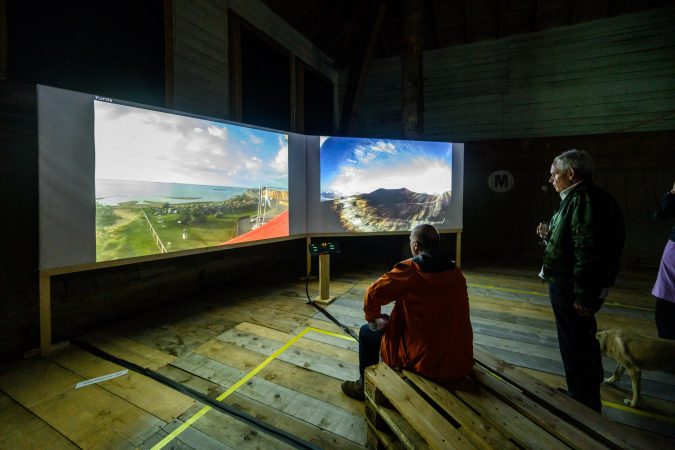
[Dries Depoorter] found a way to use some of the many unsecured CCTV cameras around the world for a beautiful reason: to constantly show the sun rising and setting. Here’s how it works: a pair of Raspberry Pi 3B + boards pull the video feeds and display the sunrise/sunset location and the local time on VFD displays using an Arduino Nano Every. There isn’t a whole lot of detail here, but you can probably get the gist from the high-quality pictures.

If you wanted to recreate this for yourself, we might know where you can find some nice CCTV camera candidates. Just look through this dystopian peephole.

Thanks for the tip, [Luke]!