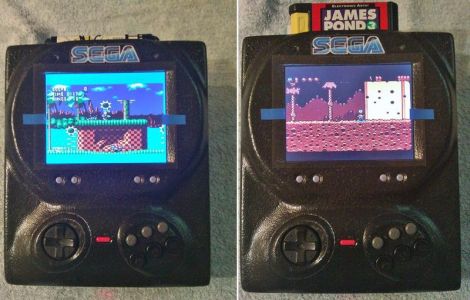
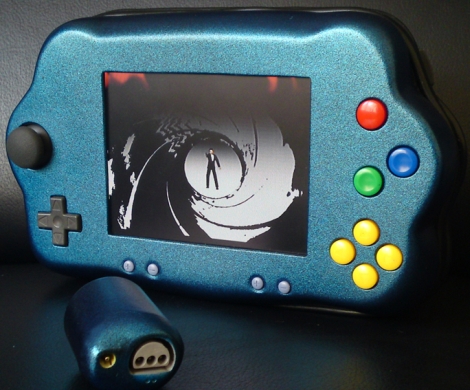
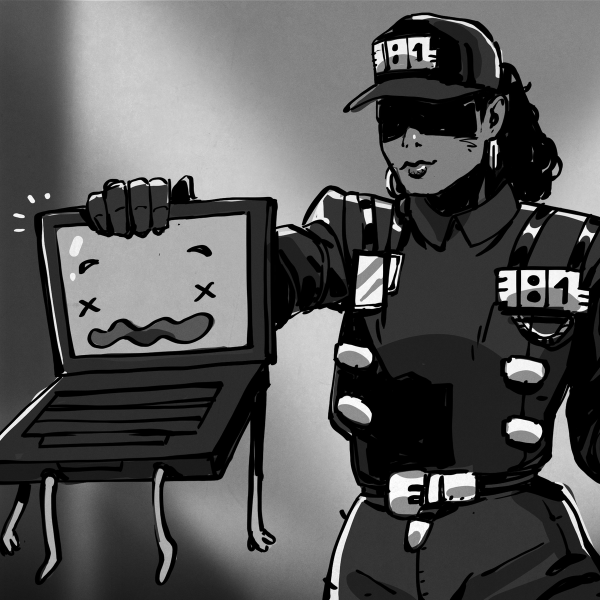
A PSOne In The Palm Of Your Hand

Sony’s original Playstation wasn’t huge, and they did shrink it for re-release later as the PSOne, but even that wasn’t small enough for [Secret Hobbyist]. You may have seen the teaser video a while back where his palm-size Playstation went viral, but now he’s begun a series of videos on how he redesigned the vintage console.

Luckily for [Secret Hobbyist], the late-revision PSOne he started with is only a two-layer PCB, which made reverse engineering the traces a lot easier. Between probing everything under the microscope and cleaning the board off to follow all the traces in copper, [Hobbyist] was able to reproduce the circuit in KiCAD. (Reverse engineering starts at about 1:18 in the vid.)

With a schematic in hand, drafting a smaller PCB than Sony built is made easier by the availability of multi-layer PCBs. In this case [Hobbyist] was able to get away with a four-layer board. He was also able to ditch one of the ICs from the donor mainboard, which he called a “sub-CPU” as its functionality was recreated on the “PSIO” board that’s replacing the original optical drive. The PSIO is a commercial product that has been around for years now, allowing Playstations to run from SD cards– but it’s not meant for the PSOne so just getting it working here is something of a hack. He’s also added on a new DAC for VGA output, but otherwise the silicon is all original SONY.

This is the first of a series about this build, so if you’re into retro consoles you might want to keep an eye on [Secret Hobbyist] on YouTube to learn all the details as they are released.

Continue reading “A PSOne In The Palm Of Your Hand”

An orange PSOne in the shape of a crab sits next to a large CRT monitor displaying a video game of a person running through what appears to be a park. A Pepsi logo is toward the top of the HUD.

Playstacean Evolves The PSOne Into The Crab It Was Always Meant To Be

Odd hardware designs crop up in art and renders far more frequently than in the flesh, but console modder [GingerOfOz] felt the need to bring [Anh Dang]’s image of the inevitable carcinization of our gaming consoles to life.

Starting with the image as inspiration, [GingerOfOz] got to work in CAD, creating an entirely new shell for the battered PSOne he adopted for the project. The final product is slightly less curvy than the picture, but some artistic license was necessary to go from the page to the real world.

The enclosure itself looks straightforward, if a bit tedious, but the articulating crab controller is a work of art itself. He could’ve made the arms static or non-functional, but they’re a fully-functional PlayStation controller that can move around just like on your favorite crustacean at the beach, minus the pinching. We love this whimsical take on the console mod which is a breath of salty air to the continuous race to get increasingly complex consoles into handheld form, although there’s certainly nothing wrong with that!

If you’re looking for some other console mods, how about this Apple M1 inside a Wii or getting your old Ouya up-and-running again?

Continue reading “Playstacean Evolves The PSOne Into The Crab It Was Always Meant To Be”
What Happened To Running What You Wanted On Your Own Machine?

When the microcomputer first landed in homes some forty years ago, it came with a simple freedom—you could run whatever software you could get your hands on. Floppy disk from a friend? Pop it in. Shareware demo downloaded from a BBS? Go ahead! Dodgy code you wrote yourself at 2 AM? Absolutely. The computer you bought was yours. It would run whatever you told it to run, and ask no questions.

Today, that freedom is dying. What’s worse, is it’s happening so gradually that most people haven’t noticed we’re already halfway into the coffin.

Continue reading “What Happened To Running What You Wanted On Your Own Machine?”

Nintendo Does Sony, Better Than Sony

Fans of game consoles from the golden era of TV game appliances have been in for a treat over the past couple of years as a slew of official reboots of the stars of the past have reached the market. These so-called “classic” consoles closely follow the styling of the originals, but under the hood they pack modern hardware running an emulator to play a selection of games from ROM. Even better, with a bit of hacking they can run more than just the supplied emulator, people have managed to use them to emulate completely different consoles. Even then, it’s unexpected to find that a PlayStation emulator on a Super Nintendo Classic runs PlayStation games better than the same emulator built in to Sony’s own PlayStation Classic console.

The feat from [8 Bit Flashback] is achieved despite both machines having near-identical hardware specifications based upon the Allwinner R16 system-on-chip. The Nintendo provides smoother action and more responsive controls, making for a far superior gaming experience. How is this achieved? The most significant difference is that the SNES Classic had the RetroArch front end installed upon it, which may have lent some optimisations and tweaks to make the system more efficient.

Readers with an eye for unusual consoles may remember another Nintendo/Sony hybrid, the ill-fated early-1990s prototype SNES with a CD-ROM which was the first machine to bear the name “PlayStation” (or “Play Station” as it was sometimes styled, leading Sony marketeers to be hot on writers using a space between the words a few years later).

Continue reading “Nintendo Does Sony, Better Than Sony”

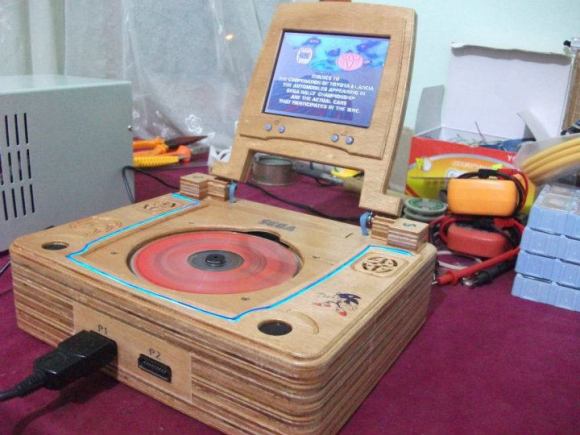
Wooden Case Sega Saturn Laptop

CNC'ed Wooden Case for Sega Saturn

Remember the Sega Saturn? You know, that short-lived game system of the mid 90’s. Well, [c_mon] is still a fan and decided to make a portable version with a built in screen.

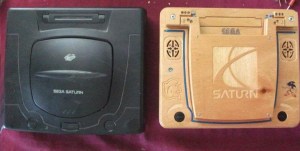
As you can see from the photos, the main case is made from wood, plywood to be exact. Several pieces of the plywood were cut out using a CNC Router and laminated together to achieve the full height needed to enclose the internal electronics. The finished case takes up a little less real estate than the original, however it is slightly taller.

You may recognize the screen as an old PSOne unit. The screen was taken part and housed in it’s own wooden enclosure which is hinged to the main case. The video is supplied to the screen by a composite output from the Saturn. There is no unique CD lid either, the screen functions as one when it is folded down. For sound there are a couple built in powered speakers that tap into the stock audio output.

To ad a little pizzazz, [c_mon] routed in a groove in the top to accept some EL wire. There are also some cool engravings in the wooden case, including the Saturn Automobile Manufacturer logo on the top of the screen lid…. whoops!

CNC'ed Wooden Case for Sega Saturn


N64 In An N64 Controller

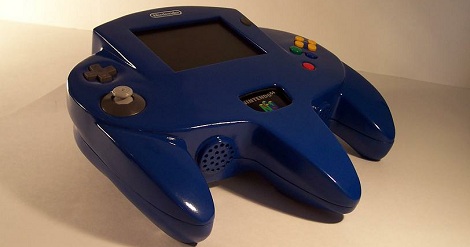
We’ve seen portable N64s before, but none were at the level of [Bungle]’s oversized N64 controller casemod.

Instead of the usual ‘sanding Bondo and gluing styrene’ method we’ve seen in other casemods, [Bungle] decided to make a silicone mold with a positive master. Not only did [Bungle] end up with a case indistinguishable from something produced in a factory, but the molding process left him with more internal room and the ability to make identical duplicates of his over sized controller.

The electronics are the standard fare – a slightly modified N64 with a PSone LCD screen. Because the rumble and memory packs are built in to the body of the gigantic controller, [Bungle] added a multifunction pak to provide ports for power, brightness controls, a/v, and a second controller.

This is an amazing build that really steps up the game for console modders. You can check out [Bungle]’s demo video after the break.

Continue reading “N64 In An N64 Controller”

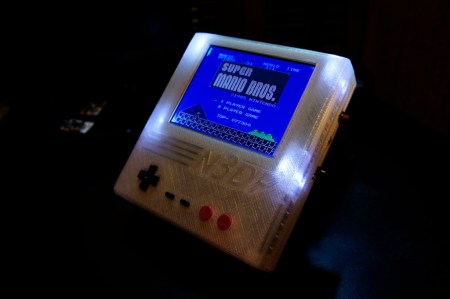
3d Printed Nes Portable Looks Fantastic And Contains No Hot Glue

[Parker] emailed us today to show off his latest NES portable build. This time he’s using the standard “top loader” NES instead of the typically used NES on a chip. This is pretty cool since the NES on a chip has compatibility issues with some games. For the screen, he uses a common PSone screen with a slight power modification. From the factory, the screen takes 7.4 V and converts it down to 5V to use. He removed this and ran it directly from his own 5V power source. It may not seem like that big of a deal, but with portables, every bit counts. He also ditched the sound amplifier from the PSone screen in favor of something a little more efficient. He seems to have done a pretty good job because he says it gets roughly 10 hours at full volume right now.

Another cool aspect of this deign is that the cartridge serves as a sort of stand for the unit, although the button placement looks like it might be a tiny bit awkward when used this way.