Whether you’re into fruit smoothies or icy blended cocktails, a blender comes in handy when preparing these beverages in the kitchen. But, if a small electric motor can do the job well, a noisy combustion engine can certainly do it louder. This is demonstrated ably by this project from [JT Makes It].
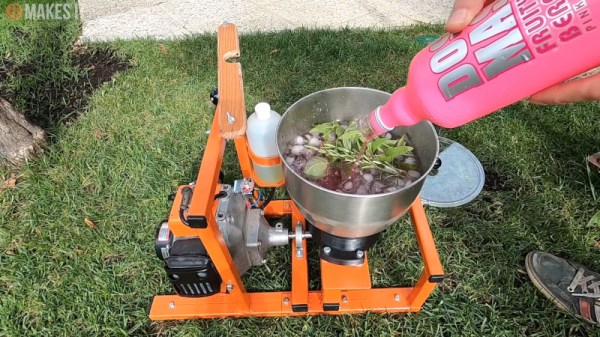
The build is a steel-framed contraption, mounting a small gas engine of the type you’d typically find in a weed trimmer or other garden tool. It’s attached to a shaft allowing it to spin a blender blade at up to 41,000 rpm when unloaded. A stout metal container is mounted on top, along with a plexiglass lid to ensure the contents of the bowl don’t escape when the blender is in action.
It’s a fun build, and one that has no trouble turning a bucket of apples into mush in under 60 seconds. More realistically, [JT] is able to whip up several litres of blended cocktail without major effort, which would be great for parties. Though, we do imagine the burning oil and gas fumes does somewhat spoil the taste sensation. We’ve seen similar hacks before, like this nitro-fuelled pencil sharpener. Video after the break.
Buying things to make your life easier certainly has its therapeutic joys, but if you really wanna feel good, you gotta make the thing yourself whenever possible. [Bjørn Brandal] happened to have a two-switch BOSS pedal just lying around, so it made sense to turn it into a wireless page turner for reading sheet music.
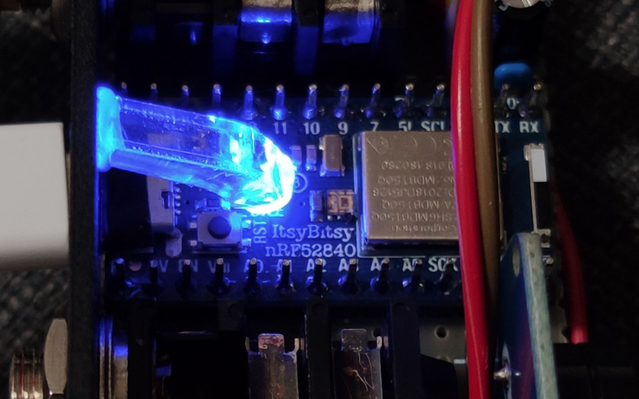
As [Bjørn] says, the circuit is simple — just two 1/4″ TRS jacks and an ItsyBitsy nRF52840 Express. The jacks are used to connect to the pedal outputs to the ItsyBitsy, which sends keystrokes over BLE.
The cool thing about this pedal is that it can work with a bunch of programs, like forScore, Abelton Live, Garage Band, and more. The different modes are accessed by holding down both pedals, and there’s confirmation via blinking LED and buzzing buzzer.
Our favorite part has to be the DIY light guide [Bjørn] that bends the ItsyBitsy’s RGB LED 90° and points it out the front of the enclosure. Nicely done!
In America, corn syrup is king, and real sugar hovers somewhere around prince status. We’re addicted to corn, and corn, in turn, is addicted to nitrogen. A long time ago, people figured out that by rotating crops, the soil will stay nutrient-rich, which helps to an extent by retaining nitrogen. Then we figured out how to make nitrogen fertilizer, and through its use we essentially doubled the average crop yield over the last hundred years or so.
The aerial roots of the Sierra Mixe corn stalk help the plant produce its own nitrogen. Image via Wikimedia Commons
Not all plants need extra nitrogen. Legumes like beans and soybeans are able to make their own. But corn definitely needs nitrogen. In the 1980s, the now-chief of agriculture for Mars, Inc. Howard-Yana Shapiro went to Mexico, corn capital of the world, looking for new kinds of corn. He found one in southern Mexico, in the Mixes District of Oaxaca. Not only was this corn taller than American corn by several feet, it somehow grew to these dizzying heights in terrible soil.
So if we already have nitrogen fertilizer, why even look for plants that do it themselves? The Haber-Bosch fertilizer-making process, which is an artificial form of nitrogen fixation, does make barren soil less of a factor. But that extra nitrogen in ammonia-based fertilizer tends to run off into nearby streams and lakes, making its use an environmental hazard. And the process of creating ammonia for fertilizer involves fossil fuels, uses a lot of energy, and produces greenhouse gases to boot. All in all, it’s a horrible thing to do to the environment for the sake of agriculture. But with so many people to feed, what else is there to do?
Over the last decade, the UC Davis researchers use DNA sequencing to determine that the mucus on the Sierra Mixe variety of the plant provides microbes to the corn, which give it both sugars to eat and a layer of protection from oxygen. They believe that the plants get 30-80% of their nitrogen this way. The researchers also proved that the microbes do in fact belong to nitrogen-fixing families and are similar to those found in legumes. Most impressively, they were able to transplant Sierra Mixe corn to both Davis, California and Madison, Wisconsin, and have it grow successfully, proving that the nitrogen-fixing trick isn’t limited to the corn’s home turf. Now they are working to identify the genes that produce the aerial roots.
One Step in a Longer Journey of Progress
We probably won’t be switching over to Sierra Mixe corn anytime soon, however. It takes eight months to mature, which is much too slow for American appetites used to a three-month maturation period. If we can figure out how to make other plants do their own nitrogen fixation, who knows how far we could go? It seems likely that more people would accept a superpower grafted from a corn cousin instead of trying to use CRISPR to grant self-nitrogen fixation, as studies have shown a distrust of genetically modified foods.
The issue of intellectual property rights could be a problem, but the researchers started on the right foot with the Mexican government by putting legal agreements in place that ensure the Sierra Mixe community benefits from research and possible commercialization. We can’t wait to see what they’re able to do. If they’re unable to transplant the power of self-fixation to other plants, then perhaps there’s hope for improving the Haber-Bosch process.
Hackaday editors Mike Szczys and Elliot Williams weigh the hacking gold found across the internet this week. We can’t get over the epic adventure that went into making a battery from 100 pounds of potatoes. It turns out you don’t need Internet for video conferencing as long as you’re within a coupe of kilometers of everyone else. And move over toner transfer method, resin printers want a shot at at-home PCB etching. We’ll take a look at what the Tesla selfie cam is doing under the hood, and lose our marbles over a ball-bearing segment clock that’s defying gravity.
Take a look at the links below if you want to follow along, and as always, tell us what you think about this episode in the comments!
Take a look at the links below if you want to follow along, and as always, tell us what you think about this episode in the comments!
When we think injection molding, the first thing that comes to mind is highly automated production lines pumping out thousands of parts an hour. However, the very same techniques are able to be scaled down to a level accessible by the DIYer, as [The CrafsMan] demonstrates.
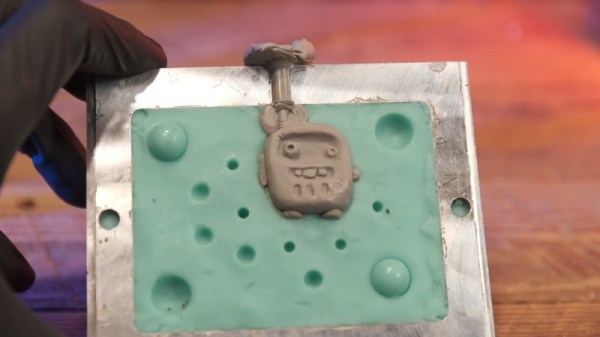
Using a compact, hand-actuated injection moulder, [The Crafsman] demonstrates the basic techniques behind small-scale injection molding. The PIM-Shooter Model 150A in question is designed to work with low melting point plastics like polypropylene and low density polyethylene, and can use aluminium molds which are much cheaper to make than the typical steel molds used in industry.
However, the real game changer is when [The Crafsman] busts out his silicone mold making techniques, and applies them to injection molding. By making molds out of silicone, they can be created far more cheaply and easily without the requirement of heavy CNC machinery to produce the required geometry. With the right attention to detail, it’s possible to get good results without having to invest in a custom aluminium mold at all.
This week, the first details of BleedingTooth leaked onto Twitter, setting off a bit of a frenzy. The full details have yet to be released, but what we know is concerning enough. First off, BleedingTooth isn’t a single vulnerability, but is a set of at least 3 different CVEs (Shouldn’t that make it BleedingTeeth?). The worst vulnerability so far is CVE-2020-12351, which appears to be shown off in the video embedded after the break.
Do you suffer from tinnitus? We were surprised to learn that 15-20% of people have this condition that amounts to constant ringing in the ears. Science doesn’t fully understand the ringing part, but one possible explanation is that the brain is compensating for the frequencies it can’t hear any more.
Then [Lim] and his team tested guinea pigs, searching here, there, and under the armpits for the best place to suppress tinnitus. As it turns out, the tongue is one of the best places when used along with a specific soundscape. So then they did a human trial with 326 people. Each person had a small paddle electrode on their tongue and headphones on their ears.
As the electrodes sparkled like Pop Rocks against their tongues, the trial participants listened to pure frequencies played over a background of sound resembling vaporwave music. The combination of the two overstimulates the brain, forcing it to suppress the tinnitus reaction. This discovery certainly seems like a game changer for tinnitus sufferers. If we had tinnitus, we would be first in line to try this out given the chance. Armed with the soundscape, we’re left to wonder how many 9V batteries we’d have to lick to approximate the paddle.