Laser-Etching Photos On To Eggs

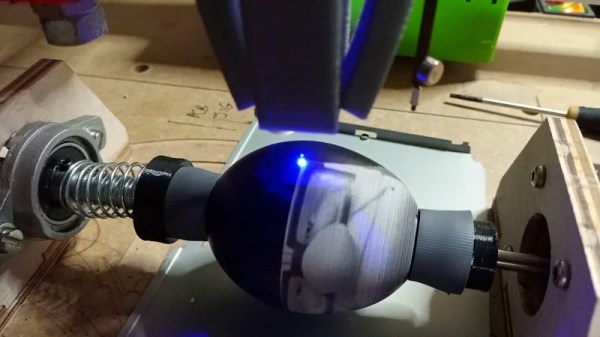
CNC machines are every maker’s dream. Capable of churning out accurate parts from CAD designs with a minimum of manual labor, they’re a great tool to have in the workshop. Alternatively, you can use them for more entertaining pursuits. [Leo]’s project is one of the latter – etching greyscale photos on to eggs.

The first thing you’ll need is an egg-compatible CNC machine. The Eggbot is a popular option, else a fourth-axis on an existing machine can also do the job as in [Leo]’s case. Coupling the egg is a delicate task, for which some rubber paper rollers are salvaged from an old printer and put to work. Then, a laser needs to be fitted to the CNC head, and the egg depth mapped with a probe to ensure the entire etching is in focus. Then it’s simply a matter of loading up an image, and turning the greyscale data into the relevant G-code to burn it onto the egg.

Using eggs coated in black ink, the results [Leo] achieves are impressive. The eggs would make an amusing Easter gift, or serve as a great cheap way to teach students about CNC techniques. Obviously, eye protection is a must, and be sure to mount your laser securely to avoid any unintentional exposures. Video after the break.

Continue reading “Laser-Etching Photos On To Eggs”

Building A Heavy Duty Open Source Ventilator

Since the COVID-19 pandemic started, we’ve seen several attempts to create homebrew ventilators designed to address the shortage of these lifesaving machines. Unfortunately, most hackers aren’t terribly experienced when it comes to designing practical medical equipment. So while many of the designs might have appeared functional on the workbench, there’s little chance they’d get used in any official capacity.

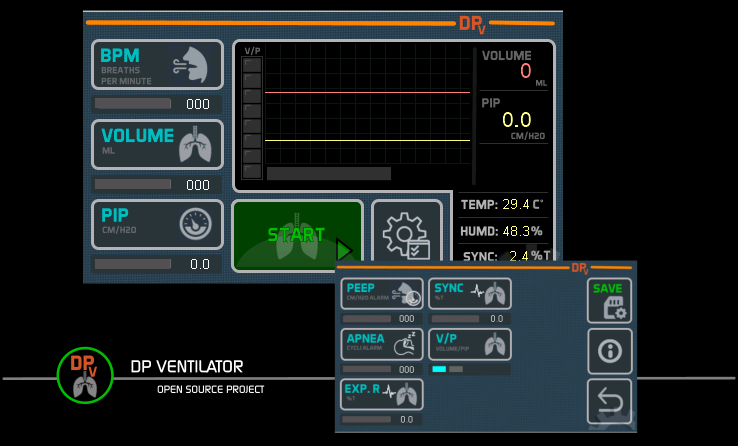
The open source DP Ventilator is still clearly the product of a couple plucky hackers, but we think it shows a level of design maturity that’s been missing in many of the earlier attempts. Made primarily with 3D printed components, this mechanical device is designed to operate a hand-held manual resuscitator; essentially standing in for a human operator. This makes the design far less complex than if it had to actually pump air itself, not to mention safer for the patient since the resuscitator (often referred to as an Ambu Bag) installed in it would be a sterile pre-packaged item.

In the video after the break, you can see just how much thought and effort has been put into the device’s touch screen interface. With a few quick taps the medical professional operating the DP Ventilator can dial in variables such as breathing rate, pressure, and volume to match the patient’s needs. While the Arduino Mega 2560 at the machine’s heart wouldn’t pass muster for any regulating body in charge of medical devices, we think with a few more tweaks, this design is getting close to something that might actually be able to save lives.

Continue reading “Building A Heavy Duty Open Source Ventilator”

A Tale Of Tutor Texts

Have you ever had one of those books that let you choose your own adventure? You know, the book will say “The bully tells you to hand over the secret message. If you want to run away, turn to page 48. If you want to fight him, turn to page 70.” While this is normally a staple of children’s literature, there were a series of training books known as Tutor Texts that used the format to teach technical topics.

In fact, one of these books was my first introduction to computer programming more years ago than I care to admit. But it wasn’t just computer programming. There were titles from the same publisher about trigonometry, slide rules, and even how to play bridge. I own four of these old books and it got me to thinking about how we deliver information on the web. Maybe these books were ahead of their time.

Continue reading “A Tale Of Tutor Texts”

Hackaday Podcast 082: DJ CNC, NFC Black Box, Sound Of Keys, And Payin’ For 3D Prints

Hackaday editors Elliot Williams and Mike Szczys check in on the best hacks from the past week. All the buzz is the algorithm that can reverse engineer your house keys from the way they sound going into the lock. Cardboard construction goes extreme with an RC car build that’s beyond wizard-level. Speaking of junk builds, there’s a CNC mill tipped on its side grinding out results worlds better than you expect from something made with salvaged CD-ROM drives. And a starburst character display is a clever combination of laser cutting and alternative using UV-cured resin as a diffuser.

Take a look at the links below if you want to follow along, and as always, tell us what you think about this episode in the comments!

Take a look at the links below if you want to follow along, and as always, tell us what you think about this episode in the comments!

Direct download (60 MB or so.)

Continue reading “Hackaday Podcast 082: DJ CNC, NFC Black Box, Sound Of Keys, And Payin’ For 3D Prints”

Creating Kelvin Test Leads For Four-Wire Measurments

[VoltLog] has a cheap Hantek LCR meter, but it only has two probes. The best resistance and impedance measurements, though, use four wires to improve accuracy. The first order of business was a custom PCB to fit into the connector of the meter, along with a 3D-printed case.

Using a four-wire scheme requires unusual alligator clips that don’t electrical short the jaws together. The clips were hard to solder and even harder to strain relief. but [VoltLog] seemed to handle it with little problem.

Continue reading “Creating Kelvin Test Leads For Four-Wire Measurments”

This Week In Security: XCode Infections, Freepik, And Crypto Fails

There is a scenario that keep security gurus up at night: Malware that can detect software compilation and insert itself into the resulting binary. A new Mac malware, XCSSET (PDF), does just that, running whenever Xcode is used to build an application. Not only is there the danger of compiled apps being malicious, the malware also collects data from the developer’s machine. It seems that the malware spreads through infected Xcode projects.

WordPress Plugins

WordPress has a complicated security track record. The core project has had very few serious vulnerabilities over the years. On the other hand, WordPress sites are routinely compromised. How? Generally through vulnerable plugins. Case in point? Advanced Access Manager. It’s a third party WordPress plugin with an estimate 100,000 installations. The problem is that this plugin requires user levels, a deprecated and removed WordPress feature. The missing feature had some unexpected results, like allowing any user to request administrator privileges.

The issue has been fixed in 6.6.2 of the plugin, so if you happen to run the Advanced Access Manager plugin, make sure to get it updated. Beyond that, maybe it’s time to do an audit on your WordPress site. Uninstall unused plugins, and make sure the rest are up to date, along with the WordPress installation itself. Continue reading “This Week In Security: XCode Infections, Freepik, And Crypto Fails”

Open Hardware Laptop Built On Power PC ISA

Since Apple switched to Intel chips in the mid-00s, the PowerPC chips from Motorola and the PowerPC Instruction Set Architecture (ISA) that they had been using largely fell by the wayside. While true that niche applications like supercomputing still use the Power ISA on other non-Apple hardware, the days of personal computing with PowerPC are largely gone unless you’re still desperately trying to keep your Power Mac G5 out of the landfill or replaying Twilight Princess. Luckily for enthusiasts, though, the Power ISA is now open source and this group has been working on an open-source laptop based on this architecture.

While development is ongoing and there are no end-user products available yet, the progress that this group has made shows promise. They have completed their PCB designs and schematics and have a working bill of materials, including a chassis from Slimbook. There are also prototypes with a T2080RDB development kit and a NXP T2080 processor, although they aren’t running on their intended hardware yet. While still in the infancy, there are promising videos (linked below) which show the prototypes operating smoothly under the auspices of the Debian distribution that is tailored specifically for the Power ISA.

We are excited to see work continue on this project, as the Power ISA has a number of advantages over x86 in performance, ARM when considering that it’s non-proprietary, and even RISC-V since it is older and better understood. If you want a deeper comparison between all of these ISAs, our own [Maya Posch] covered that topic in detail as well as covered the original move that IBM made to open-source the Power ISA.

Continue reading “Open Hardware Laptop Built On Power PC ISA”