Depositing Metal On Glass With Fiber Laser

Fiber lasers aren’t nearly as common as their diode and CO2 cousins, but if you’re lucky enough to have one in your garage or local makerspace, this technique for depositing thin films of metals in [Breaking Taps] video, embedded below, might be worth checking out. 

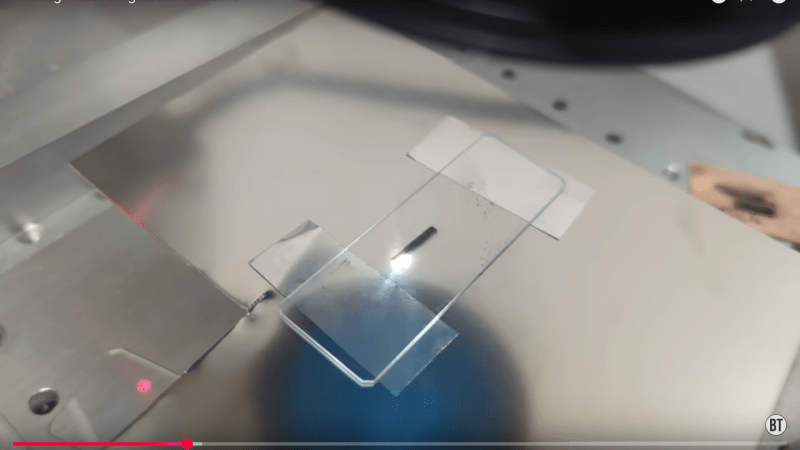
It’s a very simple hack: a metal shim or foil is sandwiched between two pieces of glass, and the laser is focused on the metal. Etching the foil blasts off enough metal to deposit a thin film of it onto the glass.  From electron microscopy, [Breaking Taps] reveals that what’s happening is that microscopic molten metal droplets are splashing up to the ̶m̶e̶t̶a̶l̶  glass, rather than this being any kind of plasma process like sputtering. He found this technique worked best with silver of all the materials tested, and there were a few. While copper worked, it was not terribly conductive — he suggests electroplating a thicker layer onto the (probably rather oxidized) copper before trying to solder, but demonstrates soldering to it regardless, which seems to work. 

This might be a neat way to make artistic glass-substrate PCBs. More testing will be needed to see if this would be worth the effort over just gluing copper foil to glass, as has been done before. [Breaking Taps] suspects, and we agree, that his process would work better under an inert atmosphere, and we’d like to see it tried.

One thing to note is that, regardless of atmosphere, alloys are a bit iffy with this technique, as the ‘blast little drops off’ process can cause them to demix on the glass surface. He also reasons that ‘printing’ a large area of metal onto the glass, and then etching it off would be a more reliable technique than trying to deposit complex patterns directly to the glass in one go. Either way, though, it’s worth a try if you have a fiber laser. 

Don’t have a fiber laser? Maybe you could build one. 

Continue reading “Depositing Metal On Glass With Fiber Laser”
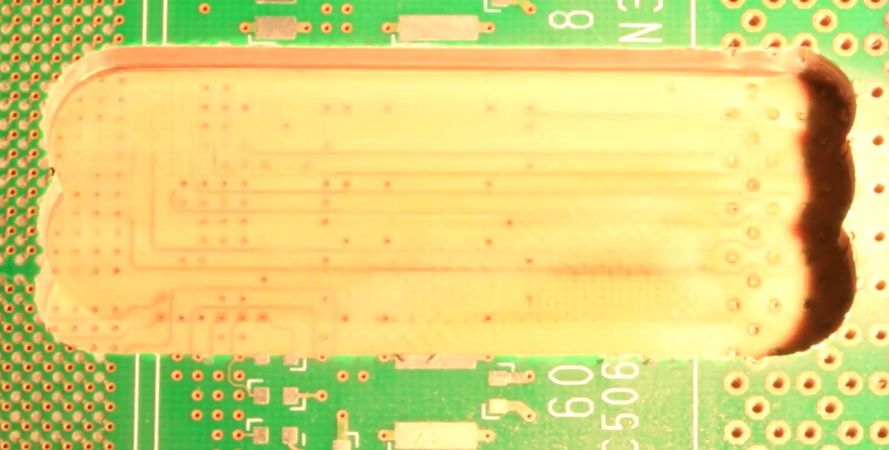
Exposed inner copper on multilayer PCB. (Credit: mikeselectricstuff, YouTube)

LACED: Peeling Back PCB Layers With Chemical Etching And A Laser

Once a printed circuit board (PCB) has been assembled it’s rather hard to look inside of it, which can be problematic when you have e.g. a multilayer PCB of an (old) system that you really would like to dissect to take a look at the copper layers and other details that may be hidden inside, such as Easter eggs on inner layers. [Lorentio Brodeso]’s ‘LACED’ project offers one such method, using both chemical etching and a 5 Watt diode engraving laser to remove the soldermask, copper and FR4 fiberglass layers.

This project uses sodium hydroxide (NaOH) to dissolve the solder mask, followed by hydrogen chloride (HCl) and hydrogen peroxide (H2O2) to dissolve the copper in each layer. The engraving laser is used for the removing of the FR4 material. Despite the ‘LACED’ acronym standing for Laser-Controlled Etching and Delayering, the chemical method(s) and laser steps are performed independently from each other.

This makes it in a way a variation on the more traditional CNC-based method, as demonstrated by [mikeselectricstuff] (as shown in the top image) back in 2016, alongside the detailed setup video of how a multi-layer PCB was peeled back with enough resolution to make out each successive copper and fiberglass layer.

Continue reading “LACED: Peeling Back PCB Layers With Chemical Etching And A Laser”

DIY laser microphone on cutting mat

Spy Tech: Build Your Own Laser Eavesdropper

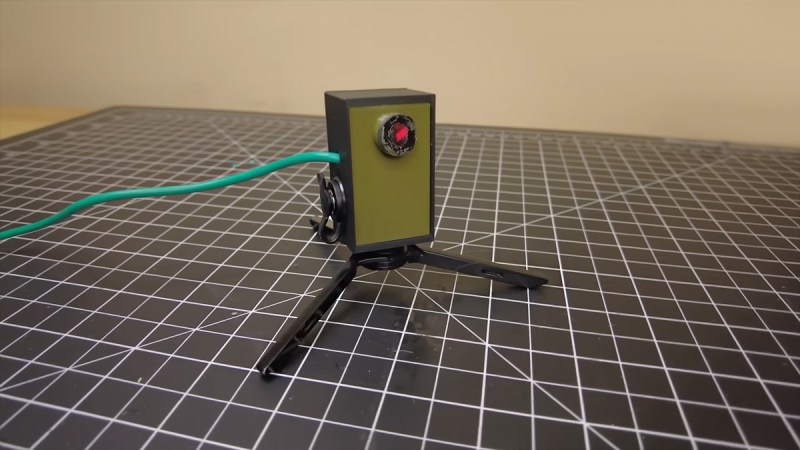
Laser microphones have been around since the Cold War. Back in those days, they were a favorite tool of the KGB – allowing spies to listen in on what was being said in a room from a safe distance. This project by [SomethingAbtScience] resurrects that concept with a DIY build that any hacker worth their soldering iron can whip up on a modest budget. And let’s face it, few things are cooler than turning a distant window into a microphone.

At its core this hack shines a laser on a window, detects the reflected light, and picks up subtle vibrations caused by conversations inside the room. [SomethingAbtScience] uses an ordinary red laser (visible, because YouTube rules) and repurposes an amplifier circuit ripped from an old mic, swapping the capsule for a photodiode. The build is elegant in its simplicity, but what really makes it shine is the attention to detail: adding a polarizing filter to cut ambient noise and 3D printing a stabilized sensor mount. The output is still a bit noisy, but with some fine tuning – and perhaps a second sensor for differential analysis – there’s potential for crystal-clear audio reconstruction. Just don’t expect it to pass MI6 quality control.

While you probably won’t be spying on diplomats anytime soon, this project is a fascinating glimpse into a bygone era of physical surveillance. It’s also a reminder of how much can be accomplished with a laser pointer, some ingenuity, and the curiosity to see how far a signal can travel.

Continue reading “Spy Tech: Build Your Own Laser Eavesdropper”

High-Speed Reservoir Computing With Integrated Laser Graded Artificial Neurons

So-called neuromorphic computing involves the use of physical artificial neurons to do computing in a way that is inspired by the human brain. With photonic neuromorphic computing these artificial neurons generally use laser sources and structures such as micro-ring resonators and resonant tunneling diodes to inject photons and modulate them akin to biological neurons.

General reservoir computing with laser graded neuron. (Credit: Yikun Nie et al., 2024, Optica)

One limitation of photonic artificial neurons was that these have a binary response and a refractory period, making them unlike the more versatile graded neurons. This has now been addressed by [Yikun Nie] et al. with their research published in Optica.

The main advantage of graded neurons is that they are capable of analog graded responses, combined with no refractory period in which the neuron is unresponsive. For the photonic version, a quantum dot (QD) based gain section was constructed, with the input pulses determining the (analog) output.

Multiple of these neurons were then combined on a single die, for use in a reservoir computing configuration. This was used with a range of tests, including arrhythmia detection (98% accuracy) and handwriting classification (92% accuracy). By having the lasers integrated and the input pulses being electrical in nature, this should make it quite low-power, as well as fast, featuring 100 GHz QD lasers.

Getting Started In Laser Cutting

If you were to walk into most of the world’s hackerspaces, it’s likely that the most frequent big-ticket tool you’ll find after a 3D printer is a laser cutter. A few years ago that would inevitably been one of the ubiquitous blue Chinese-made K40 machines, but here in 2024 it’s become common to see something far more sophisticated. For all that, many of us are still laser cutter noobs, and for us [Dominic Morrow] gave a talk at last summer’s EMF Camp in the UK entitled “Getting Started In Laser Cutting“. [Dominic] is a long-term laser cutting specialist who now works for Lightburn, so he’s ideally placed to deliver this subject.

It’s fair to say that this is an overview in the time available for a hacker camp talk rather than an in-depth piece, so he takes the approach of addressing people’s misconceptions and concerns about cutters. Perhaps the most important one he addresses is the exhaust, something we’ve seen a few in our community neglect in favor of excessive attention to laser cooling or other factors. An interesting one for us though was his talking about the cheaper diode lasers, having some insight into this end of the market is valuable when you have no idea which way to go.

We’re sorry to have missed this one in the real world, perhaps because of the allure of junk.

Continue reading “Getting Started In Laser Cutting”

A Laser With Mirrors Makes A CRT-like Display

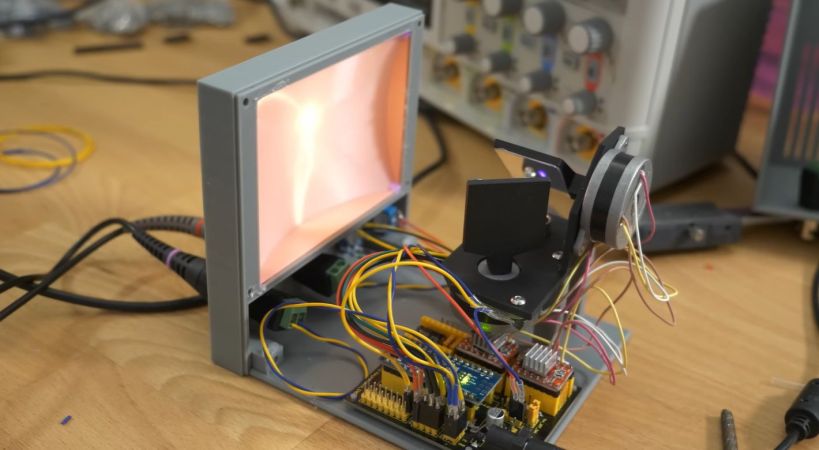
[bitluni]’s laser-based display pretending to be a an old-school vector CRT.
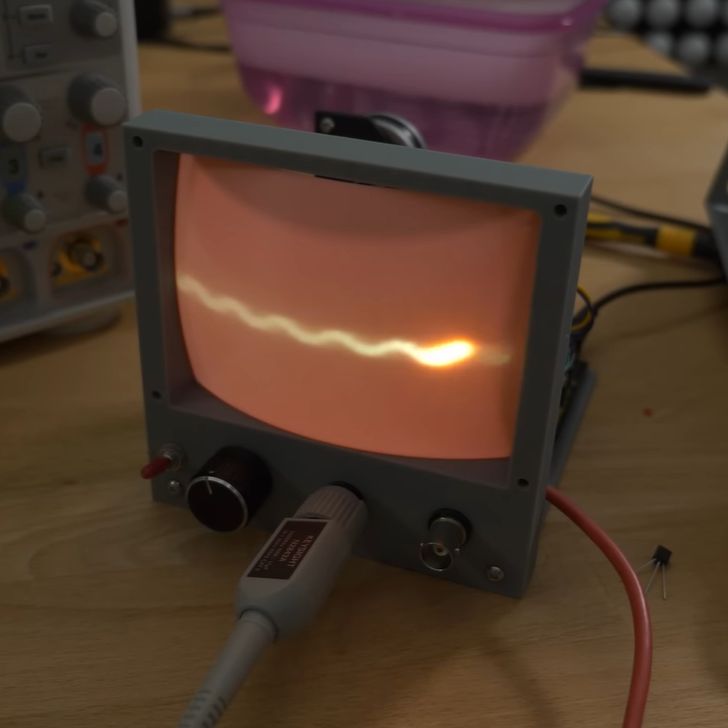
Phosphor-based displays like CRTs rely on the phosphor to emit light for a set amount of time after being activated, allowing them to display a seemingly persistent image with one drawing beam per color. Translated to UV-sensitive PLA filament, this means that you can totally use a printed sheet of this material in combination with a 405 nm laser diode to create a display that doesn’t look dissimilar to an early CRT. This is exactly what [bitluni] did in a recent video, meshing together said laser diode, UV-sensitive PLA, stepper motors and two mirrors with an Arduino-based controller to create a rather interesting vector display.

In the video, [bitluni] goes over the development steps, including a range of improvements like being able to turn off the laser when moving between the end of a line and the beginning of a new one. While the Arduino Nano board does the driving of the stepper motor controllers, an ESP32 provides the drawing instructions. The STL and other project files including Nano & ESP32 firmware can be found on the GitHub project page.

While far from being a practical display with a single-digit Hz refresh rate, it does provide an interesting demonstration of these types of persistence of vision based displays, and without the use of exotic MEMS mirror modules or the like.

Continue reading “A Laser With Mirrors Makes A CRT-like Display”

Laser Painting Explained

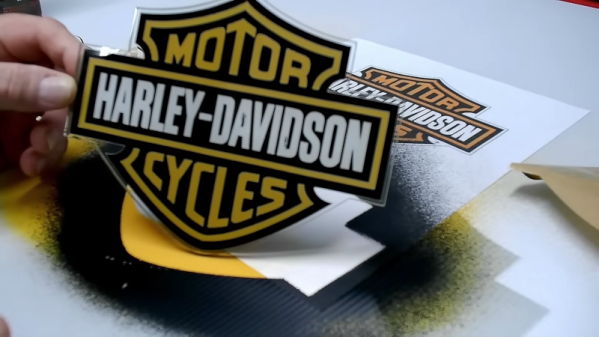
If you get an inexpensive diode laser cutter, you might have been disappointed to find it won’t work well with transparent acrylic. The material just passes most of the light at that wavelength, so there’s not much you can do with it. So how did [Rich] make a good-looking sign using a cheap laser? He used a simple paint and mask technique that will work with nearly any clear material, and it produces great-looking results, as you can see in the video below.

[Rich] starts with a piece of Acrylic covered with paper and removes the paper to form a mask. Of course, even a relatively anemic laser can slice through the paper covering with no trouble at all. He also cuts an outline, which requires a laser to cut the acrylic. However, you could easily apply this to a rectangular hand-cut blank. Also, most diode lasers can cut thin acrylic, but it doesn’t always come out as cleanly as you’d like.

Continue reading “Laser Painting Explained”