It’s (Almost) Two Keytars In One!

All the best retro-1980s chiptune acts should possess a keytar. It’s the Law, or something. [Theremin Hero] has reminded us of this with a new video we’ve shown below featuring an instrument he had a part in creating alongside [Sam Wray] and [Siddharth Vadgama] a few years ago. The Blade is a 3D-printed keytar featuring two Guitar Hero necks and an integrated pair of Game Boys to provide the sound from the authentic silicon.

To describe it in those terms though is to miss a wealth of other components and featured. The keyboard itself is from a Rock Band keytar which feeds MIDI to a Raspberry Pi running PD Extended that handles all the button press mappings. An Arduino Mega performs the same task for the two Guitar Hero necks. Midi from the various sources is processed by an Arduino Boy which then feeds the Game Boys that make the sounds. Oh – and there’s a Leap Motion 3D motion controller in the mix as well, though that doesn’t seem to be used directly in the chiptune synth functionality.

We’ve had a few keytars here over the years, but this one makes us think of the Commodore 64 instrument created by [Jeri Ellsworth].

Continue reading “It’s (Almost) Two Keytars In One!”

Rad-Hard ARM Microcontrollers, Because Ceramic Components Are Just Cooler

If you’re building a cubesat, great, just grab a microcontroller off the shelf, you probably don’t need to worry about radiation hardening. If you’re building an experiment for the ISS, just use any old microcontroller. Deep space? That’s a little harder, and you might need to look into radiation tolerant and radiation hardened microcontrollers. Microchip has just announced the release of two micros that meet this spec, in both radiation-tolerant and radiation-hardened varieties.

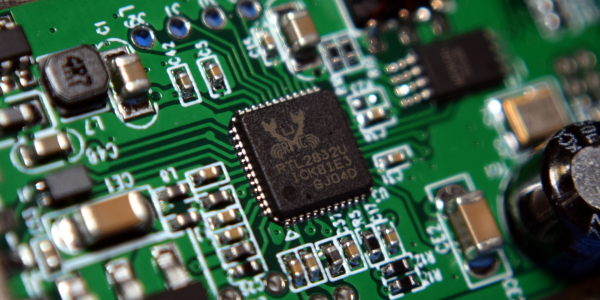
The new devices are the SAMV71Q21RT (radiation-tolerant) and the SAMRH71 (rad-hard), both ARM Cortex-M7 chips running at around 300 MHz with enough RAM to do pretty much anything you would want to do with a microcontroller. Peripherals include CAN-FD and Ethernet-AVB, analog front-end controllers, and the usual support for I2C, SPI, and other standards. This chip does it in space, and comes in a ceramic quad flat package with gold lead frames. These are beautiful devices.

Microchip has an incredible number of space-rated, rad-hard hardware; this is mostly due to their acquisition of Atmel a few years ago, and yes, it absolutely is possible to build a rad-hard Arduino Mega using the chip, space rated.

Of course, there are very, very, very few people who would actually ever need a rad-hard microcontroller; I would honestly expect this to be relevant to only one or two people reading this, and they too probably got the press release. If you’ve ever wanted to build something that goes to space, and you’d like to over-engineer everything about it, you now have the option for an ARM Cortex-M7.

Pick And Place For Toys

Toys are great for keeping the kids amused at play time, but oftentimes its difficult to get them to understand the importance of tidying up after themselves. It would naturally be ideal to have some manner of robot to help in this regard, and [Paco Garcia] might just be leading the charge in this area.

[Paco]’s project involves combining a robotic arm with computer vision tools in order to allow it to pick and place small objects – in this example, toys. The robot arm is of a gantry type, built on an aluminium frame with 3D printed components. The computer vision side of things is handled by a Raspberry Pi, fitted with the standard camera and running OpenCV software for object recognition. This then passes commands to an Arduino which runs the stepper motors controlling the arm.

[Paco] notes that the hardest part of the build was learning how to generate real-world coordinates from a single camera feed in OpenCV. With that mastered, the rest of the dominoes began to fall. With trigonometry and kinematics knowledge in hand, the robot has grown capable of reliably picking and placing small objects across its range of motion. Future work aims to improve the robot’s abilities to rotate and otherwise manipulate its end effector for more versatility.

Naturally, we typically see pick and place machines used for PCB production – and this build is no exception. Video after the break.

Continue reading “Pick And Place For Toys”

Electronics On Ice

We see all manner of electronics enclosures pass through these hallowed pages. Lasercut wooden builds with fancy kerf bending, expertly prepared acrylic boxes, and even the occasional device cast in concrete. [Mike Kohn] decided that all of these were too permanent, however, and chose a different material – ice.

[Mike] shares the ups and downs of his experiments with electronics and frozen water. Initial tests with a circuit sealed in DAP Ultra Clear were largely successful.  A tilt sensor was installed to allow the batteries to remain undrained during the freezing process, and once freed after a few hours of thawing, the circuit was operational. Later builds required some more work – the RC car in particular took a few attempts to avoid the mold leaking. The ice hands are a particular highlight, though – created with rubber gloves, these would be a remarkably spooky decoration come Halloween.

It’s a study in the techniques required to work with this ephemeral material, and there’s a few lessons to learn. Sealing electronics is good, and the best results are with simple circuits with a few LEDs that make everything glow nicely.

If you’re looking for other ideas, you could always create a frozen lens for photographical purposes. Video after the break.

Continue reading “Electronics On Ice”

Telephone Plays The Songs Of Its People

Music, food, and coding style have one thing in common: we all have our own preferences. On the other hand, there are arguably more people on this planet than there are varieties in any one of those categories, so we rarely fail to find like-minded folks sharing at least some of our taste. Well, in case your idea of a good time is calling a service hotline for some exquisite tunes, [Fuzzy Wobble] and his hold music jukebox, appropriately built into a telephone, is just your guy.

Built around an Arduino with an Adafruit Music Maker shield, [Fuzzy Wobble] uses the telephone’s keypad as input for selecting one of the predefined songs to play, and replaced the phone’s bell with a little speaker to turn it into a jukebox. For a more genuine experience, the audio is of course also routed to the handset, although the true hold music connoisseur might feel disappointed about the wide frequency range and lack of distortion the MP3s used in his example provide. Jokes aside, projects like these are a great reminder that often times, the journey really is the reward, and the end result doesn’t necessarily have to make sense for anyone to enjoy what you’re doing.

As these old-fashioned phones gradually disappear from our lives, and even the whole concept of landline telephony is virtually extinct in some parts of the world already, we can expect to see more and more new purposes for them. Case in point, this scavenger hunt puzzle solving device, or the rotary phone turned virtual assistant.

Continue reading “Telephone Plays The Songs Of Its People”

Etch-A-Snap Will Sketch Your Selfies

The Etch-a-Sketch was a hugely popular toy in the days before video games and the Internet became ubiquitous. These days, they’re a fun amusement, but can still be difficult to master. Rather than learn the necessary skills himself, [Martin Fitzpatrick] decided to build a machine to draw for him. Enter the Etch-a-Snap.

The build starts with a Raspberry Pi Zero, equipped with the requisite camera. Images taken are processed into a 100×60 pixel image with 1-bit color. At this stage, a network graph representation is built of the image and used to generate commands for the plotting mechanism to draw the scene. Plotting is achieved with stepper motors that turn the knobs through 3D-printed gears. Plotting is slow, with images taking 15 minutes to an hour to “develop”. The system can also be used to draw manually processed images, which can improve results when images are chosen carefully.

It’s a project that combines modern hardware with a classic toy for some interactive fun. We could imagine a large-scale version of this being a great installation at a science museum or MakerFaire. We’ve seen others tackle a computer-controlled Etch-A-Sketch, too. Video after the break.

Continue reading “Etch-A-Snap Will Sketch Your Selfies”

Building An RC Air Boat From Garbage

What do you get when you combine an old optical drive, some empty soda bottles, and a microcontroller? Well…nothing, really. That’s still just a pile of rubbish. But if you add in a battery, an RC receiver, and some motors, you’re getting dangerously close to a fun little toy to kick around the pond as [Antonio Rizzo] recently demonstrated.

A couple of plastic bottles lashed together make up the hull of the boat, and [Antonio] has used the internal frame of an old optical drive bent at a 90 degree angle to hold the two small DC motors. In a particularly nice touch, the drive’s rubber anti-vibration bushings are reused as motor mounts, though he does admit it was just dumb luck that the motors were a perfect fit.

For the electronics, [Antonio] has paired a custom motor controller up with the uChip, a diminutive Arduino-compatible microcontroller in a narrow DIP-16 package. Wireless communication is provided by an off-the-shelf cPPM receiver such as you might see used in a small plane or quadcopter.

The whole build is powered by a common 18650 lithium-ion battery, which could also be easy enough to recover from the trash given how common they are in laptop batteries; though if you threw a new cell into this build we wouldn’t hold it against you. Everything is put into a high-tech plastic sandwich bag to provide minimum of waterproofing with the minimum of effort.

If using a commercial RC receiver and transmitter is a bit too mainstream for your tastes, you could always roll your own radio.

Continue reading “Building An RC Air Boat From Garbage”