The Prettiest Darn Arcade Cabinet You’ll See Today

We see an awful lot of arcade cabinets around here, and so it’s pretty unusual for a build to get much more than a second glance. But, this beauty is just too good not to mention. The entire build, named “Ready Player One” as a nod to the engrossing Ernest Cline novel, is detailed in [scoodidabop’s] post on Reddit.

Continue reading “The Prettiest Darn Arcade Cabinet You’ll See Today”

A One LED Clock

Esoteric clocks are something of a staple among hardware hacker projects. If it can be made to tell the time correctly, even if only twice a day, the chances are someone’s made a clock from it. And if the only person who can read that clock is its creator, so much the better. Universal accessibility is not always a virtue in the world of unusual timepieces.

6145191469481901992

[Setvir] writes to us with details of his One LED Clock. It’s an Arduino Pro Micro with an RTC module and an LED. That’s all, time is communicated to the world through LED flashes. You might expect therefore that it would use Morse Code, but he’s come up with his own timing communication scheme which does have some merit. Long flashes cover a quarter of the clock face, while short flashes cover individual hours or five-minute segments. He goes into detail on the project page and we can see that once you are used to the scheme it has an elegance to it, but it certainly ticks the essential unreadable-to-the-uninitiated box for an esoteric clock.

We like it though for its simplicity and for the flashing scheme, which once explained is both efficient and easy to read. If you would like to have a go yourself he’s published his code, so go forth and cover the world with baffling single-LED timepieces!

We’ve featured a few minimalist LED clocks before, at least one with a minimal face, and another single-LED offering. But that one used a bi-colour LED, so [Setvir] takes the minimalism crown.


Fail Of The Week: Magnetic Flow Measurement Gone Wrong

Physics gives us the basic tools needed to understand the universe, but turning theory into something useful is how engineers make their living. Pushing on that boundary is the subject of this week’s Fail of the Week, wherein we follow the travails of making a working magnetic flowmeter (YouTube, embedded below).

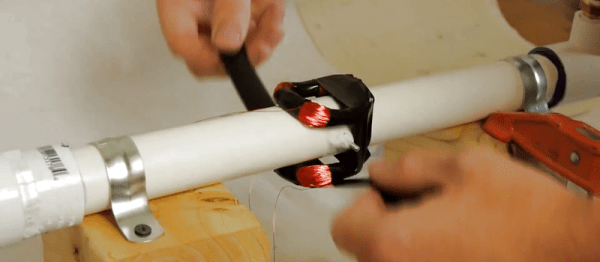
Theory suggests that measuring fluid flow should be simple. After all, sticking a magnetic paddle wheel into a fluid stream and counting pulses with a reed switch or Hall sensor is pretty straightforward, right? In this case, though, [Grady] of Practical Engineering starts out with a much more complicated flow measurement modality – electromagnetic detection. He does a great job of explaining Faraday’s Law of Induction and how a fluid can be the conductor that moves through a magnetic field and has a measurable current induced in it. The current should be proportional to the velocity of the fluid, so it should be a snap to whip up a homebrew magnetic flowmeter, right? Nope – despite valiant effort, [Grady] was never able to get a usable signal out of the noise in his system. 

The theory is sound, his test rig looks workable, and he’s got some pretty decent instrumentation. So where did [Grady] go wrong? Could he clean up the signal with a better instrumentation amp? What would happen if he changed the process fluid to something more conductive, like salt water? By his own admission, electrical engineering is not his strong suit – he’s a civil engineer by trade. Think you can clean up that signal? Let us know in the comments section. 

Continue reading “Fail Of The Week: Magnetic Flow Measurement Gone Wrong”

The Problem With Software Defined Radio

There’s a problem with software defined radio. It’s not that everyone needs to re-learn what TEMPEST shielding is, and it’s not that Bluetooth is horribly broken. SDR’s biggest problem is one of bandwidth and processing. With a simple USB TV Tuner, you can listen in on aircraft, grab Landsat images from hundreds of miles up, or sniff the low-power radios used in Internet of Things things. What you can’t do is make your own WiFi adapter, and you can’t create your own LTE wireless network. This is simply a problem of getting bits from the air to a computer for processing.

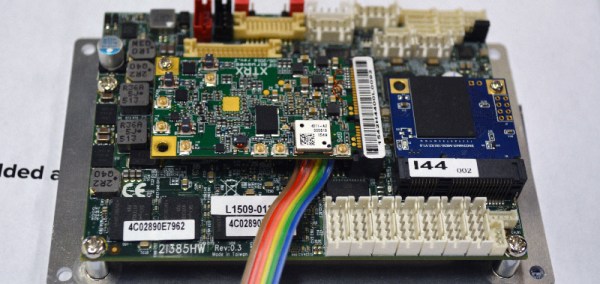
At HOPE last weekend, the folks behind the very capable LimeSDR and a new company working with Lime’s hardware laid out the possibilities of what software defined radio can do if you make a link to a computer very fast, and add some processing on the SDR itself.

Continue reading “The Problem With Software Defined Radio”

Books You Should Read: The Annotated Build-It-Yourself Science Laboratory

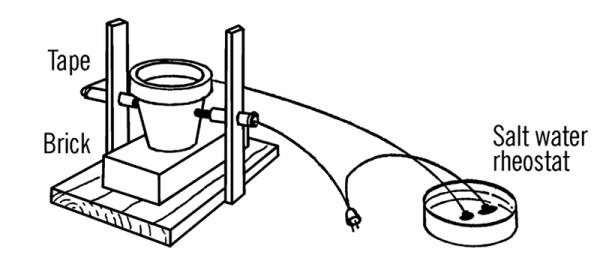
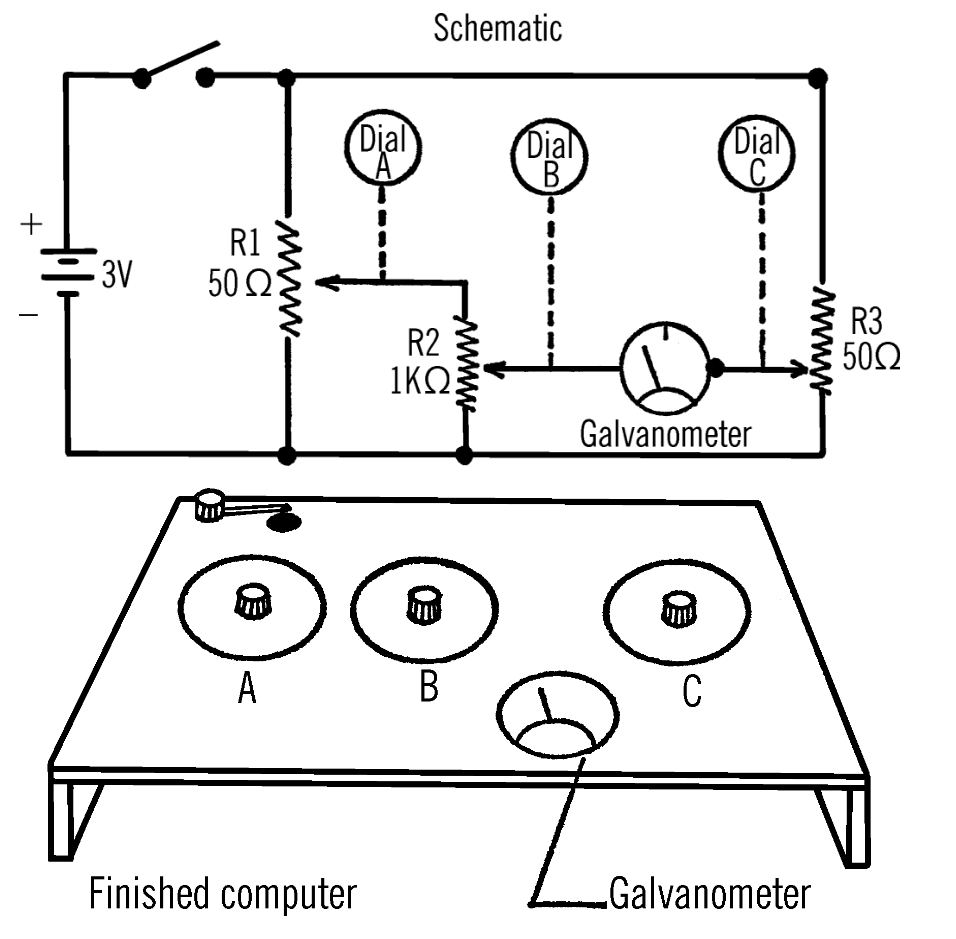
Like a lot of engineers, I spent a lot of time in libraries when I was a kid. There were certain books you’d check out over and over again. One of those was [Raymond Barrett’s] Build-It-Yourself Science Laboratory. That book really captured my imagination with plans for things as simple as a funnel to as complex as an arc furnace (I actually built that one; see diagram above), a cloud chamber, and an analog computer (see below). That book was from 1963 and that did present a few unique challenges when I read it in the 1970’s. It presents even more difficulty if you try to reproduce some of the projects in it today.

anacomp

The world of 1963 was not as safe as our world today. Kids rode bicycles with no protective gear. Dentists gave kids mercury to play with. You could eat a little paint or have asbestos in your ceiling, and no one really worried about it.

That means some of the gear and experiments Barrett covers are difficult to recreate today or are just plain dangerous. For example, he suggests getting sulphuric acid at the drugstore. I don’t suggest you call your local Walgreens and ask them for it. The arc furnace — which could melt a nail, as I found out first hand — used a salt water rheostat which was basically an AC power cord with one conductor cut and passed through and open glass jar containing salt water! Fishing sinkers kept the wire from moving about (you hoped) and I suppose the chlorine gas probably emitted didn’t do me any permanent harm.

I was delighted to see that [Windell Oskay] has revised and rebuilt this great old book into a new edition. As much of the original as possible is still present, but with notes about how to work around material you can’t get any more or notes about safety.

Continue reading “Books You Should Read: The Annotated Build-It-Yourself Science Laboratory”

ESP8266 MicroPython Contest Gives You The Excuse You Need

As if the prospect of having everyone’s favorite scripting language ported over weren’t enough to get you to install MicroPython on a spare ESP8266, there is now a contest for that. Over on Hackaday.io the MicroPython on ESP8266 contest is under way and you’ve only got until the end of August to submit your creation.

The prizes? First place gets an OpenMV camera board because [Radomir], who’s running the contest, has an extra one. OK, it’s not as lush as the corporate-sponsored goody-bag that we’ve got running in the Hackaday Prize, but there’s no reason that you can’t enter both. And if anyone wants to throw some more goodies into the pot, I’m sure they’d be welcome.

The rules are simple: use an ESP8266 or ESP8285 with MicroPython and post the project up on Hackaday.io. Bonus points are given for creating new libraries or hardware drivers. Basically, this just gives you an extra reason to get in there and play around. How cool is that?

If you need a start-up on MicroPython on the ESP8266, the official tutorial is great. We wrote up a first-look review of running MicroPython on the WeMos D1 hardware, but were plagued with (re-)flashing difficulties, so we’re going to have to give it another go.

[Nick Thatcher]’s Plan-B Is A Commuter Electric Unicycle

[Nick Thatcher] is a serial builder of self-balancing rides. His various Segway clones and unicycles have until now suffered from one significant problem, that of portability when not being ridden. Taking one on a train was a significant undertaking, hardly convenient in a personal transport machine.

His latest design, the Plan-B, is an electric unicycle designed to address this problem to create a truly portable piece of commuter transport. It has been designed to be as compact as possible with the ability to fold to fit in a confined space, and the weight has been reduced to a minimum.

Power comes from a 24V 350W geared motor kept on a leash through a Dimension Engineering motor controller by an Arduino with a gyro to maintain the unit’s stability The battery is an ULTRAMAX LiFePO4 , and the single wheel is an inexpensive plastic wheelbarrow part with chain drive from the motor.

The result is both rideable and portable, though with a 10mph top speed not the fastest of personal transport. He’s posted a video which you can see below the break, showing him taking it on a train journey and traversing the British urban landscape.

Continue reading “[Nick Thatcher]’s Plan-B Is A Commuter Electric Unicycle”