College Researcher Makes Supercomputer From 420 PS3s

Noting that funding for science has run dry for many researchers, [Gaurav] has built a supercomputer from 200 Playstation 3 consoles housed and chilled inside an old refrigerated shipping trailer. His mission at UMass Dartmouth from the National Science Foundation is simulating black hole collisions with an eye on learning something about gravitational waves.

Dr. [Gaurav Khanna] is no stranger to using PS3 supercomputers to do meaningful science. Seven years ago he proposed a 16-PS3 supercomputer running Linux and managed to convince Sony to donate four consoles. The university kicked in funding for another 8 and [Gaurav] ponied up for the last four out of his own pocket. He dubbed it the “PS3 Gravity Grid” and received international attention for the cluster. For equivalent performance, it cost him only 10% the price of a real supercomputer. This led to published papers on both hacked supercomputers and gravity waves. But that rig is looking a little old today. Enter the Air Force.

Dr. [Khanna] was not the only one using PS3s to crunch data – back in 2010 the US Air Force built the “Condor Cluster” of 1,760 PS3s to perform radar imaging of entire cities and do neuromorphic AI research. With their hardware now expired, the Air Force donated 200 of the PS3s to [Gaurav] for his new build. Now that he has wired them up, the Air Force is donating another 220 for a not-snicker-proofed total of 420.

For those sceptical that the now 8-year-old hardware is still cost-effective, even with free consoles it is marginal. RAM is an issue and modern graphics cards are each equivalent to 20 PS3s. Ever the popular target these days, Sony has the PS4 OS locked down from the get go – thanks Sony. The next cluster planned will be with PCs and graphics cards. For now, [Gaurav] has plenty of calculations that need crunching and a queue of colleagues have formed behind him.


Hackaday Links Column Banner

Hackaday Links: The Last One Of 2014

The guy behind the Microslice, a tiny Arduino-controlled laser cutter, has a new Kickstarter out. It’s called the Multibox PC, and it’s exactly what you need if you want to turn a Raspi, Banana Pi, HummingBoard, or Odroid U3 into an all-in-one desktop. 14″ 1366 x 768 LCD, and speakers turns dev boards into a respectable little Linux box.

If you’re learning to design schematics and lay out PCBs, you should really, really think about using KiCAD. It’s the future. However, Eagle is still popular and has many more tutorials. Here’s another. [Mushfiq] put together a series of tutorials for creating a library, designing a schematic, and doing the layout.

Another kickstarter wristwatch. But wait, this thing has a circular display. That’s really cool. It’s a 1.4″ 220×220 pixel, 262k color display. No, the display doesn’t use a polar coordinate system.

[Jari] wrote a digital logic simulator, Atanua, started selling licenses, and figured out it wasn’t worth developing on his own anymore. As promised, Atanua is now open source. If you want to look at the finances behind Atanua, here you go.

In 1970, you didn’t have a lot of options when it came to memory. One of the best options was Intel’s 1405 shift register – 512 bits of storage. Yes, shift registers as memory. [Ken Shirriff] got his hands on a memory board from a Datapoint 2200 terminal. Each of the display boards had 32 of these shift registers. Here’s what they look like on the inside

There’s a lot of talk about North Korean hackers, and a quick review of the yearly WordPress stats for Hackaday puts a tear in our eye. This year, there were fifty-four views from the Democratic People’s Republic of Korea. That’s just great. It’s awesome to see the hacker ethos make it to far-flung lands and through highly restricted firewalls. There’s still a long road ahead of us, though, and we’ll redouble our efforts on bringing the hacker mindset to Tuvalu and Saint Helena in the year 2015.

Pendulum Music For Oscilloscope And Photodiodes

Two turntables and a microphone? Try two oscilloscopes and a couple of photodiodes. [dfiction] reinterpreted Steve Reich’s classic feedback piece for more modern electronics. The video is embedded after the break.

The original Pendulum Music is a conceptual musical composition from the heady year of 1968. Basically, you set a bunch of microphones swinging across speakers, making feedback as they pass by. The resulting rhythmic and tonal oscillations change over time as the swinging damps down. It’s either mesmerizing or entirely boring, depending on your mindset.

In the [dfiction] version, the feedback is produced by passing a “light microphone” over an oscilloscope. And since he’s got a pair of these setups, the one microphone also feeds the other ‘scope. The resulting sound is this chaotic and gritty noise-rumble. We dig it.

If slowly evolving “process music” pushes the boundaries of your attention span (or if it’s just not your thing) you can totally skip around in the video. Try around 1:40 and 3:45 into the piece just to get an idea of what’s going on. But once you’re there, you might as well let it run its course.

Continue reading “Pendulum Music For Oscilloscope And Photodiodes”

PuzzleBox

Captain Hermano’s Mystery Box Is Full Of Puzzles

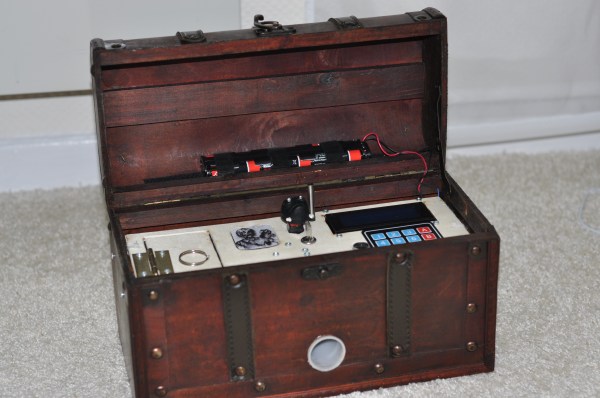
[Raffi] needed a birthday present idea but he wanted to do something extra special. He realized that a big part of gift giving is the anticipation and excitement of opening the present. In order to prolong this experience, [Raffi] built an electronic puzzle box. The box contains the final gift, but first a series of puzzles must be solved in order to open the box.

The project runs on an Arduino Mega. This is hooked up to several sensors, including a temperature sensor, GPS unit, and CO sensor. There is also an LCD screen and numeric keypad for user input and output. The project page contains a flow chart that shows all of the puzzles and their solutions. One of the more interesting puzzles requires the user to blow tobacco smoke into a tube. The CO sensor detects the smoke and unlocks the next puzzle.

Some of the puzzles require interacting with outside systems. For example, one puzzle requires the user to send an email to the fictional Captain Hermano’s email address. If the correct keyword is included in the email, the user will receive a reply with the code to enter into the box. Another puzzle requires the user to call a particular phone number and listen for another riddle. We’ve included the video demonstration below.

This isn’t the first puzzle box we’ve seen, but each one has its own special flair. This one is very well made and looks like a lot of care was put into it. We’ve seen another that uses only discrete components. We’ve seen yet another that uses Morse code. Continue reading “Captain Hermano’s Mystery Box Is Full Of Puzzles”

arduino server

Turn On Your Computer From Anywhere With An Arduino Server

Unless you live off-the-grid and have abundant free electricity, leaving your rig on while you go away on trips is hardly economic. So if you’re like [Josh Forwood] and you happen to use a remote desktop client all the time while on the road,  you might be interested in this little hack he threw together. It’s a remote Power-On-PC from anywhere device.

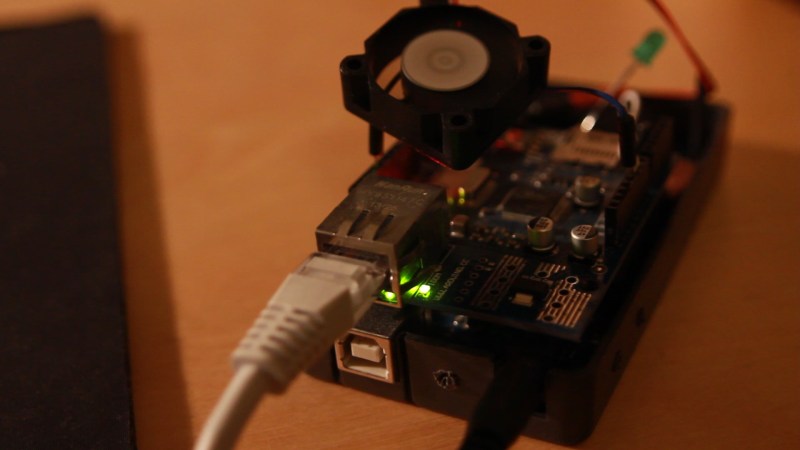
It’s actually incredibly simple. Just one Arduino. He’s piggybacking off of the excellent Teleduino software by [Nathan] who actually gave him a hand manipulating it for his purpose. The Arduino runs as a low-power server which allows [Josh] to access it via a secure website login. From there, he can send a WOL packet to his various computers to wake them up.

The system is working so well, he’s set it up with all his roommates’ computers as well, giving each their own login information on the Arduino’s page to allow them to access their own computer. Not a patient fellow, he also wanted a way to tell when his desktop would be ready to access…

Continue reading “Turn On Your Computer From Anywhere With An Arduino Server”

unicycle

Offset Unicycle Built Mostly From A Single Bicycle

[Lou’s] friends all said that it would be impossible to build a unicycle that had offset pedals. Moving the pedals to the front of the unicycle would throw off the balance and prevent the user from being able to ride it. [Lou] proved them wrong using mostly components from a single donor bicycle.

The donor bike gets chopped up into a much smaller version of itself. The pedals stay attached in the original location and end up being out in front of the rider. The seat is moved backwards, which is the key to this build. Having the rider’s legs out in front requires that there be a counter balance in back. Moving the seat backwards gets the job done with relative ease.

To prevent the hub from free wheeling, [Lou] lashes the sprocket directly to the wheel spokes using some baling wire. He also had to remove the derailer and shorted the chain. All of this gives the pedals a direct connection to the wheel, allowing for more control. The video does a great job explaining the build quickly and efficiently. It makes it look easy enough for anyone to try. Of course, actually riding the unicycle is a different matter. Continue reading “Offset Unicycle Built Mostly From A Single Bicycle”

Class D Amp With An H-Bridge

Class D amps are simple – just take an input, and use that to modulate a square wave with PWM. Send this PWM signal to a MOSFET or something, and you have the simplest class D amp in existence. They’re so simple, you can buy a class D amp chip for $3, but [George] thought that would be too easy. Instead, he built his own with an ATTiny and an H-bridge motor driver. No surprise, it works, but what’s interesting is what effect the code on the ATtiny can have on the quality of the audio coming out of the speaker.

The microcontroller chosen for this project was the ATtiny 461, a part we don’t see much, but still exactly what you’d expect from an ATtiny. The heavy lifting part of this build is an L298 chip found on eBay for a few dollars. This dual H-bridge is usually used for driving motors, but [George] found a home for it in the power section of an amplifier.

The ATtiny is clocked at 16 MHz, making the ADC clock run at 1 MHz. A 10-bit precision conversion takes place, and this value sets the PWM duty cycle. Timer1 in the chip is set up to run at 32 MHz, and by counting this timer up to 1023 gives this amp its PWM cycle speed of 31.25 kHz. That’s right in the neighborhood of what a class D amp should run at, and the code is only about 30 lines. It can’t get simpler than that.

[George] put up a video of this amp in operation, and despite not following the standard design of a Class D amp, it sounds pretty good. You can see that video below.

Continue reading “Class D Amp With An H-Bridge”