30 Years Later TED Finds His Voice: A Commodore Story Part II

[Continued from 30 Years later TED finds his voice: A Commodore Story Part I]

Like parents standing on the porch waiting to see their children off to their first day of school we waited for what comes next in a release to production. Among our children: The C116 ($49 Sinclair killer), the C264 ($79 office computer), and the V364 – The computer with an interactive desktop that could speak (courtesy of [John Fegans] who gave us the lion’s share of what made the C64 software great).

Something happened then, and by something I mean nothing. Nothing happened. We waited to assist in production builds and stood ready to make engineering change notices, and yet nothing happened. It was around this time that [Mr. Jack Tramiel] had left the company, I know why he left but I can’t tell due to a promise I made. Sadly, without [Tramiel’s] vision and direction the new product releases pretty much stopped.

What happens when Marketing tries to design a computer: a TED in a C64 case known as a C16
What happens when Marketing tries to design a computer: a TED in a C64 case known as a C16.

Meanwhile in Marketing, someone came up with the idea to make the C264 more expensive so that they could then sell it for a prohibitively high price in. They changed the name, they told us to add chips, and they added software that (at best) wasn’t of interest to the users at that price. They wanted another C64, after all it had previously been the source of some success. Meanwhile the C116 and the V364 prototypes slowly melded into the random storage of a busy R&D lab. We literally didn’t notice what had happened; we were too busy arguing against abominations such as the C16 — a “creation” brought about by a shoving a TED board into a C64 case (the term inbred came to mind at the time).

Continue reading “30 Years Later TED Finds His Voice: A Commodore Story Part II”
An Electric Arc Printer For Rapid 3D Prototyping

Additive manufacturing, aka 3D printing, is able to produce wonderful and amazing objects in relatively short periods of time. Items are now being created in hours, not days, which is an extraordinary leap in technology. However, waiting for a 3D printer to complete its cycle is still a lot like watching paint dry. It takes way too long, and occasionally, time is of the essence when prototyping products for a client. Sometimes you just need it done now,…not a few hours from now.

[0n37w0] is hoping solve this problem by working on a way to ‘print’ 3D objects using arcs of electricity. We are still trying to wrap our heads around how this will work, but from the looks of it, arc printing “is done by completing an electrical current on an area of granulated metal thus heating the metal enough to form a bond to the structure being printed.

The printer is comprised of four main components (the print bed, the lifting device, the control box, and the granulated metal supply bin). The supply bin feeds granulated metal, possibly by vibration, onto the print bed. A lifting mechanism is then lowered within electrical contact and the printing begins. After each layer, the object is raised.

To find out more, check out the Hackaday.io project page.

The badge from Queercon 11 at Defcon

The Queercon 11 Badge

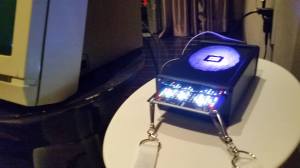
DEFCON is known for its unique badge designs, which have featured displays, radios, and tons of LEDs in the past. This year, there was another digital badge at DEFCON. The Queercon 11 badge featured an MSP430, a LED display, an IR interface, and an ISM band radio.

Queercon started off as a DEFCON party for LGBT hackers. Over the past eleven years they’ve run events at DEFCON including parties, mixers, and networking events. Over time the group has grown, become a non-profit, and provided a social network for LGBT people in tech. We must admit that they throw quite a good pool party.

This badge gave you points for meeting other people. When held near another QC11 badge, the IR link sends the identifier for each person. Both badges light up and display the other person’s name, and store the event. This process became known by a variety of colloquialisms, and “badginal intercourse” was a common occurrence at events.

The reader for Queercon 11 badges
The QC11 Badge Reader

The RF radio, implemented using a HopeRF RF69 module, shows how many people with QC11 badges are near you. A base station at events sends out data to give badges points for attendance. As points are accumulated, the rainbow LEDs on either side of the display light up.

At Queercon parties, a reader connected to a dumb terminal read data off the badges. It then shows who the badge has paired with, and what events its been to.

The hardware design and source code have all been released on the Queercon website. The full functionality is discussed in the README.

Subway radar

LEDs Turn This Paper Map Into A Tram Tracker

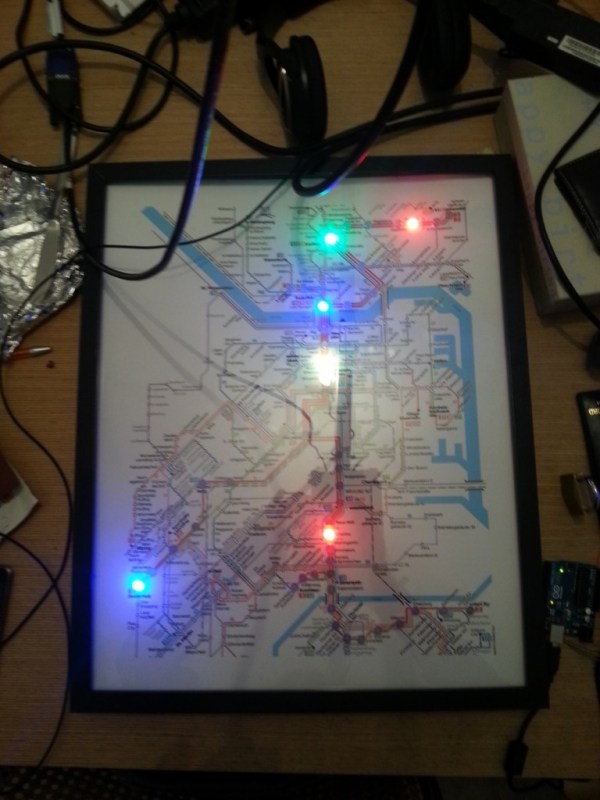
Public transit can be a wonderful thing. It can also be annoying if the trains are running behind schedule. These days, many public transit systems are connected to the Internet. This means you can check if your train will be on time at any moment using a computer or smart phone. [Christoph] wanted to take this concept one step further for the Devlol hackerspace is Linz, Austria, so he built himself an electronic tracking system (Google translate).

[Christoph] started with a printed paper map of the train system. This was placed inside what began as an ordinary picture frame. Then, [Christoph] strung together a series of BulletPixel2 LEDs in parallel. The BulletPixel2 LEDs are 8mm tri-color LEDs that also contain a small controller chip. This allows them to be controlled serially using just one wire. It’s similar to having an RGB LED strip, minus the actual strip. [Christoph] used 50 LEDs when all was said and done. The LEDs were mounted into the photo frame along the three main train lines; red, green, and blue. The color of the LED obviously corresponds to the color of the train line.

The train location data is pulled from the Internet using a Raspberry Pi. The information must be pulled constantly in order to keep the map accurate and up to date. The Raspberry Pi then communicates with an Arduino Uno, which is used to actually control the string of LEDs. The electronics can all be hidden behind the photo frame, out of sight. The final product is a slick “radar” for the local train system.

DIY Lantern

Lantern Made In Preparation Of Zombie Apocalypse

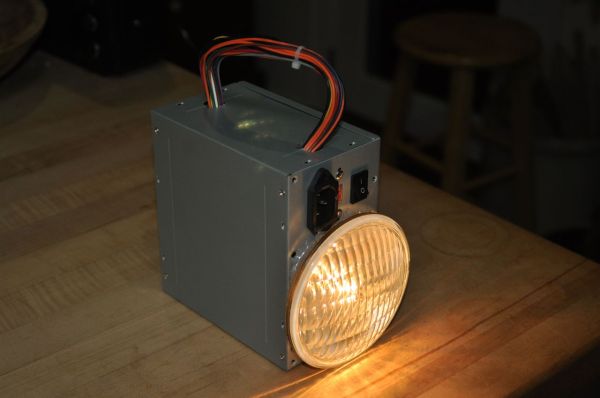
[BenN] was at his local hackerspace one day when a friend stopped by and offered him a used 5AH lead acid battery. As any good tinkerer would, he jumped on the opportunity and immediately started looking around for a project to use the battery in. One of [BenN’s] recent other projects involved 12volt landscaping lights, the same voltage as the battery he was just given. At this point it was clear that he had a good start to making a lantern. This lantern project also supports [BenN’s] obsession with hobby of preparing for the zombie apocalypse.

A lantern needs an enclosure. Over on the hackerspace’s spare-parts rack was an old ATX power supply. All of the internal electrical components were removed to make room for the battery which fit inside nicely. The landscaping light just happened to be slightly larger than the power supply’s fan cut outs. Once the grill was removed from the metal power supply enclosure, the lamp fit in nicely and was secured using silicone glue which can tolerate any temperature the bulb can produce.

The feature that separates a lantern from a flashlight is the top-mounted carrying handle and this lantern will receive one made from the wiring removed from the ATX power supply. The electrical wiring is fairly straight forward. The battery is connected to the landscaping light by way of the original ATX on/off switch. The two terminals of the battery were also wired to the power supply’s AC input connector. This allows [BenN] to connect a DC battery charger to two of the three pins in order to charge the battery. Although this is a creative way to re-use the AC connector, it leaves quite a bit of potential to accidently plug in a 120v AC cord!


A DIY CNC dust collector

DIY CNC Dust Collection

CNC machines are great at churning out custom parts, but they tend to make a mess in the process. [Darcy] has built up his own CNC dust collection rig to collect the dust and keep his workspace clean.

To capture the dust, a custom dust skirt encloses the cutting tool and directs the vacuum. This was made by gluing acrylic parts together, creating a box that contains the dust and provides a connection for the vacuum system.

For $1, [Darcy] built a cyclone dust extractor. This spins air around in circles, causing the dust to fall to the bottom of a container. The result is less dust reaching the vacuum, and much less money spent on vacuum bags.

Since the vacuum makes quite a bit of noise, a muffler was needed. This is just a simple wood box to contain the machine. It can also be used to vent the exhaust outside to further prevent polluting the workspace.

While we’ve seen some similar builds in the past, [Darcy]’s design could be helpful for those looking to build their own system. He also gives us a video which shows the effectiveness of the dust skirt, which you can find after the break.

Continue reading “DIY CNC Dust Collection”

Hackaday Links, September 14, 2014

Photonicinduction is back! The Brit famous for not setting his attic on fire has built a 20,000 Watt power supply. It connects directly to England’s national grid with huge connectors. Impeccable fabrication and triple servo controlled variacs, and apparently this will be used for making a lot of hydrogen and oxygen through electrolysis of water.

In case you missed it, there’s a group buy for Flir’s Lepton thermal imaging module. Here’s the breakout board.

Need to solder something away from an outlet, and all you have is a disposable lighter? There’s a fix for that.

A Raspberry Pi case designed to be compatible with Lego. Now we need a hat/shield for NXT connectors.

Need another channel in your RC remote? Here’s this. It uses the gyro gain channel on a receiver. If someone wants to figure out how this works, wee do have a rather cool project hosting site.

0x06 0x1f1 CHSJOXWA OM YUFJPAI XFADBLY GIKQB CRZ MIXRB JRWV NN LZVOD XRI TBJKKVX MYYGID BLS LWNY XJVS FJO PYXBM MW D ELX ZG BIM CWMG JF PKI TKI ESZ WBME LKNLI BL 1407981609

Here’s something impossibly cool: The Macintosh PowerBop. It’s a Powerbook 170 with the floppy drive replaced with the radio in a cordless phone. It was part of France’s BiBop network, and you could buy private base stations for use at home. It is technically possible to use the radio as a wireless link to a modem, but [Pierre] couldn’t get PPP or a sufficiently ancient browser working. Plus ten points for taking it to an Apple store, and another twenty for trying to connect to our retro edition.

Chicken Lips. [Fran] and our very own [Bil Herd] are hanging out a bunch and recalling [Bil]’s time at Commodore. For this little featurette, [Bil] brought out his very own Commodore LCD. There are three of those in the world. Also included: tales of vertical integration, flipping bits with photons, and 80s era ERC.