ROM dump

Raiders Of The Lost ROM

Once upon a time, arcades were all the rage. You could head down to your local arcade with a pocket full of quarters and try many different games. These days, video arcades are less popular. As a result, many old arcade games are becoming increasingly difficult to find. They are almost like the artifacts of an ancient age. They are slowly left to rot and are often lost or forgotten with time. Enter, MAME.

MAME (Multiple Arcade Machine Emulator) is a software project, the goal of which is to protect gaming history by preventing these arcade machines from being lost or forgotten. The MAME emulator currently supports over 7000 titles, but there are still more out there that require preservation. The hackers who work on preserving these games are like the digital Indiana Jones of the world. They learn about lost games and seek them out for preservation. In some cases, they must circumvent security measures in order to accurately preserve content. Nothing as scary as giant rolling boulders or poison darts, but security nonetheless.

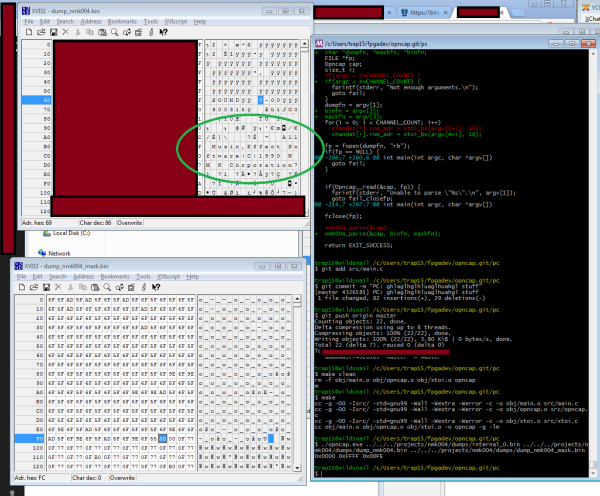
Many of the arcade cabinets produced by a publisher called NMK used a particular sound processor labeled, “NMK004”. This chip contains both a protected internal code ROM and an unprotected external ROM that controls the sound hardware. The actual music data is stored on a separate unprotected EEPROM and is different for each game. The system reads the music data from the EEPROM and then processes it using the secret data inside the NMK004.

The security in place around the internal ROM has prevented hackers from dumping its contents for all this time. The result is that NMK games using this chip have poorly emulated sound when played using MAME, since no one knows exactly how the original chip processed audio. [trap15] found it ridiculous that after 20 years, no one had attempted to circumvent the security and dump the ROM. He took matters into his own hands.

The full story is a bit long and contains several twists and turns, but its well worth the read. The condensed version is that after a lot of trial and error and after writing many custom tools, [trap15] was able to finally dump the ROM. He was able to accomplish this using a very clever trick, speculated by others but never before attempted on this hardware. [trap15] exploited a vulnerability found in the unprotected external ROM in order to trick the system into playing back the protected internal ROM as though it were the sound data stored on the EEPROM. The system would read through the internal ROM as though it were a song and play it out through the speakers. [trap15] recorded the resulting audio back into his PC as a WAV file. He then had to write a custom tool to decode the WAV file back into usable data.

[trap15] has released all of his tools with documentation so other hackers can use them for their own adventures into hardware hacking. The project was a long time in the making and it’s a great example of reverse engineering and perseverance.

[Thanks Ryan]
Inductive charger

Inductive Charger Mod Allows For Non-Stop Wireless Rocking

When you want to jam out to the tunes stored on your mobile devices, Bluetooth speakers are a good option. Battery power means you can take them on the go and the Bluetooth connection means you don’t have to worry about cables or wires dangling around. Unfortunately the batteries never seem to last as long as we want them too. You can always plug the speaker back in to charge up the battery… but when you unhook those cords they always seem to end up falling back behind the furniture.

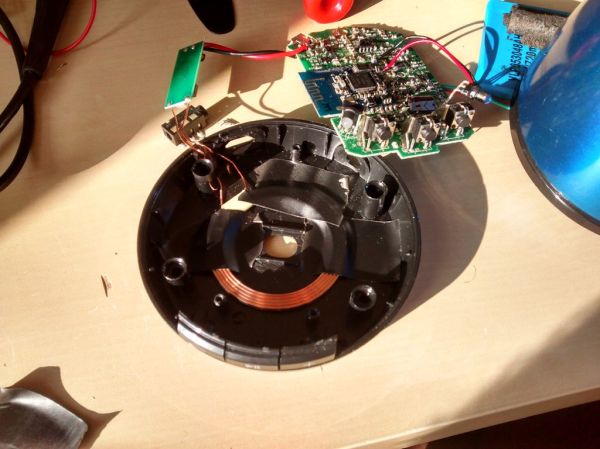
[Pierre] found himself with this problem, but being a hacker at heart meant that he was able to do something about it. He modified his JAM Classic Bluetooth Wireless Speaker to include an inductive charger. It used to be a lot of work to fabricate your own inductive charging system, or to rip it out of another device. But these days you can purchase kits outright.

The JAM speaker was simply put together with screws, so no cracking of the plastic was necessary. Once the case was removed, [Pierre] used a volt meter to locate the 5V input line. It looks like he just tapped into the USB port’s power and ground connections. The coil’s circuit is soldered in place with just the two wires.

All [Pierre] had left to do was to put the speaker back together, taking care to find space for the coil and the new circuit board. The coil was taped to the round base of the speaker. This meant that [Pierre] could simply tape the charging coil to the underside of a glass table top. Now whenever his Bluetooth speaker gets low on battery, he can simply place it on the corner of the table and it will charge itself. No need to mess with cables.


DIY Bike Turn Signals

DIY Bike Brake Light And Turn Signals

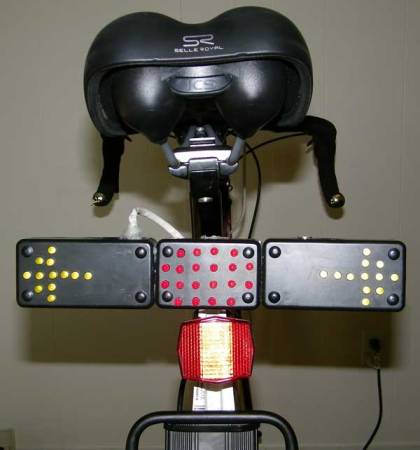
If you ever take your bike out and share the road with large automobiles, you know that sometimes it can get a little hairy. As a biker, you will stand no chance in a collision with a vehicle. Communicating your intentions, i.e. turning and braking, can certainly reduce your risk of getting in an accident. [Mike] didn’t like the traditional idea of taking a hand off the handlebars in order to signal to traffic so he did something about it, he built turn signals and a brake light for his bike.

The business end of this project is the rear-facing light bar mounted under the rider’s seat. It is made from Radio Shack project boxes and mounted to an off-the-shelf L bracket. A bunch of LEDs were installed in the project boxes, the yellow turn signal LEDs are arranged in the shape of arrows and the red brake light LEDs are in an oval. Inside the project boxes you will find the 9v battery that powers the circuit and also a breadboard that is home to the circuits responsible for blinking the turn signals.

DIY Bike Turn Signals

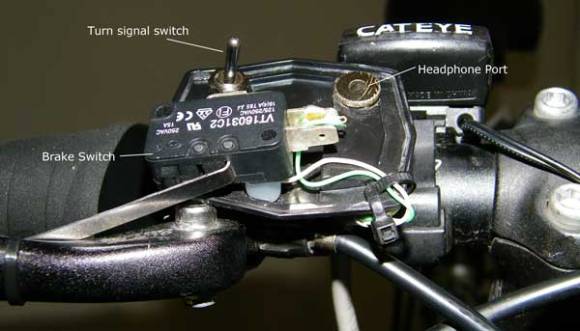
Check out the switch assembly that is mounted to the handle bars. It was built using an old reflector bracket which was already the correct size to mount to handle bars. As you would expect, there is a toggle switch for turning the turn signals on and off. A little bit more interesting is the brake switch. It is a hinge-lever style limit switch and positioned in a manner such that it is activated when the brake lever is pulled. There is no additional thought or effort required on the cyclist’s part!

Something that is certainly not expected on the switch assembly is the headphone jack. [Mike] likes to listen to music while he rides and a cord dangling around from a backpack or bike bag gets in the way. On the rear light bar, there is a headphone jack that allows an MP3 player to be plugged into. The audio signals travel up the same CAT5 cord used for the turn and brake signals. This allows only a short run of headphone cable from the handlebars to [Mike’s] ears.

THP Quarterfinalist: Hypoglycaemia

For somewhat obvious reasons, there aren’t many medical hacks making their way to the quarterfinal selection of The Hackaday Prize. One exception to this is [Thomas]’ Hypoglycaemia Alert System, a Bluetooth device that detects low blood sugar in sleeping diabetics and calls for help.

This isn’t the only blood glucose monitor that made it to the quarterfinals of The Hackaday Prize. [John Costik] reverse engineered a continuous glucose monitor for his Type 1 son (we also did a hacker bio on him). This project has a slightly different scope and doesn’t rely on pre-existing blood glucose sensors. In fact, it doesn’t detect glucose at all. Instead, it uses humidity and temperature sensors to detect the heavy sweating that often occurs with low blood glucose levels.

This hypoglycaemia monitor is meant to be worn by a user at night. Glucose levels can drop while sleeping, and if they drop too low blood sugar can result in death. When the monitor detects the symptoms of low blood glucose, it connects to a smartphone through a Bluetooth link and sends an SMS alert to phone numbers in the contact list. Whoever receives this message will then try to wake the potentially unresponsive diabetic, and failing that, would put some cake frosting under their gums (Seriously. Ask a police officer/EMT for cake frosting. The good ones have some).

[Thomas] is well on his way to a functional device despite having a few problems with his enclosure. Right now he’s working on the Bluetooth comms part of the build, and we hope a complete, working device is right around the corner.


SpaceWrencherThe project featured in this post is a semifinalist in The Hackaday Prize.

Persistence Of Vision Clock On A Propeller

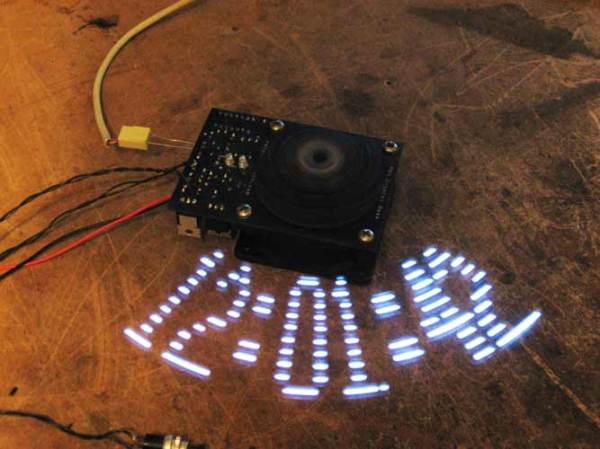
If you have a spare DC motor, a PIC16F84A microcontroller, and a lot of patience, then [Jon] has a great guide for building a persistence of vision clock that is sure to brighten up any room. For those who are unfamiliar with this type of clock, the principle is simple: a “propeller” with LEDs spins, and at just the right moment the LEDs turn on and display the time.

We’ve featured persistence of vision projects before (many times), and have even featured [Jon]’s older clocks, but the thing that makes this POV clock different is the detail of the project log. [Jon] wasn’t satisfied with the documentation of existing projects, and went through great pains to write up absolutely everything about his clock. The project log goes through four major versions of the hardware and goes into great depth about the software as well, making it easy for anyone to recreate this robust clock.

As for the clock itself, the final revision of the hardware has a PCB for all of the components, and uses a PC fan motor to spin the propeller. Power delivery eliminates slip rings or brushes in favor of wireless power transfer, which is an impressive feat on its own. Indeed, the quality of the clock is only surpassed by the extreme level of detail!

The CC3200 dev board with Energia

Energia On The CC3200

If you’re looking to connect things to the internet, with the goal of building some sort of “Internet of Things,” the new CC3200 chip from TI is an interesting option. Now you can get started quickly with the Energia development environment for the CC3200.

We discussed the CC3200 previously on Hackaday. The chip gives you an ARM Cortex M4 processor with a built-in WiFi stack and radio. It supports things like web servers and SSL out of the box.

Energia is an Arduino-like development environment for TI chips. It makes writing firmware for these devices easier, since a lot of the work is already done. The collection of libraries aids in getting prototypes running quickly. You can even debug Energia sketches using TI’s fully featured IDE.

With this new release of Energia, the existing Energia WiFi library supports the built-in WiFi radio on the CC3200. This should make prototyping of WiFi devices easier, and cheaper since the CC3200 Launchpad retails for $30.

THP Hacker Bio: AKA

Thermal imaging cameras are the new hotness when it comes building DIY tools that are much less expensive than their commercial counterparts. [Mike Harrison] built a very high-resolution version from Flir’s Lepton module, but an IR temperature sensor and a servo can also create a decent image. [AKA] played around with some of these thermal imaging modules, but found them a little hard to interface. Panasonic’s Grid-EYE module, however is reasonably cheap as far as thermal imaging devices go, and can be read over an I2C bus.

[AKA]’s entry for the Hackaday Prize, the GRID-EYE Thermal Camera is one of two Prize entries that survived the great culling and made it into the quarterfinalist round. [AKA] was kind enough to sit down and do a short little interview/bio with us, available below.

Continue reading “THP Hacker Bio: AKA”