A Do-It-Yourself Air Conditioner With Evaporative Cooling 5 Gallon Bucket

image42-300x225The people over at Gray Wolf Survival have this amazing little air conditioning project that is a perfect addition to any household that doesn’t have flowing air wafting through. It was created by [Figjam] for a trip to Burning Man, where all kinds of crazy ideas are bred in the hot dry heat of The Playa sun.

The design uses no ice, which is the cooling agent typical found in other DIY air conditioners. Those generally cut holes in the top of a cooler, put a fan on top to blow the air down across the ice. This is similar, but acts more like an evaporative cooler (not really a traditional air conditioner but it does the job).
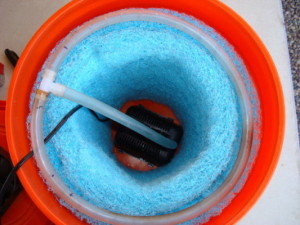
397648283-300x225It uses a LOT less energy than an air conditioner unit so there won’t be a need to increase the power capabilities of a simple system to work it, and it can reduce the temperature by up to 30 degrees as well as alleviate the dryness associated with living through a Burn. It runs off 12V DC so it can either use the solar panel or connect to a battery. It has a 12V power plug for this, and draws as little power as absolutely possible. Plus, it has the ability to easily connect to a larger water source so it won’t have to be continually refilled. These considerations make it very portable and perhaps backpackable as well.

[Figjam] took a 5 gallon bucket, wrapped the inside with two layers of swamp cooler matting, made a loop of hose above it connected to a submersible pump and ran a fan out the top with piping. Connecting it to a shelter is done with a vent hose.


Turning Street Sweeper Bristles Into Lock Picking Tools…For Science!

In between writing for Hackaday, most of us (if not all of us) like to design projects on our own, creating whatever might come to mind. I, for instance, enjoy experimenting with lock picking techniques at industrial, gritty, and real warehouses in Southern California learning how to utilize the resources there, turning spare parts into something completely different.

One such skill I learned is how easy it is to make lock picking sets from discarded scraps of metal. The documentation is found on a personal blog of mine called HackerTrips (we cover our own stuff sometimes). It contains several photos and descriptions of the process involved which I picked up thanks to a hackerspace in Fullerton where local makers dream up all kinds of interesting projects.

The project starts out by walking on the streets, which is a rarity these days. This is because the general modes of transportation now are either a car, a bus, a subway, a train, a bike, or a plane, which puts the attention on the destination at hand rather than peering into the fractures of the road. This means that a lot of the time, people don’t notice the hidden treasures found on the side of the street, including the street sweeper bristles that have been knocked off their edges.

Continue reading “Turning Street Sweeper Bristles Into Lock Picking Tools…For Science!”

Lego Technic Mechanical Seven Segment Display

TeemingColdDiplodocus

Here’s a rather mesmerizing piece of Lego genius, displayed as a .GIF for your enjoyment. It’s a 7-segment display that is completely mechanical!

Built by [aeh5040], this beauty features 7 separate linkages that control each display segment. It’s powered off of a single motor which rotates a cylinder covered in small protrusions, similar to how music boxes work. As the cylinder rotates, the protrusions knock the main drive gears back and forth, flipping each segment between the ON and OFF states through a series of axle joints and bevel gears.

It makes rather satisfying sounds too!

Continue reading “Lego Technic Mechanical Seven Segment Display”

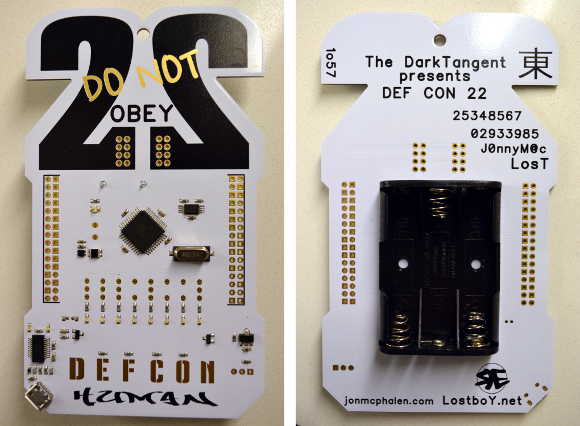
view of front and back

Hands-On DEFCON 22 Badge

It took a measly 2-hours in line to score myself entry to DEFCON and this nifty badge. I spent the rest of the afternoon running into people, and I took in the RFIDler talk. But now I’m back in my room with a USB cord to see what might be done with this badge.

First the hardware; I need a magnifying glass but I’ll tell you what I can. Tere are huge images available after the break.

  • Parallax P8X32A-Q44
  • Crystal marked A050D4C
  • Looks like an EEPROM to the upper right of the processor? (412W8 K411)
  • Something interesting to the left. It’s a 4-pin package with a shiny black top that has a slightly smaller iridesent square to it. Light sensor?
  • Tiny dfn8 package next to that has numbers (3336 412)
  • Bottom left there is an FTDI chip (can’t read numbers)
  • The DEFCON letters are capacitive touch. They affect the four LEDs above the central letters.

I fired up minicom and played around with the settings. When I hit on 57600 8N1 I get “COME AND PLAY A GAME WITH ME”.

Not sure where I’m going from here. I don’t have a programmer with me so not sure how I can make a firmware dump. If you have suggestions please let me know in the comments!

Continue reading “Hands-On DEFCON 22 Badge”

Easy To Build Solar Pool Heater Saves Money And Keeps You From Freezing

For those cool summer days it’s sometimes nice to have a heated pool — but usually pretty expensive too. Looking for a simpler solution [Martin] came up with his own solar pool heater for under $100!

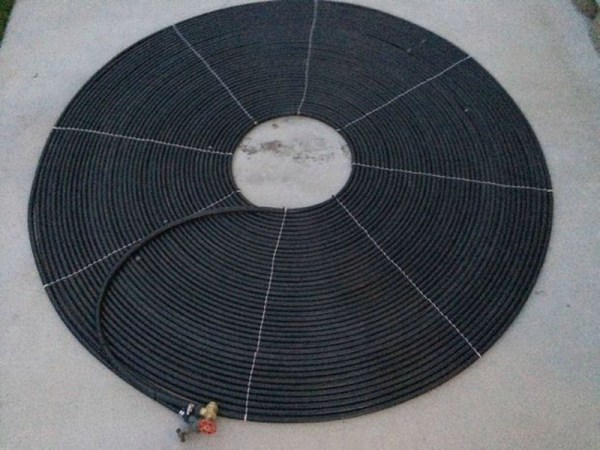
He’s copied the basic design of a solar pool heater but managed to do it using fairly cheap parts from the hardware store. It consists of three 100′ lengths of 1/2″ drip irrigation hose, and the way he’s connected them is rather ingenious. Using a half inch piece of copper pipe and a blow torch, he was able to squeeze the pipe into one hose end and then the other for a permanent seamless connection. He then coiled the resulting hose into a large circle by interweaving string back and forth to keep its shape.

A 12V utility pump coupled with a timer allows water to sit in the hose under the sun for one hour, at which point it cycles the system for 10 minutes, pumping the warm water into the pool, and refilling itself with cool water from the bottom of the pool. This one is only made for a small above ground pool, but the design could easily be doubled or even tripled for larger pools. You could also throw in a PID temperature controller or even an Arduino to make it even better… but it sounds like it works quite well by itself with a timer.

Combine this with a compost-based hot water system for indoors and you’ll really be cutting the expense associated with your hot water needs!

Nerds Helping Sea Turtles

Sea Turtle Nest Monitoring Device

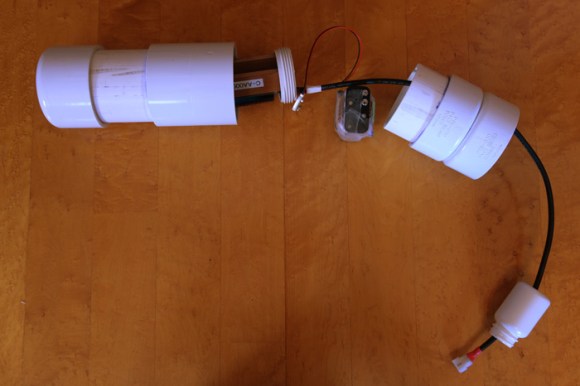
Life as a sea turtle can be rough. Not only are turtles trying to survive predators, destruction of habitat, fishing nets, and pollution, but only about 1% of hatchlings survive to face those challenges in the first place. Enter [Samuel Wantman] and a new volunteer hacker group called Nerds Without Borders, with their first order of business of creating an egg-shaped monitoring device for sea turtle nests.

Sea turtles are protected under the Endangered Species Act, which goes to great lengths to protect certain species from human activity. The ultimate goal of the project is to help people and sea turtles better coexist under this law by more accurately predicting hatching times. A suite of sensors and a cell network antenna are placed in a plastic “egg” that can be buried in a nest after a sea turtle lays the real eggs. The sensors detect vibrations within the eggs as the embryos grow, which is an indication that the tiny turtles are about to break free of their eggs and head for the open ocean!

Click past the break for more on this project.

Continue reading “Nerds Helping Sea Turtles”

Dots And Dashes… On A Roll!

morse code device

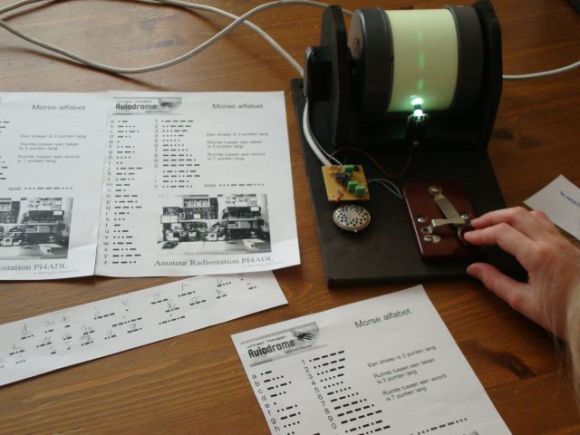
Morse code was once a staple of the communications industry, but with advancing technology it has become relegated almost exclusively to movies and a niche group of ham radio operators. [Jan] has created a device which might not put a stop to this trend, but will at least educate children on the basics of how Morse code works by visually displaying Morse code as it’s generated.

The setup is fairly simple. An old momentary switch (which could easily be used in an actual Morse code setup) activates two pieces of circuitry. The first is a 555 timer circuit that creates an audible tone when the switch is pressed so the user can hear exactly what an operator would hear when decoding a real Morse code message.

The second piece of circuitry is where the real genius lies: a continuously spinning roll of glow-in-the-dark tape is placed in front of a white LED. When the switch is pressed, the LED turns on, which produces dots and dashes on the roll of tape as it passes by. This eliminates the need for rolls of paper or a more complicated moving pen/pencil setup to draw on the paper which might also be less child-proof.

While [Jan] built this as a toy, the children who used it thoroughly enjoyed it! They even decoded some Morse code messages and used the device to practice on it. After a while they’ll easily be able to master the Morse code trainer!