3D Printed Christmas Cookies

3d-printing-christmas-cookies

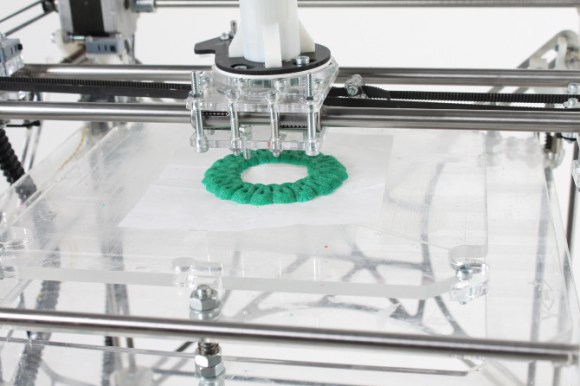
Here is yet another way to get into the holiday spirit at your local Hackerspace (or at home if you’re happen to have your own 3D printer). [Ralph Holleis] wrote in to show off his 3D printed Christmas cookies. The majority of the info on this project comes from the video embedded after the break. The extruder head he’s using includes a syringe which is filled with what we assume is Spritz Cookie dough. It is squeezed out in a pattern before heading to the oven for baking.

[Ralph] mentioned that he’s using UNFOLD Pastruder as the print head. We looked and couldn’t find that exact design, but it seems like it might be related to this Claystruder head designed by a user named [Unfold]. If you have the exact link to the extruder design seen above please let us know in the comments section.

If you don’t already have this type of head it’s just a matter of printing the mounting brackets and buying a syringe to match. But you’ll also need compressed air and a valve to regulate the flow of dough. It might be easier just to print your own cookie cutters. This is a great project for people who don’t have access to a laser cutter for gingerbread house work.
Continue reading “3D Printed Christmas Cookies”

Scavenged Tube Television Makes A Nice Fish Tank

aquarium-from-junked-television-set

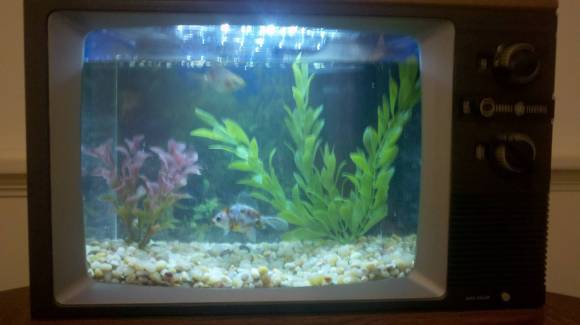
[McCaulsey] found an old TV waiting for garbage pick-up on the side of the curb. He brought it home and gave it a new life as an aquarium.

His technique is a little rough, but the finished look is exactly what he was going for. He picked up the cheapest aquarium set he could find at the pet store. It just happens to have a curved front to it which helps to recreate the look of the original CRT. After removing most of the electrical components he went to work on the plastic fins that were used to mount them. Having somehow misplaced his Dremel tool the work was done with a drill and a 1/4″ paddle bit.

Once the demolition was over he started the rebuild by placing a backer in the tank. This is an underwater image that will save him from having to look at the inside of the TV case through the water. A piece of Styrofoam was used as a base to properly frame the front of the tank. The only thing we can’t tell from the build album is how he will manage to feed the fish without taking everything apart again.

[via Reddit]

Mains Rated Solid State Relay Test Box

building-a-mains-solid-state-relay-test-box

We like our nice, safe, 5V prototyping projects where the only thing that might get fried is a chip. But there are times when you want to switch appliances for one reason or another and then you’re going to want a mains rated relay. [Viktor] got tired of having exposed high voltage on the bench during the prototyping stage of these projects so he recently built a solid state relay test box.

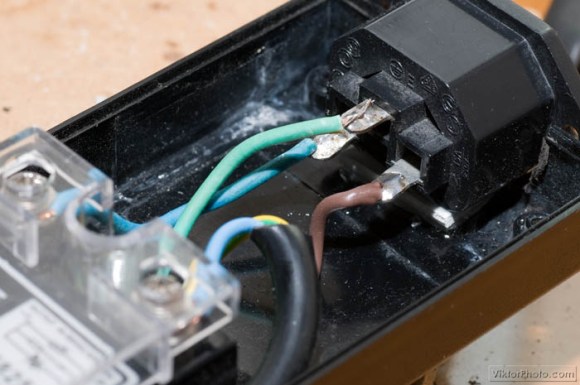
The only thing he bought for the project was the SSR itself. To act as an enclosure he used the brick from an old laptop power supply. This is perfect for a couple of reasons. First off, it’s designed to contain high voltage if there is ever a short or other problem. Second, it’s already setup for incoming and outgoing power. He just needed to remove the guts and mount the relay. Notice that it comes with a clear plastic shield that physically separates the high voltage side from the low voltage control end. This, along with the cable routing, keeps the dangerous stuff on one side to ensure you won’t get an arc to the low voltage portion of the project.

PyMCU Test Project Looks Like A Minecraft Mob

pymcu-controlled-blockhead

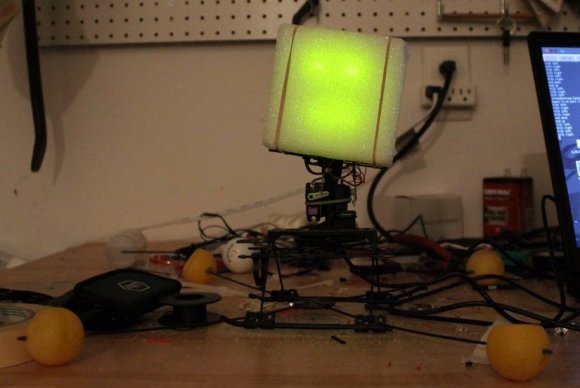
Hackaday’s own [Jeremy Cook] has been testing out the pyMCU board and managed to put together an animated block head that looks like it could be a foe in Minecraft. That’s thanks mostly to the block of foam he’s using as a diffuser. The face of the project is a set of LEDs. These, along with the servo motors that move the neck are controlled using Python code which you can glance at after the break (there’s a video demo there too).

We first saw pyMCU early in the year. The PIC 16F1939 offers plenty of IO and acts as a USB connected bridge between your hardware and your Python scripts. Speaking of hardware, the test platform used to be an RC helicopter. [Jeremy] scrapped most of it, but kept the servo motors responsible for the pitch of the rotors. The board makes these connections easy, and the concept makes controlling them even easier. In fact, there’s only about 17 lines of code for the functions that control the servos. The rest is a simple UI built with Tkinter.

Continue reading “PyMCU Test Project Looks Like A Minecraft Mob”

Modifying An EEG Headset For Lucid Dreaming

moddedmindwave4

[Michael], [Tom], and a few other people on the Lucid Scribe Database project have been using off-the-shelf EEG equipment to invoke lucid dreaming. Yes, that’s where you take control of your dreams and become a god. This requires wearing an EEG setup while you sleep, and these products aren’t very comfortable sleeping wear. [Tom] decided to take apart a NeuroSky MindWave and turn it into something comfortable to wear all night.

The folks at the Lucid Scribe Database log their dreams with consumer-level EEG equipment, usually something made by NeuroSky. The NeuroSky MindWave is the smallest and cheapest EEG headset available, but it’s still a hard plastic device not conducive to sleeping.

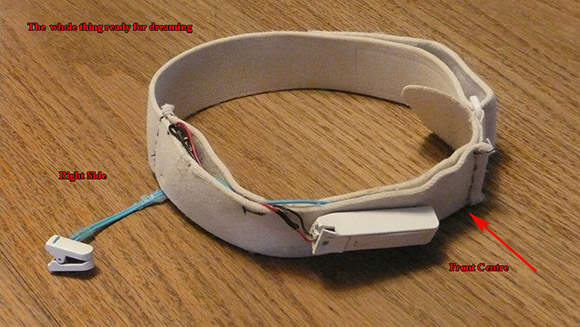
[Tom] removed all the guts and electronic goodies out of his MindWave and attached them to an elastic headband. The MindWave has two sensors – a forehead and ear lobe sensor. For the forehead sensor, [Tom] simply soldered a piece of wire to a penny and attached it to the elastic. The ear lobe sensor in the stock MindWave is a simple clip that was kept in the stock configuration for [Tom]’s mod.

Now that [Tom] has a much more comfortable EEG setup, he can get on with improving his lucid dreaming skills and even try communicating via Morse from inside a dream.

Custom MOTD For The Raspberry Pi

motd

With so many uses for a Raspberry Pi in a headless configuration – especially with the impending release of the Raspi Model A – we’re surprised it has taken so long for someone to send in a way to create a custom message of the day that is displayed whenever you SSH into everyone’s favorite Linux board.

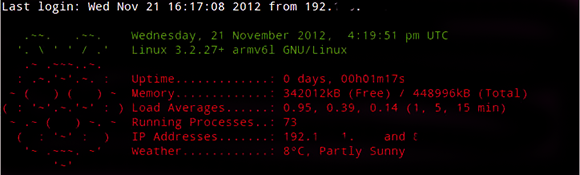
A MOTD is used by servers to display messages to new users, or simply system information for server admins. It’s a simple text file stored in /etc/motd, but with some proper beardly Unix wizardry it’s possible to display uptime, free memory, and even the weather wherever the Raspi is located.

[yanewby] over on the Raspberry Pi forums created a nice little MOTD that grabs weather data from the Internet and displays it alongside an ASCII rendering of the Raspberry Pi logo. Of course like everything in Unix, this MOTD can be modified to do just about anything, from checking your Twitter to sending a text message to your phone.

Two Computer Vision Builds From Cornell

land

[Bruce Land], professor at Cornell, is a frequent submitter to our tip line. Usually he sends in a few links every semester from undergraduate electronics courses. Now the fall semester is finally over and it’s time to move on to the more ambitious master’s projects.

First up is a head-mounted eye tracker, [Anil Ram Viswanathan] and [Zelan Xiao] put together a lightweight and low-cost eye tracking project that will record where the user is looking.

The eye tracker hardware is made of two cameras mounted on a helmet. The first camera faces forward, looking at the same thing the user is. The second camera is directed towards the user’s eye. A series of algorithms detect the iris of the user’s eye and overlays the expected gaze position on the output of the first camera. Here’s the design report. PDF, natch.

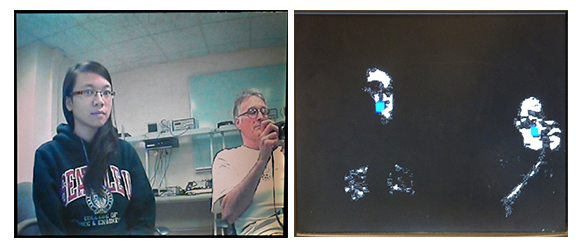
Next up is a face tracking project implemented on an FPGA. This project started out as a software implementation of a face tracking algorithm in MATLAB. [Thu-Thao Nguyen] translated this MATLAB code to Verilog and eventually got her hardware running on an FPGA dev board. Another design report.

Having a face detection and tracking system running on an FPGA is extremely interesting; the FPGA makes face tracking a very low power and hopefully lower-cost solution, allowing it to be used in portable and consumer devices.

You can check out the videos for these projects after the break.

Continue reading “Two Computer Vision Builds From Cornell”