Custom Boards At Home Without Etching

PCB

PC board houses are getting more accessable and less expensive all the time. Some of us are even getting very, very good at making our own circuit boards at home. There are times, though, when a project or prototype requires an extremely cheap custom board right now, something etching a custom board won’t allow. [KopfKopfKopfAffe] has a unique solution to this problem, able to create custom boards in under an hour without any nasty chemicals.

Instead of starting his build with copper-clad board, [KopfAffe] used every rapid prototyper’s friend, simple one-sided perf board. The shape of the board was milled out on a CNC machine, and both the top silk screen and bottom layer were marked off using the toner transfer method. After that, a custom circuit is just a matter of placing components and putting solder bridges between all the marked pads.

[KopfAffe] is only using this technique for single-sided boards, but we don’t see any reason why it couldn’t be employed for simple double-sided boards. This would still have the problem of making vias between the layers, but that’s still a problem with proper, home-etched double sided boards.

Auto Off For Any Circuit

autooff

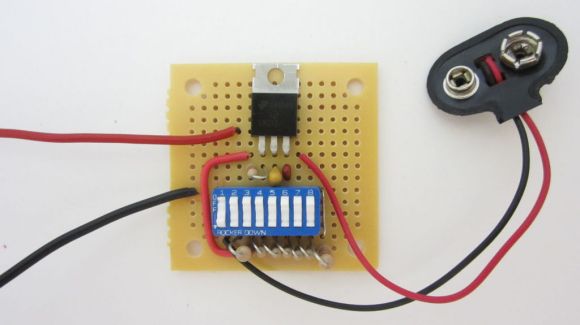
Properly configured, your computer will go into sleep mode when left unattended for a long enough time. So will your cell phone, and just about every other piece of sufficiently complex electronics. Much simpler circuits, though, are left at the mercy of a SPST switch; if you forget to turn a flashlight off, it will be dead next time you need to use it. Wanting an auto-off circuit simple electronics, [Kyle] threw together this auto shutoff circuit.

The basic idea behind the cirucuit is to use a microcontroller as a timer controlling two transistors. When [Kyle]’s circuit is power cycled, the timer inside an AVR starts, making a pin high, and when the timer is up, making the pin low again. This pin feeds into a PNP transistor which is in turn connected to a NPN transistor, creating a very tiny auto off circuit for anything with an SPST switch.

[Kyle] says there are a few improvements to be made – using MOSFETS to handle higher currents and possibly using a smaller microntroller like an ATtiny 4/5/9/10 to shrink the circuit’s volume. It’s a great idea, bringing the idea of a flashlight with auto shutoff into reality.

Testing Caps With A DIY ESR Meter

There’s a problem with collecting old tube amps and vintage electronics – eventually the capacitors in these machines will die. It’s not an issue of a capacitor plague that causes new electronics to die after a few years; with time, just about every capacitor will dry out, rendering antique electronics defective. The solution to getting old gear up and running is replacing the capacitors, but how do you know which ones are good and which are bad? With [Paulo]’s DIY ESR meter, of course.

An ideal capacitor has a zero equivalent series resistance, and failure of a capacitor can be seen as an increase in its ESR. Commercial ESR meters are relatively cheap, but [Paulo] was able to build one out of a 555 chip, a small transformer, and a few other miscellaneous components.

The entire circuit is built on stripboard, and if you’re lucky enough to find the right parts in your random parts bin, you should be able to build this ESR meter with components just laying around.

Sonic Screwdriver Meets TV-B-Gone

sonic

[furrysalamander] has a friend that is a really big Doctor Who fan. It happens that this friend has a birthday coming up, and [furrysalamander] wanted to get her something amazing. A Sonic Screwdriver is always a great gift, but [furrysalamander] wanted to put his personal touch on it. He ended up adding a TV-B-Gone to [10]’s screwdriver, turning a fictional deus ex machina into a functional device.

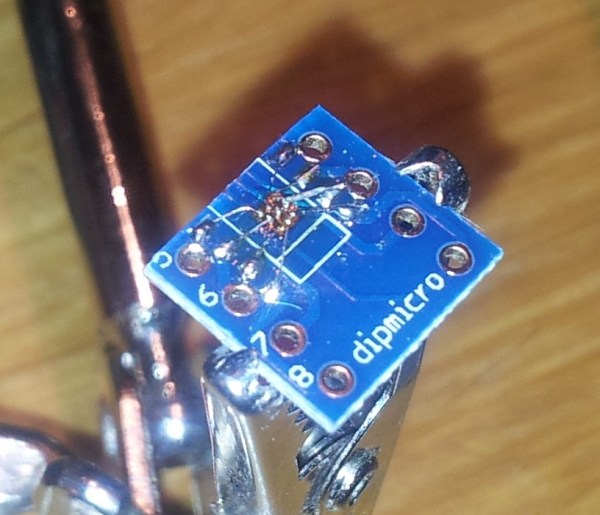
The body of the Sonic comes from this replica of [10]’s screwdriver from Think Geek. Inside, the screwdriver has space for a battery a circuit board to control the lights and sound normally expected of a sonic screwdriver. [furrysalamander] added a freeform circuit composed of an ATtiny85, a transistor, LED, and a few resistors to add the ability to turn just about any TV off.

Of course [furrysalamander] needed to program the ATtiny with the TV-B-Gone firmware, and lacking any AVR development tools he used a Raspberry Pi’s GPIO pins to write the firmware to the microcontroller. That’s something we’ve seen before, but [furrysalamander] is a champ for including the process in his Instructable.

The end result is a Sonic Screwdriver that doesn’t work on wood and can’t break a deadlock seal. It turns off TVs just fine, though, and looks great to boot. You can check out a demo of [furrysalamander]’s sonic in action after the break.

Continue reading “Sonic Screwdriver Meets TV-B-Gone”

AC Vs DC Human Pain Test

AC-vs-DC-human-pain-test

Ever wondered just how much being zapped by electricity hurts? Curious if AC is worse than DC? Want to know just how many volts a human body can take? Although many people might cringe at the shear thought of it, [Mehdi Sadaghdar] is an electrical engineer who decided to turn himself into a human guinea pig and find out.

[Mehdi] measured the electrical resistance of his dry skin, his wet skin, and finally his tongue.  He found that his tongue had the least resistance, so it would feel the electricity at much lower levels. Using a bench power supply, he then used his tongue as a testing ground – slowly turning the voltage up and up until he could no longer take the pain. He tested the levels at which: he could first feel the electricity, when it began to get annoying, when it felt like torture, and when he could no longer stand the pain. He tried both AC and DC, and reports that AC is much worse.

Check out the informative, yet admittedly hilarious at times, video after the break. [Mehdi] seems like one awesome engineer! Remember – don’t try this at home.

Continue reading “AC Vs DC Human Pain Test”

Midwest RepRap Festival

We’re a US-centric site, but aside from events in New York or California, we don’t see many hacker, maker, or 3D printer events aimed at the parts of the country filled with corn and WalMarts. The 1st annual Midwest RepRap Festival aims to change that with enough events, speakers, and activities to make Elkhart, Indiana look like the hoppingist place around.

Officially, the festival started yesterday but the schedule of events really ramps up today. [Josef Prusa] will be taking the stage talking about the state of the RepRap, and a ton of 3d printing vendors will be there showing off their wares and selling some really cool stuff. There’s also tons of experienced RepRappers available to help you tune your machine to perfection; just as well, because the festival is going for the world record for the greatest number of 3D printers printing simultaneously.

If you’re around northern Indiana, you might want to check out the festival and send us a few pics or videos.

Mug Plotter Based On The Egg-Bot

mug-plotter

Here’s a fun way to break up the monotony in the old cubicle farm. The Mug Plotter will let you expertly inscribe your coffee vessel with a different witty saying or design for each day of the week. If it looks familiar that’s because it’s loosely based on the non-flat drawing robot, the Egg-Bot.

[Teed] built the machine using laser cut plywood parts. He starts off the build description with the griping technique. There are two parts to this, one is concave and fits in the mouth of the mug. The convex side grips the bottom edges of it. These parts go on the frame along with the slide and thread rods which hold the stylus. A servo motor is along for the ride, providing the ability to lift the marker when necessary.

You can see in the clip after the break that there’s a bit of oscillation in the rig when one of the steppers starts turning really fast. But it doesn’t seem to affect the look of the design very much at all.

Continue reading “Mug Plotter Based On The Egg-Bot”