Porsche 911 Made Electric

[Kurt] wanted an electric car, and always wanted to drive a Porsche. Killing two birds with one stone, he decided to combine these wishes and convert a 2002 Porsche 911 into an electric vehicle.

After removing the engine, fuel tank, exhaust, radiator, and all the other things that make an internal combustion engine work, [Kurt] installed a high power motor, controller and 72 lithium phosphate batteries weighing in at over 500 pounds. He’s put over 300 miles on the car in the last few months while working out the kinks, but now he’s finally gotten the bugs out of the system allowing him to take it up to some relatively high speeds.

Already [Kurt] has taken his new ride to 100 mph and done a little bit of range testing that told him he should expect around 40 miles per charge in his new ride. It’s not exactly what he hoped, but more than enough for a few trips around town while riding in style.

After the break is a video [Kurt]’s first test drive of his electric Porsche.
Continue reading “Porsche 911 Made Electric”

Google Books Team Open Sources Their Book Scanner

It’s no secret that Google has been scanning hundreds of thousands of books in the hope of recreating the Library of Alexandria. Publishers and authors really didn’t like that idea, so the Google books team is doing the next best thing: they’re releasing the plans for a very clever book scanner in the hope others will pick up the torch of creating a digital library of every book ever written.

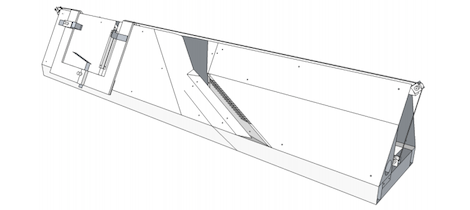
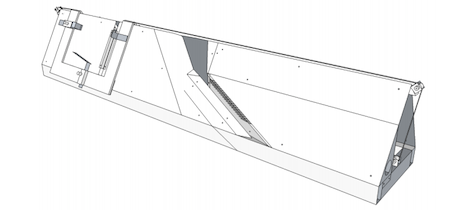
Unlike some other book scanners we’ve seen that rely on an operator manually flipping pages, this linear book scanner turns the pages automatically with the help of a vacuum cleaner and a cleverly designed sheet metal structure after passing them over two image sensors taken from a desktop scanner.

The bill of materials comes in at around $1500, but according to the official design documents this includes a very expensive scanner, something that could be replaced in true hacker style with a few salvaged flatbed scanners.

After the break you can check out a Google Tech Talk presented by [Dany Qumsiyeh] going over the design and function of his DIY book scanner. There’s also a relatively thorough design document over on a Google code page.

Continue reading “Google Books Team Open Sources Their Book Scanner”

Hackaday Links: November 15, 2012

Another way to break out dual pin headers

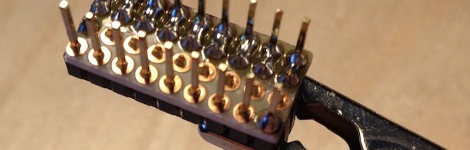
[Uwe] wrote in to share his technique for breaking out dual pin headers. He uses two single pin headers, a piece of protoboard, and a dual row pin socket to make an adapter. This is removable where the other method we saw this week was not.

Web-based slide show hack

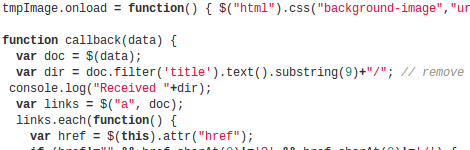
Wanting to use an old Android tablet as a digital picture frame, [Gordon] coded up a simple way to use an HTML page to scan your picture directories to feed a rotating background image.

The simplest hot plate

For his chemistry experiments [Charlie] is using a plain old clothes iron for a hot plate. he simply clamps it upside down to the bench. It doesn’t have any stirring abilities, but we already have an old iron in the shop which we use for toner transfer so we’ll have to keep this in mind if we ever need to heat chemicals (might be a good way to warm etchant).

A charging VU meter

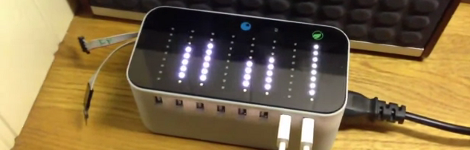
This Cambrionix series8 universal charger has columns of LEDs that are animated when a device is charging. [Steve Tyson] works for the company and has had some fun messing with the firmware. He’s showing off the display as a VU meter.

Game Boy knockoff teardown

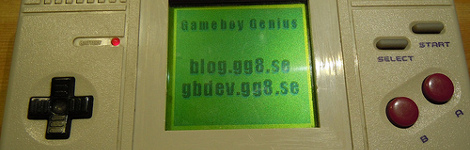
This wide-form-factor Game Boy is a knockoff from way back when the original system hit the market. You won’t want to miss this lengthy post that takes a look at what’s inside. [Thanks Neil]


In-depth Comparison At STM32 F3 And F4 Discovery Boards

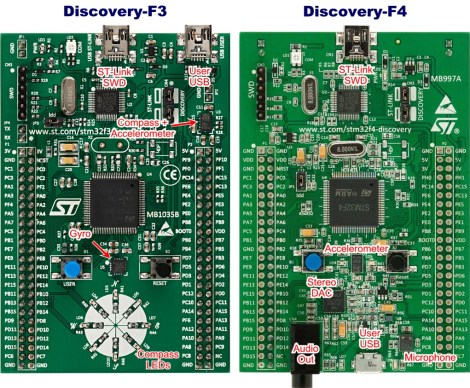
The STM32 F3 and F4 Discovery boards have been around for a while now. We’ve looked at both separately and they’re impressive dev boards for the price. Now can get a closer look at each from this in-depth comparison of the two Cortex-M4 development tools.

To start off, both of the boards have the same size and footprint (there are two dual-row pin headers which break out the connections to the ARM chip). Fundamentally the F3 and F4 chips have a different level of features, but the boards themselves are aimed at different applications as well. The F3 series of microcontrollers looks to be more affordable than the F4, containing less program memory, no Ethernet capability, and only one USB port. But both have hardware floating-point abilities and they’re blazing fast. The boards offer a MEMS accelerometer for prototyping. But the Discovery-F3 also contains a gyroscope while the Discovery-F4 provides audio hardware like a microphone, and DAC.

If you want to use a Linux box to develop with these tools you might find this guide helpful.

Roomba And Virtual Walls Make Up This Theme Family Halloween Costume

It figures. You spend a ton of time making a cool set of costumes and then you can’t get your kid to pose for a picture. It’s okay though, we still get the point. This themed set of costumes dresses the little one as a Roomba vacuuming robot while mom and dad are suited up as virtual walls (modules that are used to keep the bot from falling down stairs, etc.). It’s fun and unique, but had it not been for some additional electronics this would have been relegated to a links post. For safety sake each costume was outfitted with a ring of LEDs. As a challenge, the lights were given the ability to sync up patterns with each other.

Each costume has a circular frame at the top with a set of RGB LED strings attached. To get them to display synchronized patterns an IR transmitter/receiver board was designed and ordered from OSHPark. Each costume has four of these modules so no matter where the wearers are facing it should not break communications. A demo of the synchronized light rings can be seen after the break

Continue reading “Roomba And Virtual Walls Make Up This Theme Family Halloween Costume”

An Umbrella Stand That Tells You The Weather Forecast

This project takes an umbrella stand and gives it the ability to let you know if you need to take an umbrella when you leave the house. The image above is a concept drawing, but a first prototype was built and seems to work quite well. See for yourself in the video after the break.

The project was put together by openPicus. They sell a prototyping module called the Flyport which provides a WiFi connection to your projects. This board connects to a set of LEDs which are used to illuminate the translucent plastic umbrella stand. But you might not notice the color change if the LEDs were always on. Also designed into the system is a PIR motion sensor. When you walk toward the door to leave for the day it switches on the appropriate color — green for clear, blue for raining, and red for storming — catching your attention in time to grab an umbrella as you pass by.

You don’t need to spend a bundle to pull off a hack like this. You can scavenge for a PIR sensor, use one color of LEDs just to tell you when rain or storms are forecast, and an ENC28J60 is a cheap and easy Ethernet alternative to using WiFi.

Continue reading “An Umbrella Stand That Tells You The Weather Forecast”

Variometer Build For Gliding Aircraft

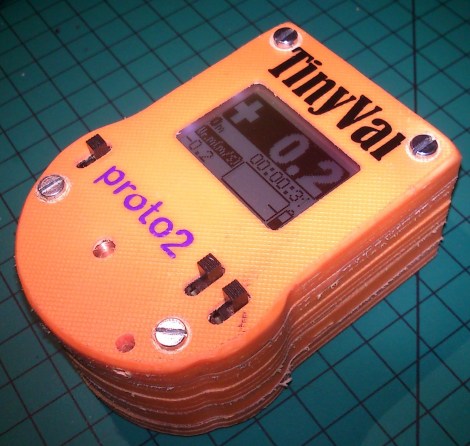
If you’re flying through the air in a non-powered vehicle your rate of descent is something that you want to keep any eye one. With that in mind, [Adrian] decided to design his own Variometer (translated) what will have a place in the cockpit next to the other instrumentation. It emits a pitch whose frequency is dictated by the rate at which altitude is being lost or gained.

He went with a PIC 24FJ64 microcontroller to drive the device. It’s reading data from an MS5611 barometric pressure sensor. This measures changes in air pressure associated with a change in altitude. As a user interface he chose one of SparkFun’s Nokia 5110 LCD screen breakout boards. He also went with one of their boost converts which lets him power the device from just one battery cell. The case itself is cut from several layers of plastic using a CNC mill.

In the video after the break you can see how sensitive the device is. Moving it just a few feet up or down has an immediate effect on the sound and the displayed data.

Continue reading “Variometer Build For Gliding Aircraft”