Key Code Door Lock Won’t Endanger Your Security Deposit

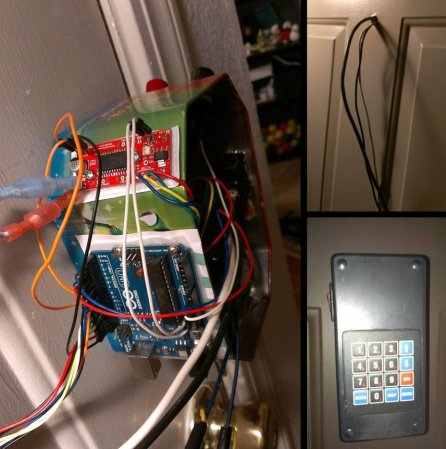
College students have returned in droves to dorms and apartments at campuses everywhere. So this is the time of year we usually start seeing some coded entry hacks. [Charmonkey] recently took on the challenge at his new apartment. There were some caveats though. He needed to ensure the Landlord could still enter using a key, and he didn’t want to alter the door or the jamb in any way. What he came up with is a coded entry system that can turn the deadbolt.

In order to mount some hardware on the door he removed the inner part of the dead bolt assembly and used the pair of threaded tubes on the adjoining lock section as anchor points. This holds the Pokemon tin he’s using as a project box securely in place. The rest of the components all mount to it. These include the stepper motor that actuates the deadbolt, a switch for manual operation, an Arduino, and a motor driver board.

He got really creative with the keypad. The wires connecting it travel through the door’s peephole and into the smaller plastic project box that hosts the rest of the hardware.

[via Reddit]

How To Build Your Own Dedicated Pandora Radio

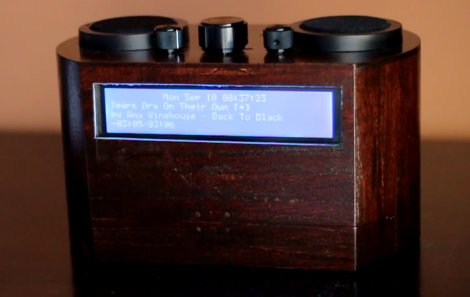
This mix of modern and retro acts as a standalone Pandora client. It’s certainly a radio upgrade, falling somewhere in between the passive listening of traditional broadcasts, and the complete control of music players that use playlists.

Inside the wooden case a BeagleBoard does most of the work. It’s running Ubuntu 12.04 on which pianobar, a command line interface package for Pandora is running. Those components alone would make a pretty nice listening experience, but since Pandora rolls different music into the mix it’s nice to be able to see what you’re listening to. The four-line LCD is wide enough to display plenty of information. It’s being controlled by a PIC24 microcontroller which also monitors the controls on the top. As you can see in the video after the break, the user interface offers almost everything you could want. It’s easy to switch stations, and you can still register your preferences on each track being played.

Continue reading “How To Build Your Own Dedicated Pandora Radio” →

Programming An ARM With BASIC

For those of us old enough to remember the beginnings of the microcomputer revolution, we can look back fondly on ‘the programming environment is the OS,’ a ton of BASIC programs, and typing in small programs found in the backs of computer magazines. It’s a whole new world now with cell phones and Linux computers the size of credit cards, but some companies still remember the beginning.

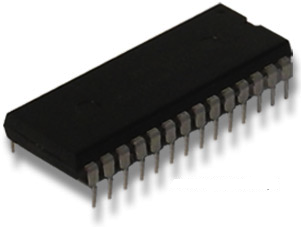
Coridium is releasing an ARM microcontroller in the vein of old fashioned microcomputers updated for the 21st century. Based on the LPC1114 Cortex M0 ARM microcontroller stuffed into a DIP28 package, the Coridium ARM BASIC provides a programming environment in the firmware.

The ARM BASIC is a complete system on a chip, with Rx and Tx connections to connect to a serial terminal. To get this BASIC microcontroller up and running, all you’ll have to do is connect 3.3 Volts of power. Then, it’s a simple matter of plugging in an FTDI cable and pretending it’s 1989.

Coridium is planning on giving away a few hundred of these ARM BASIC chips to makers in a few days. I’ll put up the announcement of free microcontrollers up in a few days, but [Bruce] at Coridium is sending me one very shortly. Hopefully I’ll be able to do a demo before the stock of free chips is completely depleted.

VFX1 Virtual Reality Headset LinkBox


[Kevin Mellott’s] take on the VFX1 was to update it so it can be used with modern computers requiring just a USB socket and VGA feed.

The VFX1 is a Virtual Reality Headset that hit the market in the first half of the 90’s. The headset was the first of its kind to hit the home market and was ahead of its time. The VFX1 was developed and marketed by Forte Technologies, who’s assets where purchased in 1997 by Vuzix who now produce modern day Video glasses with optional tracking system.

What [Kevin] has achieved is nothing more than remarkable. The original system required a massive ISA card and a link from this card to the Feature Connector on the display card. [Kevin] did away with the ISA card and FCON replacing it with what he calls the LinkBox. This LinkBox has serial or USB out and accepts stereo/mono VGA input or RGB.

The system can now be used with modern day computers including laptops. Those into VR should really check this out.

Continue reading “VFX1 Virtual Reality Headset LinkBox” →

Token Authentication For Gmail Using A EZ430 Chronos Watch

Two-factor authentication allows you to use your chosen password, as well as a one-time password to help keep your services secure. The one-time passwords traditionally come from a dedicated piece of hardware, but there are also solutions for smart phones. [Patrick Schaumont] shows how a TI eZ430 Chronos Watch can be used to generate authentication tokens. After walking through the process he uses it to beef up his gmail login.

This method of token authentication is often called Time-based One Time Passwords (TOTP). It’s part of the Open Authentication (OATH) initiative, which seeks to sort out the password-hell that is modern computing. A portable device generates a password by applying an algorithm and a private encryption key to an accuarte time-stamp. On the server side of things a public key is used to verify the one-time password entered based on the server’s own time-stamp. In this case the portable device is the Chronos watch and the server is Google’s own TOTP service.

You can do this with other simple microcontrollers, we’ve even seen an Arduino implementation. But the wrist-watch form factor seen here is by far the most convenient — as long as you always remember to wear the watch.

[Thanks Oxide]

Homebrew FPGAs

Homebrew CPUs made out of logic chips are nothing new, but a homebrew FPGA is another matter entirely. [Joshua] sent in a project he whipped up where he made a single logic cell FPGA.

Despite how complicated and intimidating they are in practice, FPGAs are really very simple. They’re made of thousands of logic blocks capable of transmuting into AND, OR, NAND, and XOR logic gates. These logic blocks are all tied together, and with a somewhat complex hardware design language are capable of becoming a CPU, a micocontroller, or even a video card. Basically, programming a microcontroller tells a chip what to do, while programming an FPGA tells the chip what to be.

To build his single logic block FPGA, [Joshua] used a four-bit multiplexer to hard wire a truth table out of a 74HC174 D-type flip-flop. A bit of Arduino code changes the state of the pins connected to the multiplexer allows for any combination of TRUE and FALSE to be calculated for AND, NAND or XOR logic functions.

Yes, it’s only a single logic block for an FPGA, and if this build were expanded to even a few hundred cells it would be gargantuan. Still, there’s no better way to learn the ins and outs of abstract hardware, so we’ll gladly tip our hat to [Joshua] and his homebrew FPGA.

Makerbot, Occupy Thingiverse, And The Reality Of Selling Open Hardware

Yesterday, Makerbot Industries introduced the Replicator 2, a very good-looking 3D printer that will is probably the closest thing we’ll see to a proper ‘consumer’ 3D printer for a year or so. There’s only one problem. The new Replicator 2 is rumored to be closed source. If that’s not enough, [Bre Pettis], co-founder and CEO of Makerbot Industries will be speaking at the Open Source Hardware Association conference next week with the suitably titled talk, “Challenges of Open Source Consumer Products.”

Of course, the Replicator 2 being closed source is hearesay, and we can’t blame them for closing up parts their product; they have investors to worry about and people are blatantly copying their work. There was another change in Makerbot’s operation at the press conference yesterday: Makerbot now owns everything you’ve put up on Thingiverse.

This news comes from [Josef Prusa], creator of what is probably the most widely used 3D printer in the world.

[Prusa] begins his rant with the history of the RepRap. The project began with a team of core developers headed by [Adrian Bowyer], and supported by [Zach Smith], [Adam Mayer], and [Bre Pettis]. [Boyer] gave the guys a bit of money to start Makerbot, and it’s something the guys at Makerbot have never been ashamed of. Makerbot went on to create Thingiverse, became the darlings of the Open Hardware movement, and acquired $10 million from investors.

All things change, of course, and Makerbot is no exception. Along with the (again, rumored) closed-source Replicator 2, [Prusa] pointed out the Terms of Use for Thingiverse say that Thingiverse – and thus Makerbot Industries – owns everything submitted by Thingiverse users. [Prusa] started an Occupy Thingiverse movement in response to this discovery.

Honestly, we hope [Josef Prusa] is wrong on this one. We hope the specific clauses in Thingiverse’s Terms of Use granting itself a license to do whatever it wants with uploaded Things is just a bunch of legal mumbo jumbo added in by lawyers to protect Thingiverse from being sued by crazy people. Still, if rumors are true, it may be a portent of things to come.

In any event, [Prusa] will be taking his Thingiverse things down. He plans on posting his stuff on GitHub, probably the most Open Source-friendly community in existence. You can do the same with this GitHub template for 3D printed objects.

So, learned reader of Hackaday, what do you make of this? Is Makerbot right to close up their projects? Are we finally becoming disillusioned with Open Hardware? What say you?