Drop-in Board For NES ROM Chip Makes Cartridge Reprogrammable

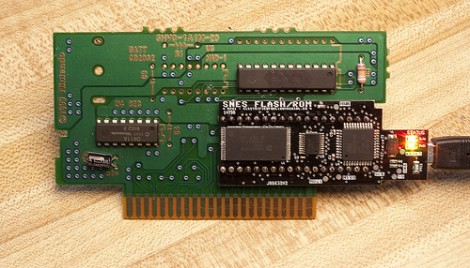
Here’s the guts from [Dext0rb’s] Super Nintendo cartridge. It’s easy to pick out the dark-colored board which lets him reflash SNES ROMs via USB. We’ve seen this done a number of times, but this is a much cleaner option than hacks that just add a dead-bug-style memory chip.

The board he designed has a double-row of pin headers sized to fit the footprint vacated by the original ROM chip. The board has a mini-USB connector which can be accessed through a hole he cut in the side of the cartridge enclosure. This is in the right place so that you cannot plug it in when it’s being used in the SNES (which would cause damage). The ATmega32u4 chip handles USB connectivity and programs the 32 megabit flash chip which stores the ROM. He’s posted a few articles on the blog portion of his site which you’ll find interesting. We suggest starting with this hardware teaser.

Jamming Gripper That’s Super Easy To Build

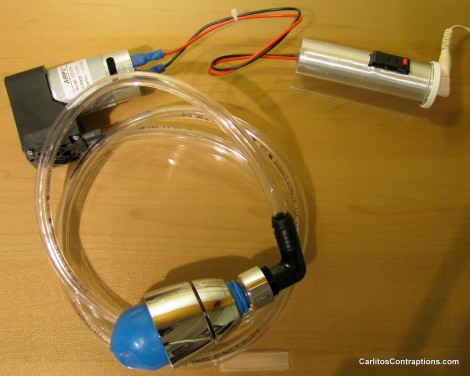
This is the simplest version of a jamming gripper that we’ve seen yet. The only component that might not be readily available is the pump in the upper left, but the rest is all hardware or grocery store stuff. It’s based on the concept we saw from a research video where the air in a bladder full of coffee grounds is removed to grip an item. In this case the bladder is a party balloon which is held in place by parts from a cheap shower head. A theaded-to-barbed right angle connector makes it easy to connect the vinyl tubing up to the pump.

The video after the break shows that this works quite well for small items. But we see a lot of downward force is exerted to firmly embed them in the grounds. We’re not sure if this is par for the course, or if it would work a bit better if more air were in the bladder initially. This other jamming gripper build uses a servo to release pressure from the system, and we think that might be of help here too.

Continue reading “Jamming Gripper That’s Super Easy To Build”

Stiltwalker Beat Audio ReCAPTCHA

This talk from the 2012 LayerOne conference outlines how the team build Stiltwalker, a package that could beat audio reCAPTCHA. We’re all familiar with the obscured images of words that need to be typed in order to confirm that you’re human (in fact, there’s a cat and mouse game to crack that visual version). But you may not have noticed the option to have words read to you. That secondary option is where the toils of Stiltwalker were aimed, and at the time the team achieved 99% accurracy. We’d like to remind readers that audio is important as visual-only confirmations are a bane of visually impaired users.

This is all past-tense. In fact, about an hour before the talk (embedded after the break) Google upgraded the system, making it much more complex and breaking what these guys had accomplished. But it’s still really fun to hear about their exploit. There were only 58 words used in the system. The team found out that there’s a way to exploit the entry of those word, misspelling them just enough so that they would validate as any of up to three different words. Machine learning was used to improve the accuracy when parsing the audio, but it still required tens of thousands of human verifications before it was reliably running on its own.

Continue reading “Stiltwalker Beat Audio ReCAPTCHA”

12 Gauge Shotgun Bow: Real Or Fake?

It’s time once again for everyone’s favorite comments section game: Real or Fake? This week we’re looking into this 12 gauge shotgun bow. Why use arrows when you can fire shells? This gentleman has apparently removed the stock of a 12 gauge shotgun and positioned the barrel as if it were an arrow. When he releases the bowstring the gun fires.

Take a look a the quick clip after the break and let us know what you think. We’ve fired a 12 gauge and the kick is surprising. Although the sound matches in this video, we think he’s got arms of steel if he can control the weapon that well with one outstretched arm. But then again, perhaps our arms are just too wimpy from all that intricate surface mount soldering we do.

If you’ve missed out on this game in the past be sure to look back on the last couple features.

Continue reading “12 Gauge Shotgun Bow: Real Or Fake?”

Redbull’s New Creation Contest Comes To Your Workshop

We get bombarded with press releases daily. Our inbox overflows with brand new iPhone cases and cheap LED manufacturers in china. We generally have no interest in sharing obvious product advertisement with you. However, some people understand what we’re interested in. Redbull gets it. They’re embracing hackers and running contests that promote DIY/hacking. Last year, we saw some cool results from their contest.

So, we’re happy to announce that this year, they are doing it again! Only this time, the contest will come to the location of the entrants! If you qualify to be one of the final teams involved, they’ll set up to stream live from your home workshop/hackerspace for the contest. You might be thinking, “aren’t you just advertising for red bull?”, we feel that as long as they’re promoting hacking, they’re advertising for us!

You can catch the details after the break.

Continue reading “Redbull’s New Creation Contest Comes To Your Workshop”

Adding Wireless To The Raspberry Pi

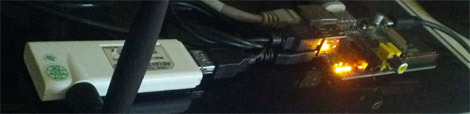
For those of us who haven’t received their Raspberry Pis yet, it may come as a bit of a shock to realize the RasPi doesn’t have an on board WiFi adapter. While the Model B RasPi has an RJ45 Ethernet plug, but the Model A must rely on USB-bound networking dongles. [Mike] over at Mitch Tech put up a great guide to using a Realtek WiFi dongle with his Raspberry Pi.

Stock, the standard Debian install recommended by the folks at Raspberry Pi has the drivers for the Realtek WiFi adapter, but no firmware. [Mike] goes over how to get the firmware for this series of WiFi adapters to keep the kernel from complaining. Interestingly, [Mike]’s instructions also work for a slew of Realtek-based wireless dongles, so the installation instructions should work for a bunch of adapters available from DealExtreme or eBay.

[Mike] also has a guide for installing Quake 3 on a RasPi. Combine these two builds and you’ve got the perfect setup for a Raspberry Pi LAN party. Anyone want to host?

Putting An Atari POKEY In Your Pocket

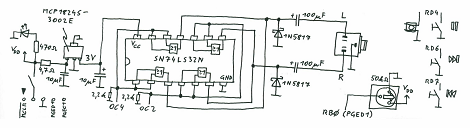
The Atari POKEY served as the main I/O chip on the venerable Atari 400/800 and XL/XE 8-bit computers. While a chip designed to get voltages from game paddles and scanning a matrix of keyboard switches wouldn’t normally be remembered 30 years later, the POKEY had another function: generating very, very distinctive music and sound effects for those old Atari games. [Markus Gritsch] wanted a portable version of the POKEY, so he emulated one on a modern microcontroller. Now he’s able to take those old Atari chiptunes where ever he goes.

The build uses the Another Slight Atari Player by emulating a 6502 and POKEY chip inside [Markus]’ PIC32MX-based microcontroller. There’s not much physical hardware [Markus] had to deal with – the board is built on a QFP proto board [Markus] picked up with a few buttons and a jack added for some simple I/O.

This isn’t [Markus]’s first attempt at portabalizing chiptunes – last year, we saw a truly awesome portable SID player that used the same PIC32 microcontroller and an emulated 6502. Between the Atari SAP Music Archive and the High Voltage SID Collection, [Markus] has more than enough chiptunes for days of listening pleasure.