A DIY Audio Player For When All That Matters Is The Music

orange-mepod

[Grissini] hasn’t had the best of luck when it comes to personal audio players. He estimates that he’s gone through about half a dozen iProducts/iKnockoffs over the years, which ultimately adds up to a lot of money poured right down the drain. Rather than lay down his cold hard cash for yet another music player that would succumb to a dead battery or cracked screen, [Grissini] decided that he would be better off if he built one himself.

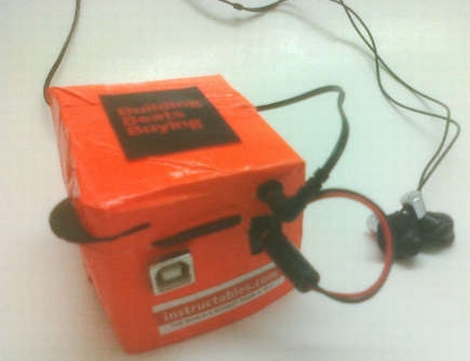
His Orange mePod isn’t exactly the most attractive or sleekest music player out there, but [Grissini] says it works like a charm. An Arduino Uno powers the device, and he uses an Adafruit Wave Shield to handle the audio playback. Power is supplied via 4AA batteries which keep the tunes going for a reasonable amount of time, and afford him the ability to swap them out for recharging without much fuss.

The player was encased with some leftover cardboard and wrapped in bright orange duct tape, before being mounted on [Grissini’s] belt. He says he gets plenty of looks when he’s out and about, which you would expect from such a unique design.

Stick around to see a quick video of the audio player in action.

Continue reading “A DIY Audio Player For When All That Matters Is The Music”
Lighting LEDs With Raindrops

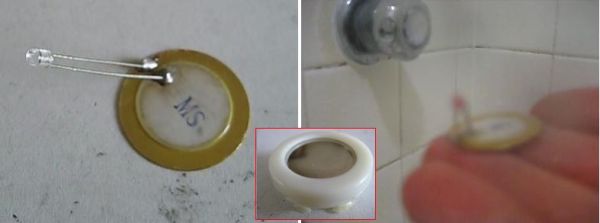
[Steven] had one of those musical gift cards laying around, and thought he might as well reuse the piezo speaker inside it. Without a particular project in mind, he soldered an LED to the piezo and tapped on it, which caused the LED to illuminate as expected. He started to wonder what quantity of force would be required to light the LED, and if it could be done by a raindrop.

He first tested his theory in the shower, and as you can see in the video below it actually worked, though the light was dim and sporadic as you might imagine. He eventually discovered that for optimal lighting, the piezo worked best when struck by single droplets falling with pauses in between, from a minimum height of 4 feet. To achieve a water flow within those specifications, he built a rain funnel so that he can control the droplet frequency and intensity.

It seems to work pretty well from what we can see. Off the top of our heads we can’t seem to come up with any practical applications of the water powered LED, but it is an interesting set of experiments nonetheless.

Have an idea to use this setup that we totally missed? Let us know in the comments!

[Thanks, Rob]

Continue reading “Lighting LEDs With Raindrops”

tesla-coil-hat

A Head-mounted Tesla Coil – What Could Possibly Go Wrong?

We can hear the commercial now…

“Reeeeeeal men of geniuuuuuuus! Here’s to you Mr. no-fear, singing Tesla coil on your hat wearing guy…”

Call him a genius or call him crazy – all we know is that [Tyler’s] Tesla coil hat is awesome! Even though it’s the middle of November, we couldn’t pass up this Halloween costume.

[Tyler’s] creation essentially boiled down to taking a standard dual resonant solid state Tesla coil and shrinking it down to a reasonable size for mounting on his skull. The mini Tesla features a pretty compact boost core which worked reasonably well, at least for a little while. He says that the boost never truly worked properly and needs a redesign, which is something he’ll tackle when he gets some free time.

Boost issues or not, we think that the video below speaks for itself. The hat is certainly an attention getter, and we think it’s great – even if wearing a Tesla coil on your head is not necessarily the safest thing to do.

Continue reading “A Head-mounted Tesla Coil – What Could Possibly Go Wrong?”

Monitoring Batch Jobs The Cylon Way With Python And A Parallel Port

parallel-port-trigger

If you happen to do a lot of video encoding, you know that your computer can really drag while the process is carried out. Our own [Mike Szczys] transcodes videos at home fairly often, and because the process is automated, he doesn’t always know if a conversion is taking place in the background.

He has been tinkering with Larson Scanners recently and thought he could put everything he’s learned along the way to good use by using the scanner as a “busy” indicator for his PC. He hooked the scanner up to the computer’s parallel port, and took a few minutes to bang out some Python code that would alert him when his PC was busy.

He set his notifier script to launch along with FFMPEG, whenever his MythTV setup had something ready to convert. The Python script drives a pin on the parallel port high, triggering the Larson Scanner’s animation. Every minute, the script checks the status of FFMPEG and continues to hold the pin high until the application exits. Once the conversion is done, the scanner goes back to sleep, letting [Mike] know that the coast is clear.

Check out the video below the break to see his parallel port trigger in action.

Continue reading “Monitoring Batch Jobs The Cylon Way With Python And A Parallel Port”

Double-pendulum Spray Gives This Graffiti Bot Some Style

Here’s an art exhibit that does its own painting. The Senseless Drawing Bot (translated) uses the back and forth motion of the wheeled based to get a double-pendulum arm swinging. At the end of the out-of-control appendage, a can of spray paint is let loose. We’re kind of surprised by the results as they don’t look like a machine made them.

The video after the break gives a pretty good synopsis of how the robot performs its duties. The site linked above is a bit difficult to navigate, but if you start digging you’ll find a lot of build information. For instance, it looks like this was prototyped with a small RC car along with sticks of wood as the pendulums.

We can’t help but be reminded of this robot that balances an inverted double pendulum. We wonder if it could be hacked to purposefully draw graffiti that makes a bit more sense than what we see here?

Continue reading “Double-pendulum Spray Gives This Graffiti Bot Some Style”

Adding Keypad Security To Your Automobile’s Ignition System

[BadWolf] managed to make some free time to get back to his own electronic projects. This time around he’s created a security system for his car. It’s patched into the ignition, preventing the engine from starting when the key is turned. A driver must first insert the key, then type the combination on a keypad in the center console before the car will fire up.

While he was working on the project he also decided to add a start button to the dash-board (we think it does make it look like a later model vehicle). The keypad is driven by an Arduino Nano which has the start code stored in it. Power for the system is provided by a USB hub hidden behind the dash which he thinks will also come in handy with future hacks.

When the proper code is entered, you’ll hear a rendition of the Super Mario Bros. theme. The speaker also lends a pleasant beep with each keypress. See the demo clip after the break to hear it for yourself.

Continue reading “Adding Keypad Security To Your Automobile’s Ignition System”

Whole House Battery Backup Used For Lower Power Bills

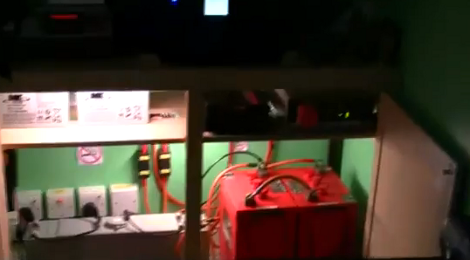
[Photonicinduction] has an impressive battery backup installation that powers his whole house. Unlike a standalone emergency generator which would require you to hook up all of the device you want to run, this setup sits in between the power meter and the breaker box, ready to step in when needed.

But get this, he’s not just using it as a backup system. It kicks in during the day to run everything including two freezers, a refrigerator, his lights, television, and computers. That’s because the price per kilowatt-hour is quite a bit higher during the day than at night. So after 10:30pm the system patches his house back into the grid and charges the batteries for use the next day.

What you see here is just a portion of his system. The control board is not pictured but is very impressive, including a network of relays which are used as a fail-safe system so that there are no conflicts between mains and the battery system. Check out his 15-minute walk through of the system after the break. Continue reading “Whole House Battery Backup Used For Lower Power Bills”