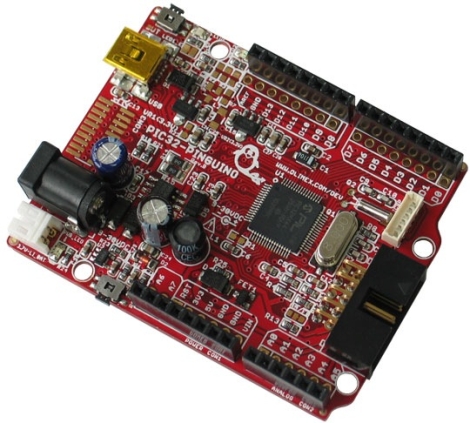
Nanode: A Low-cost Network-enabled Arduino Ethernet Alternative

nanode_ethernet_enabled_arduino_board

The folks over at Hackspace London have been working hard to create a “very low cost, open source, Internet connected platform on which others can develop their ideas”, which they have dubbed “Nanode”.

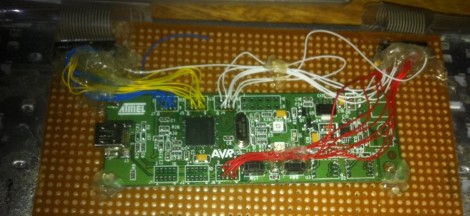
Essentially an Arduino with Ethernet networking on-board, the Nanode is armed with an ATMega 328 microcontroller along with all the other standard goodies you would expect from an Arduino-compatible device. The Nanode can be controlled with a web browser right out of the box, thanks to some custom Ethernet libraries. Additionally network of Nanodes can be easily configured to communicate with a “master” unit via a multidrop serial bus, allowing the device to be used for a wide array of distributed control tasks.

Obviously most of these features can be had in the form of an Arduino Ethernet board, or achieved by using an Ethernet shield. The Nanode is a touch cheaper than either option at $40 for a kit, and the native networking capabilities sound like they would be quite handy. That said, we are a bit bummed that it only has 10BaseT networking capabilities, though it is always nice to have options when it comes to choosing a microcontroller board.

[Thanks, TheHypnotist]

Portal Puppet Probably Won’t Kill Us

This incredibly detailed puppet of the Wheatley from Portal was sent into us, and we a so very happy that we’re not writing about a GLaDOS build right now.

Hewn from florist foam and covered Wonderflex and Apoxie Sculpt, Wheatley pretty much tows the line as far as cosplay and prop builds go. What makes Wheatley interesting is his movement mechanism – he’s actually a hand-controlled puppet. Portal quotes come a small sound module that plays 10 Wheatley quotes. The control system has ten buttons and allows for the display of a lot more emotion than we would expect from a talking sphere. We really like the completely manual solution to an articulated robot eyeball – a really great, simple solution to a complex problem.

Like the portal turret and the adorable and friendly companion cube, we’re really impressed with the build quality of Wheatley. Yet again we’re left wondering why Valve doesn’t license some awesome toys like their office sentry.

Check out the intelligence dampening sphere in action after the break.

Continue reading “Portal Puppet Probably Won’t Kill Us”

Adding A MIDI Input To A Game Boy

[Sprite_tm] is back again, and his work never fails to impress. His latest project is a Game Boy Advance MIDI synth that takes MIDI data from a keyboard or sequencer and maps that to Game Boy sound channels.

Because he seems to never do anything the normal way, [Sprite_tm] decided to run the Game Boy without a cartridge. We’ve seen this before; the GBA boots into the synth software over the link cable with multibooting.

Continue reading “Adding A MIDI Input To A Game Boy”

Add A Real Life Hardware Terminal To That Newfangled Computer Of Yours

vt200_serial_hardware_terminal_over_usb

If you find a crusty old IT guy and give him half a chance, he’ll probably regale you with stories of how things were done “in the old days” where no one had their own computer and everyone worked on mainframe-connected dumb terminals. [JSTN] yearned for a true to life terminal display that he could attach to his 2010 Mac Pro, and since there’s no chance anybody is bringing one to market any time soon, he pieced one together on his own.

He dug up a digital VT220 terminal, and got to work trying to interface this office relic with his shiny new Mac. He found a few helpful tips from someone

DIY Smart Tweezers Make SMD Work A Cinch

diy_smd_smart_tweezers

[Noel] does a lot of SMD work and wanted a pair of “smart” tweezers that could be used to place components as well as for reading their capacitance and resistance values on the fly. As we have seen, these things can be somewhat costly, and not really necessary if you already have a good multimeter. With that in mind, he figured he could build his own for almost nothing.

He started off with a pair of kids’ “training” chopsticks which are durable, but more importantly, non-conductive. He took a second pair of tweezers, this time made of metal, and split them in two. He soldered wire to a set of ring terminals, mounting one on each leg of his broken tweezers. The final bit of assembly involved using zipties to mount everything on the plastic chopsticks along with the addition of banana plugs to the end of his probes.

[Noel] says that the tweezers work quite well, and with such a low price tag, we can’t argue.

Control LED Lighting With An Old Stereo Receiver

stereo_controlled_home_lighting

[Marklar] needed an IR receiver for a project he was working on, and his local electronics store was fresh out. He dug through his junk pile and found an old stereo receiver, so he decided to pull the IR module from it before tossing it out. Once he had it taken apart, he figured that he could utilize the wide array of electronic components he found inside, and set off to start a new project.

The control panel housed the components which interested him most of all. Using an Arduino, he was able to easily interface with the rotary encoders as well as the buttons, giving him a cheap and easy way to control his home lighting system. With a bit of programming, he was able to map lighting presets to various buttons, as well as use the rotary encoder to control the LEDs’ brightness and color. As an added bonus, he kept the IR receiver intact and can control his setup wirelessly as well.

Check out the video we have embedded below to see his scavenged control system at work.

[via HackedGadgets]

Continue reading “Control LED Lighting With An Old Stereo Receiver”

Kinect-based Turntable 3D Scanner Looks Very Promising

We know that the appearance of the Kinect 3D camera hardware, and subsequent open source driver hacking conquest, is a game-changer that brings the real world into much closer contact with the virtual world. But it still amazes us when we see a concept like this turntable-based 3D object scanner that works so incredibly well.

The concept is extremely simple. A box made from foamboard rests atop a turntable. At its center is the object you wish to scan being well-lit by a small LED light source at each upper corner of the box. First up some code and capture data about the sides and top of the object as it spins. To put the shoe back together in the virtual world, he used a modified version of RGBDemo v0.6.0, a Kinect focused project written by Nicolas Burrus.

[A.J] says that the scan comes out pretty well after just one pass, but that’s not stopping him from setting his sights on making this work with three of four Kinects at once. Don’t forget to check out his video demonstration which is embedded after the break.

Continue reading “Kinect-based Turntable 3D Scanner Looks Very Promising”