How To Record 3D Video In 3D

Legalities of doing something like this aside, this concept by [MadSci labs] gives some insight into how one would go about recording a 3D movie in 3D.  Probably many of you have wondered if this could be done, but they took it one step further and actually made a device capable of doing just that.

[MadSci labs] solution involved taking some 3D glasses home from a theater, cutting them to size, and taping them to a HTC EVO 3D phone.  Each lens piece was taped over a different camera lens to separate out the two 3D elements needed to produce a stereoscopic image. Their experiment was successful, however some loss of quality was experienced.  Because of this, we’re not expecting to see a lot of in-theater movies pirated this way, but given a more professional-quality build, you never know what will happen.

You can see the “results” of their experiment after the break. As it’s not in 3D, it should give you an idea of what is going on. Continue reading “How To Record 3D Video In 3D” →

All About The Google Autonomous Vehicle Project

There have been many self-driving cars made with different levels of success, but probably the most well-known project is the Google car.  What you may not have heard of, though is the autonomous Google cart, or golf cart to be exact. The first video after the break explains the motivation behind the cart and the autonomous vehicle project.  As with another autonomous vehicle we’ve featured before, they didn’t forget to include an E-stop button (at 1:03)!

In the second video (also after the break) Google’s Sebastian Thrun and Chris Urmson get into more of the details of how Google’s more famous autonomous Prius vehicles work and their travels around different towns in California. A safety driver is still used at this point, but the sensor package includes a roof-mounted 64-beam laser sensor, wheel encoder, radars, and a GPS sensor. With Google’s vast resources as well as their work with Streetview and Google maps, it’ll be interesting to see what comes of this technology.  I, for one, welcome our new robotic overlords.

Continue reading “All About The Google Autonomous Vehicle Project” →

Medusa: A Proximity-aware Tabletop

Finally [Michelle Annett] can talk about her super secret project she did at Autodesk Research.

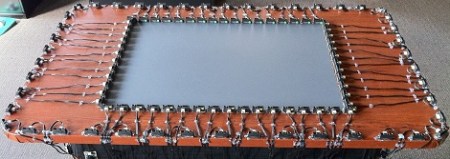
Medusa, as [Michelle]’s project is called, is a Microsoft Surface that has been fitted with 138 proximity sensors. This allows the Surface to sense users walking up to it, and detect users hands and arms above the table top. Multiple users can be detected at the same time, and the left and right hands of two users can be mapped to specific users.

The proximity sensors [Michelle] used are inexpensive, so we’re wondering when someone with a crazy multitouch setup will add proximity sensors to their build. We’d like to play with Medusa, even if just for a virtual game of Settlers of Catan. It seems like the perfect setup…

[Michelle] built Medusa last January during her internship at Autodesk. Now that UIST 2011 is over, she can finally talk about it. There’s also a video demonstrating the possibilities of Medusa, check it out after the break.

Thanks [Fraser] for sending this one in.

Continue reading “Medusa: A Proximity-aware Tabletop” →

Halloween Hacks: Flickering Jack-o’-lantern

The dollar store is always a great place to find some weird stuff, so when [jethomson] found a flickering Jack-o’-lantern, he thought it would make a great project for the 74xx logic competition.

Instead of using the flickering incandescent lightbulb that came with the blinking pumpkin, [jethomson] decided to rebuild a blinking circuit around a 74HC14 Hex inverting Schmitt trigger IC. The chip was used as a relaxation oscillator by adding a resistor and cap from the input to the ground. After a bit of component selection and some calculation, he had a red and blue LED blinking at 2,6,9, and 15 Hz.

The result is a seemingly random pattern of light that looks like a ghostly blue after image of the handheld Jack-o’-lantern. While it may not be one of the most complex builds for the 74xx competition, it gets points in our book for originality.

Although [jethomson] says his camera doesn’t pick up his project very well, he did post a video of the Jack-o’-Lantern in action. Check it out after the break.

Continue reading “Halloween Hacks: Flickering Jack-o’-lantern” →

Hacking In Cameroon For Profit And Entertainment

[Bill Zimmerman] is in Cameroon and has been posting some really interesting articles about life in the central African nation. It comes as no surprise that imported goods can be prohibitively expensive for many of the country’s residents, so building tools and goods is way to improve life and save money. The image above is a metalworking cooperative where any number of products are manufactured from recycled materials, often using tools that the craftsmen made themselves. Their wares are amazingly wide-ranging; crow bars, motorcycle seats, buckets, plows, hammers, knives, cold chisels, and much more. The video after the break shows the tradesmen hard at work. See some video of the cooperative after the break.

But adults aren’t the only ones getting in on the action. Remember [William Kamkwamba] who built a wind generator for his villiage? It seems the tinkering spirit runs deep in the children of Cameroon as well. [Bill] came across some kids who grabbed leftovers like the soles of sandals, scraps of rope, and empty sardine tins to build a steerable toy car.

Continue reading “Hacking In Cameroon For Profit And Entertainment” →

7400 Drum Machine Is A Delight

[74hc595] just finished his entry in the 7400 logic contest. It’s a drum machine built entirely from 7400-series logic chips. He hasn’t quite reached full completion of the project yet. The hardware works just fine, and he’s built a foam core face plate with many more controls than you see here but much of the circuit is still on a breadboard at this point and only two of the channels have been complete thus far.

Jump to the video clip after the break to get the details of how the system works and to hear it in action. This demonstration is one of the best we’ve seen for a synthesizer project as he actually talks about what each control does, and how that is accomplished with the hardware. We’re not going to go into detail about the circuitry he’s designed. As we said before, it uses 7400 logic but also sources a 555 timer to keep the beat. The page linked above has a PDF of the schematic available and you could really lose a lot of time studying how he did this. We might even try to build it in a simulator to see what we can learn.

Continue reading “7400 Drum Machine Is A Delight” →

Going RGB With 7 Segment Displays

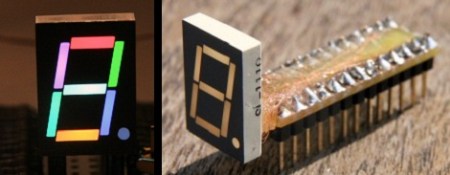
We can order seven segment displays in red, green, yellow, or blue all day long. One thing we haven’t seen is an RGB segmented display, so [Markus]’ project is really interesting. He took a stock seven segment display and modded it into an RGB display.

After taking a Dremel to the back of the stock display, [Markus] was left with a seven segment light mask. A few SMD LEDs were purchased through the usual channels. The RGB LEDs were epoxied into place on the back of the light mask one at a time. Thankfully, the LEDs came with magnet wire already attached – helpful, since these LEDs are only 1.6mm x 1.2mm big.

With 32 pieces of magnet wire, [Markus] needed some sort of socket. A small piece of perfboard and some .100″ headers handled the job very nicely. [Markus] still has to work on some way to drive the 24 cathode lines his LED display. He’d like an I2C interface, but with something like an individual seven segment display, the footprint of the circuit should be pretty small. If you’ve got any tips, drop them in the comments section. [Markus] is sure to catch them there.