A Simple DIY Solar Tracker

solar panel

The sun is a great source of energy, however, efficiently collecting this energy can be hard to do.  One thing that can improve the results of solar use is to actually track the sun’s movement. [fanman1981] hooked up his own homebrew solar tracker using some pretty clever techniques.

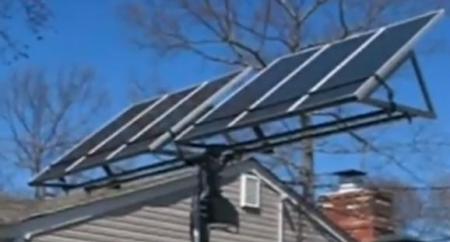
For this hack he used two Harbor freight 45 Watt solar kits, some struts on the bottom, and a Dish Network satellite dish bracket hooked up to an “old school” antenna motor.  Although one might think this device tracks the sun using some sort of sensor, it’s actually just a matter of hooking up the device to rotate at timed interval with a remote control.  This interval is figured out with the benefit of some charts on livingonsolar.com.

To see it in use, check out the video after the break.  He gives a good explanation about how everything was put together, but if you just want to see it move, fast forward to around 5:26, really quite impressive.

Continue reading “A Simple DIY Solar Tracker”

Homebrew TTL Logic Computer

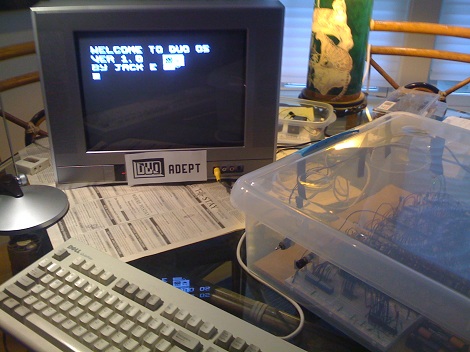
Although [Jack] just graduated High School and doesn’t have much experience with electronics, that didn’t stop him from building the DUO Adept, a homebrew computer built entirely out of TTL logic chips.

The DUO Adept has 64k of memory, 6K of which is dedicated to the video ram that outputs a 240×208 black and white image onto a TV. Bootstrapping the computer to it’s current state was quite a challenge, as an entire OS was put into th system one bit at a time though DIP switches. After the OS was written to the computer, [Jack] was able to connect a keyboard and started programming. [Jack] programmed a hex editor and a few games of his own design. If all that wasn’t impressive enough, [Jack] also programmed an assembly compiler and emulator for his homebrew system.

We’ve seen a a few homebrew computersbefore, but not many of them are laid out on 17 breadboards like the DUO Adept. With skills like these, we can’t wait to see what [Jack] comes up with next. Check out the video after the break for a walk-through of the build.

Continue reading “Homebrew TTL Logic Computer”

Making Your Own Lab Instruments

[Andrey Mikhalchuk] is trying to gather a base set of lab instruments. Specifically, he’s looking for hardware that will let him quickly filter solids out of a liquid. He first started by adding a cotton disk to a plastic funnel. It does the job, but when left to gravity it’s quite slow. He needed a way to speed up the flow even when the filter is heavily clogged with particulates.

There’s already a solution to this problem. It’s a glass container called a Büchner Flask. These feature a glass tube coming out from the neck. By hooking a vacuum pump up to this tube, reduced pressure inside the flask will pull the liquid through the filter in no time. Rather than purchase the specialty item, [Andrey] altered a rubber stopper to accept both the funnel, and a glass tube. This is a cheaper version because it uses a common conical flask but it works just as well. To create the vacuum, an altered bike pump was used. Check out videos of both hacks after the break. Continue reading “Making Your Own Lab Instruments”

360 Degree Photography Uses Very Easy Post-processing

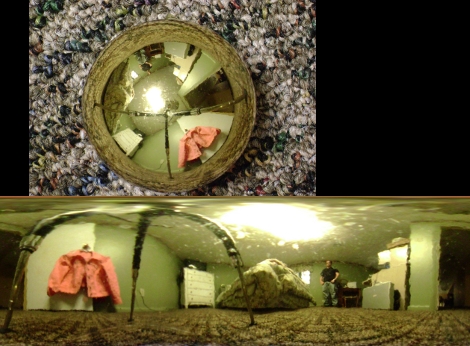
[Pixel_Outlaw] has been working on a method to capture 360 images with his camera. He’s using a shiny Christmas ball ornament to reflect the entire room into the lens of the camera. In the unwrapped image you can make out the three legs of his tripod. In that snapshot he laid the ornament on the floor and pointed the camera straight down from above.

What catches our attention is the post processing he used to unwrap the image. He loaded up The Gimp, an open source image manipulation program, and used just three steps to unwrap the image. First he cropped the picture so that it was square and the spherical ornament was perfectly centered. Then he ran the polar coordinates filter. Finally he scaled the image, setting the width to be Pi times the height. Works pretty darned well for something that doesn’t take much fiddling.

The ornament wasn’t perfectly smooth (or maybe it was a bit dirty) but you can get a much better starting image if you use a bulb with a silver reflector like we saw in this older hack.

Antenna Cannon For Amateur Radio

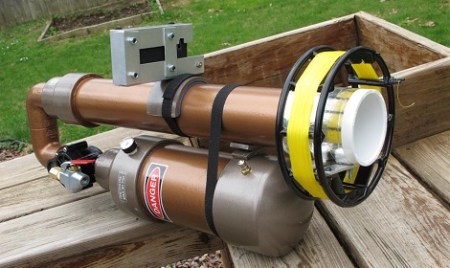
As an amateur radio enthusiast, [Andrew] sometimes has to set up impromptu antennas up to 160 meters in length. The easiest way to get these antennas off the ground is to drape them over trees, a feat normally accomplished by lofting fishing line into the air with a slingshot or bow and arrow. [Andrew] thought slings were so last century, so he came up with a spud gun inspired antenna launcher.

The launcher is built out of PVC and launches a foam filled tennis ball that can reel out 150 yards of Spectra line. In a moment of brilliance, [Andrew] decided to add an augmented reality HUD. The display is actually [Andrew]’s phone running an app called Geocam that provides him with a display of elevation and azimuth overlaid on the phone’s camera feed. The results of [Andrew]’s build are fairly impressive. The cannon was able to lob a tennis ball over a 110 foot tree at half the pressure rating of the PVC. The grouping was pretty tight as well, more than sufficient to run a line over a tree.

[Andrew]’s antenna cannon is an awesome piece of work and unlike most french fry cutters, it’s a useful tool. If you’re interested in seeing 160 meter antennas heaved over the tops of trees, amateur radio field day is next month week, June 25th and 26th.

Official Kinect SDK Released

Microsoft just released the beta of the Kinect for Windows SDK. Although, “Microsoft does not condone the modification of its products” it appears Microsoft have changed their tune and released APIs for C++, C# and Visual Basic seven months after the Kinect was officially hacked.

We’ve seen libraries being developed since the launch of Kinect, culminating in the OpenKinect project. The Microsoft release covers the same ground as the OpenKinect project, and will hopefully improve on attempts to get audio out of the Kinect.

We’ve seen Kinect hacks run the gamut from telepresence, to robotics, to 3D modeling, so the Kinect seems like a great tool in the builder’s arsenal. The Kinect is a wonderful tool, and even though most of the functionality has already been replicated by the open-source community, it’s nice to know there’s official support for all the great projects we’ve seen.

Tripod CNC Plotter

tripod printer machine

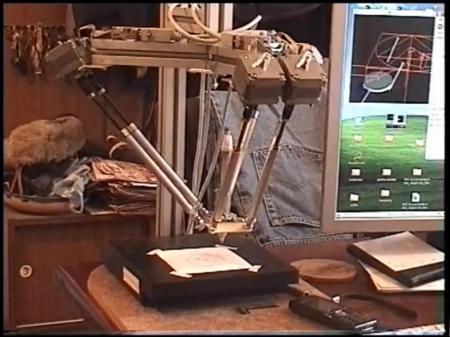
Although some may have heard of a machine like this, the CNC tripod remains an unknown machine to many in the engineering word.  This particular machine is set up as a plotter, drawing incredibly straight lines, shapes, and letters.

The machine appears to have 6 servo motors, 3 working as pairs.  This would simplify control and allows the pen to be held at a perpendicular angle to the paper.  Once could envision this being used with, instead of a pen, a spindle and mill.  Instead of the traditional movement of a CNC mill or router, this could be used to cut out complex shapes.

Additionally, if the servos were not driven in 3 tandem pairs, but were all controlled independently, it should be possible to twist the tool in a controlled angular direction.  This would add an extra axis of control to an already robust CNC setup.  It will be exciting to see how this technology develops in the future.  Until then, check out the video after the break: Continue reading “Tripod CNC Plotter”