Double Barreled Air Cannon

[Jeremy] wrote in to show off his latest creation. he has built a two barrel pneumatic air cannon. Eschewing the traditional approach of having a single barrel and pressure chamber for his spud gun, [Jeremy] wanted to have a double barreled version. Since he was doing this pneumatically, he had to rig up a way to maintain pressure in each barrel independently of each other, as well as trigger them independently. While we can all agree that one way valves and sprinkler valves aren’t ground breaking, it is nice to see it all laid out and tested. We now have the blueprints if we were so inclined to create our own version.  You can see him testing it out by filling the chambers with water and sploooshing that all over the place after the break.

Continue reading “Double Barreled Air Cannon”

Jeri Ellsworth’s Shooting Gallery

Back with another interesting vidoe, [Jeri Ellsworth] once again brings us an amusing and educational hack. This time she’s made a “shooting gallery” in the style of the old arcade games that actually used projectiles. In her version however, she’s using LEDs in the targets which are detected by the gun.  In an effort to keep the feel the same, she rigged up a pinball bell to ding at the appropriate times and it is quite effective.

As usual, she does a great job of breaking everything down and explaining how it all works. She shows us around her prototype so you can see how it is constructed, if you can make it through the solder gun shootout in the beginning.  If she were to continue with this project beyond the functional prototype stage, we’d love to see small video clips being displayed for the targets pepper’s ghost style. Maybe we’re just having fond memories of Time Traveler.

A Friendly Spiderbot Named Chopsticks

chopsticks_the_spiderbot

After seeing his fair share of hexapod-style bots on the Internet, [Russell] decided he wanted to build one of his own. One of the downsides to building these robots is the cost. He often saw them constructed from laser cut parts and very expensive servos. Rather than blow hundreds upon hundreds of dollars on the bot, [Russell] decided he could a lightweight bot on the cheap using chopsticks and polymorph modeling plastic.

His octopod robot is aptly called “Chopsticks” and utilizes 28 different servos to control its motions. 24 servos are used for its legs, 3 more are reserved for head movements, while a single additional servo manipulates the robot’s mandibles. The robot’s legs and main structure are composed of chopsticks, while the polymorph is used for feet, servo mounts, and pretty much anywhere else chopsticks just wouldn’t do.

[Russell] even added a set of eye stalks to complete the spider theme, arming them with IR compound eyes for object tracking. The robot is quite interactive as you can see in the video below.

Keep reading to see a video of Chopsticks, or swing by his Let’s Make Robots site if you get a chance – he has a pretty detailed construction journal as well as plenty of videos showing his spider bot in action.

Continue reading “A Friendly Spiderbot Named Chopsticks”

Roll Your Own Capacitors

diy_caps

Rolling your own electronics components can be fun, but can also help in explaining how certain items actually work. [Addie] from The Toymakers recently set off to figure out how capacitors work, by making her own.

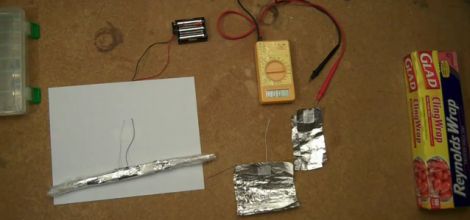
She understood the general concept behind capacitors and how they are constructed, but she wanted to see how it was done first-hand. To construct her capacitor, she selected aluminum foil as her conductor, and saran wrap as the dielectric. She admits that her first attempt was a failure, but undaunted, she carried on. Friends suggested that her conductors were a bit too small to hold any reasonable charge, so she tried larger sheets of aluminum foil to no avail.

She kept at it and found success after using several feet of foil to construct her capacitor. She charged it with a handful of AA batteries and was excited to see her multimeter come to life when she touched the leads to the cap.

While you likely wouldn’t use a hand-made capacitor in your next build, it is a fun experiment to do with children interested in learning about electronics.

[via Adafruit blog]

Continue reading “Roll Your Own Capacitors”

Synkie: The Modular Synth For Video

The folks at [anyma] have been working on an analog video processor called Synkie for a while now, and we’re amazed a project this awesome has passed us by for so long.

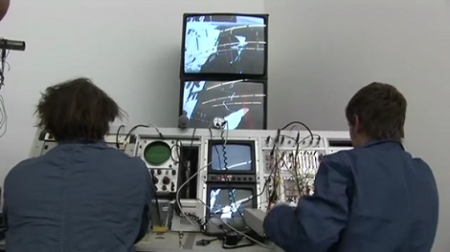
Like a Moog or Doepfer synth, the Synkie was developed with modularity in mind. So far, [anyma] has built modules to split and combine the sync and video signals, and modules to invert, add, subtract, mix, filter and amplify those signals. The end result of all this video processing produces an output that can look like a glitched Atari, art installation, and scrambled cable station all at the same time.

The Synkie’s output reminds us of the original Doctor Who title sequence, and actually this idea isn’t far off the mark – both use video feedback that will produce anything from a phantasmagoric ‘flying through space’ aesthetic to a fractal Droste effect visualization. We’re impressed with Synkie’s capabilities, but we’re astounded by the [anyma] crew’s ability to control a video signal in real time to get what they want.

Check out a video of the Synkie after the jump. There’s also more footage of the Synkie in action on the Synkie Vimeo channel.

Continue reading “Synkie: The Modular Synth For Video”

Learning Electronics Concepts Step By Step

arduino

We realize that not everyone out there holds a degree in electrical engineering or has the ability to tell NPN transistors apart from PNP transistors by taste alone, so we occasionally like to mention things that appeal to the beginners in the crowd. While there is a clear division between Arduino supporters and detractors, it is hard to deny that the devices have their place, and can be quite useful when exploring certain electronics concepts.

For the supporters out there, [John Boxall] has put together a site jam-packed with Arduino tutorials covering a wide array of concepts and techniques. We have covered his work before in relation to specific topics, but we felt that his site deserved mention as a whole. His tutorials cover some of the most basic concepts such as lighting LEDs with the Arduino, and work their way to more advanced subjects, lesson by lesson.

He is not satisfied with simply introducing a concept and handing out a sketch that does the work. He takes the time to expand on the concepts, giving the reader enough detail to use their new-found knowledge in later projects. If you were to follow his tutorials from beginning to end, you would be exposed to LCD screen control, shift registers, real-time clocks, I2C bus communications, and more. These skills and concepts can be carried on to future projects as well as other micro controllers, making his tutorials a very valuable learning tool worth checking out.

Generating Music With Credit Cards

mozarts_credit_card

[Steve] was browsing around at a local electronics surplus store when he spotted an old Tranz 330 point-of-sale terminal that seemed pretty interesting. He took it home and after disassembling it, found that it contained a Z-80 based computer. Because the 330 shares the same processor as other hobbyist-friendly devices such as the TRS-80, he figured it would be quite fun to hack.

While the Z-80 processor is pretty common, [Steve] still had to figure out how it was interfaced in this particular device. After spending some time reverse engineering the terminal, he had free reign to run any program he desired. After thinking for a bit, he decided it would be cool to use the terminal to generate music based on whatever card was swiped through the reader – he calls his creation “Mozart’s Credit Card”.

He found that just playing sounds based on the raw contents of the mag strips didn’t produce anything coherent, so he wrote a small application for the terminal based on the Melisma Stochastic Melody Generator. Music is generated somewhat randomly using various card characteristics, as you can see in the video below.

We think it’s pretty cool, but [Steve] says he’s always open to suggestions, so let us know what you think in the comments.

Continue reading “Generating Music With Credit Cards”