Human-powered Quadcopter Flies Live Tomorrow

A team from the University of Maryland will be taking their human-powered helicopter to the air tomorrow. The current flight record for this type of vehicle is just over 19 seconds of flight at a height of about 8 feet. What surprises us about this attempt is that they’re not pedaling just one main rotor. It seems that the most success in man-powered helicopter flight has come from helicopters with a total of four rotors.

The image seen above is a 2009 test of just one of the four rotor arms that will go into UMD’s finished chopper. Fully assembled it will be about 1/3 the size of a football field, dwarfing the autonomous quadcopters we usually see around here. Get the details about the design from the video after the break. It’s interesting to hear [Dr. Antonio Filipone] talk about the need to generate both the lift and the thrust, where human-powered fixed-wing aircraft only need the thrust. He predicts that human-powered helicopter flight is possible, but that it will only lift the aircraft, with little possibility of moving it in one direction or the other.

The team is attempting to grab the $250,000 Sikorsky Prize with their creation. We wish them the best of luck.

Continue reading “Human-powered Quadcopter Flies Live Tomorrow”

Bit Banging VGA From An SD Card Slot

If you’ve got some favorite electronic device that includes an SD card slot but doesn’t have a video out port you may be able to push VGA signals through the card reader conductors. That’s exactly what’s going on above with the Ben NanoNote, a sub-$100 Linux device which we’ve seen using its SD card slot as general I/O before.

The hardware to capture the signals includes a breakout board for the card slot. Free-formed on the other end of that connector card is a gaggle of resistor which handle level conversion for the VGA color signals, with a VGA cable taking it from there to the monitor. The software that makes this happen is a dirty hack, blocking all other functions while it displays a still image. But we’re sure that it can be cleaned up somewhat. Just don’t hold out hopes for full-motion video, this little guy just doesn’t have it in him.

[via Dangerous Prototypes via Slashdot]

Roll Your Own Capacitors – High Voltage Edition

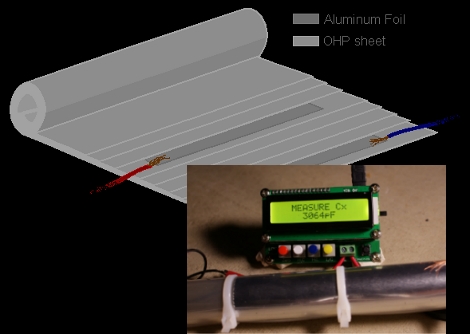
[Grenadier] tipped us off about his method for building your own high-voltage capacitors. He thought the paper and foil capacitor project was a nice introduction to the concepts, but at the same time he knew he could produce a much more powerful device.

For the dielectric he is using acetate film. This is the material from which overhead transparency sheets are made. He stuck with aluminum foil for the two plates. Just roll the foil flat with a rolling-pin, use thin wire to minimize the air that will be trapped between the dielectric layers, and make sure the foil plates are at least 4cm shorter than the acetate film on each end to prevent leakage. After rolling and securing the capacitor with zip ties you’ll be ready for the 3nF worth of fun seen in the video after the break. [Grenadier] mentions that this can be improved further if you were to vacuum impregnate the device with beeswax.

Continue reading “Roll Your Own Capacitors – High Voltage Edition”

Don’t Hit That Switch!

switch_box

Hackaday reader [Danukeru] sent us a video featuring a box-based robot with an interesting personality. The box is fairly simple and from the outside seems to consist only of a switch and an LED. When the switch is flipped however, the box comes to life.

When the box is activated, the lid opens, and a small arm reaches out to turn the switch off. We’ve seen that plenty of times, but this one turns out to be a little different. In the video, this process seems to repeat a couple dozen times before the robot gets angry and flips out. At first we thought that the end portion of the video was done with a bit of digital trickery, but after reviewing the creator’s blog, it looks like it could be legit. It is very hard to see the box’s innards in the video, but it does house a remote control car chassis that allows it to move around and spin out, as seen below.

It’s a pretty neat project, and if you can handle reading the creator’s site via Google translate, there is plenty of picture documentation of the build process for your perusal.

Continue reading “Don’t Hit That Switch!”

AVR Gameboy Dumper

[Kevan] has been hard at work latley developing a Gameboy cart dumper, and while there are a few loose ends to tie up, the device is functioning fine to build up his collection. Running an AVR (mega 16?) and a FTDI chip for the usb connection, the device reads the game’s ROM and SRAM, and can also write the SRAM if you want to load your save games on to the real cart.

On the pc side of things, the device is communicated with using a generic HID protocol and can hit speeds from 16Kbps (currently) to around 64Kbps (soon). A python script currently handles the data stream, but for the rest of us there is a GUI version in the works for both *x and windows.

Also in the works is a redesigned PCB. There were a couple issues and you can see the jumpers, and though we think it adds a little character, it would be good to have fixed in the future.

Juggling With Kinect

kinect_juggling

Some of the Kinect hacks we have featured here are quite useful in the realm of assisted living, others showcase what can be done with the clever application of video filters. Some…are just plain fun.

This pair of Kinect hacks are not necessarily going to win any awards for usefulness, but they are big on fun. [Tom] put together a neat juggling application that watches for your hands to disappear behind your back, generating a glowing ball once they return to the camera’s field of vision. The balls can be tossed away or juggled as you can see in the video below. It looks like it could be pretty fun and most definitely easier than chasing balls around while learning to juggle.

[Tom’s] hack was based off code he saw demonstrated in a video by YouTube user [hogehoge335]. His application for the Kinect allows him to replicate the Kamehameha attack from Dragonball Z, flowing hair and all.

Check out the videos below for a demonstration of both Kinect hacks, and swing by the respective Google Code sites if you want to give them a try.

Continue reading “Juggling With Kinect”

FBI Tracking Device Found; Disassembled

[ifixit] has apparently grown tired of tearing apart Apple’s latest gizmos, and their latest display of un-engineering has a decidedly more federal flair. You may have heard about Yasir Afifi’s discovery of a FBI-installed tracking device on his car back in October of last year. Apparently, the feds abandoned a similar device with activist Kathy Thomas. Wired magazine managed to get their hands on it, and gave it to ifixit to take apart. There’ve even posted a video.

The hardware itself isn’t that remarkable, it’s essentially a GPS receiver designed before the turn of the century paired with a short range wireless transceiver. The whole device is powered by a set of D-sized lithium-thionyl chloride batteries which should be enough juice to run the whole setup for another few decades–long enough to outlast any reasonable expectations of privacy, with freedom and justice for all.