GPU Password Cracking Made Easy

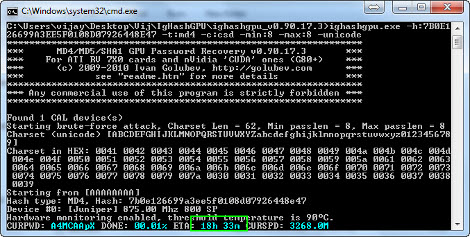
The power that a Graphics Processing Unit presents can be harnessed to do some dirty work when trying to crack passwords. [Vijay] took a look at some of the options out there for cracking passwords and found that utilizing the GPU produces the correct password in a fraction of the time. On a Windows machine he pitted the Cain password recovery tool which uses the CPU for its calculations against ighashgpu which uses ATI or Nvidia graphics cards to do the deed. Hands down ighashgpu is the fastest; with Cain taking about one year to crack an eight character password while ighashgpu can do it in under nineteen hours.

We were very interested to see how easy it is to use this package. We looked in on GPU cracking in September but didn’t focus on the software packages that are out there. Now that you know how easily your password can be unearthed perhaps you will get some use out of this article discussing the usability and security of longer passwords which we ran across over on Reddit.
[Jeri’s] Dress Lights Up When Someone Invades Her Personal Space — Step Back Nerds!

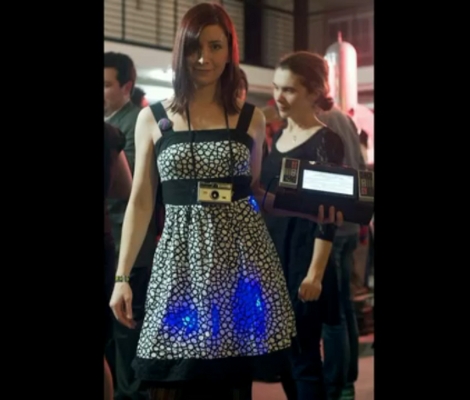
[Jeri] threw down the geeky fashion gauntlet by building this LED enhanced dress. She chose to assemble the project for her trip to BarBot 2011, and we can’t think of a more appropriate setting for such a garment. It uses a motion sensor to set off a delayed pattern of blue lights hidden underneath the fabric.The best part of the hack is the instamatic camera. It looks like a fashion accessory, but it’s really hiding all of the circuitry for the lights.

Inside the camera a PIR sensor waits until it detects motion, sending a signal through an op-amp to the trigger circuitry. A 74LS14 Schmitt Trigger chip teams up with some resistor-capacitor timer circuits to build a delay chain for the LEDs. This way, after motion is detected the LEDs come on and off in a staggered pattern that doesn’t require a microcontroller and is very pleasing to the eye. See the Analog win for yourself after the break.

Continue reading “[Jeri’s] Dress Lights Up When Someone Invades Her Personal Space — Step Back Nerds!” →

Buying, Selling, And Bartering Hacking Hardware

Regular reader [Grenadier] wrote in to let us know about his newly published hacking hardware trading post called The Junkbox. Apparently when he’s not blowing up capacitors or building his own high voltage ones, he makes time to code up a website where you can buy, sell, and barter leftover components.

We have something like this right here at Hackaday. The dollar sign icon along the right column, just underneath the featured posts banner will take you to our classifieds section which at the time of writing had a whopping nine items posts. But these things to ebb and flow. Check in on the newly posted link from time to time to see that number grow.

Whether it’s over at The Junkbox or in our classifieds section, we think the biggest problem is finding what you need when you need it. This is nothing new. If you missed it before, we’ve embedded an older episode of the EEVblog after the break where [Dave Jones] tours Apex Surplus. It’s as if a hacker who has hoarding tendencies bought a store forty years ago and just kept piling more and more merchandise to the sky.

Continue reading “Buying, Selling, And Bartering Hacking Hardware” →

Prototyping The New Office Clock

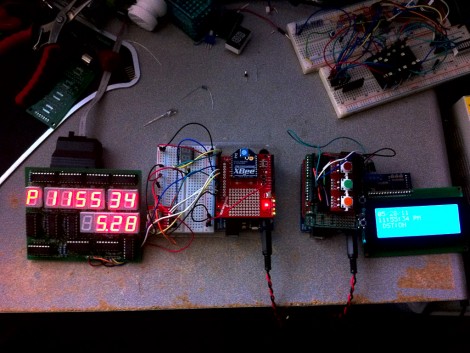
[Damage] was tapped to build a new clock to hang on the wall at the office. He got a hold of some 6.5 inch seven segment displays for the hours and minutes, as well as some 4.5 inch modules for the date and month. Rather than jump right in with the large hardware (especially because he’s waiting for the PCB order to arrive)  he built this prototype with more commonly sized displays.

His build is Arduino powered. In the video after the break he mentions the temperature compensated crystal oscillator that keeps the time. We’d wager that’s the DS3234 based RTC module that Sparkfun sells. This is the same chip family as the Chronodot and it was our choice for the Ping Pong Clock.

The finished clock will hang high on wall, out of reach when you need to set the time. This shouldn’t need to be done much – if ever – since that RTC includes a backup battery. But [Damage] took the time to develop a remote programming device anyway. Using another Arduino, an LCD display, and an Xbee pair he whipped up a remote that can be used to navigate and change the main unit’s settings.

Continue reading “Prototyping The New Office Clock” →

Devil Horns Adorn The Hood Of My Truck

When you’re hunting zombies you’ve got to give them something to fear. [Shannon Larratt] is getting ready for that eventuality by adding devil horns as his hood ornament. It looks awesome from afar, but when you see the close-up images you realize how lifelike this is. That’s because it’s not a sculpture. [Shannon] cast the ornament in a mold made from his own hand.

The process started with some dental alginate which he slobbered all over his hand as he held the devil horns pose. After the mold had hardened he cast the ornament using fast-curing black plastic resin.

With the ornament now in hand he needed a way to secure it to the hood of his vehicle. He picked up a threaded U-bolt. A hole and a slot were carved in the base of the ornament to receive the U-bold and a straight bolt for a trio of anchor points. More of the black resin fills the holes, securing the bolts and making it a snap to mount the ornament by drilling through the hood.

We also find it awesome that during this process [Shannon] took the time to cast his daughter’s fist for use as a door knob at home.

Radio Packets…from Spaaaace!

space_radio

[Bill Meara] was watching the International Space Station and the Shuttle Discovery pass overhead a few weeks ago, which rekindled an interest he gave up long ago – sending and receiving radio packets from space.

Years ago, he used to send APRS packets into space with a small rig powered by a 286 computer and HandiTalkie. These packets would drift off into space most of the time, but occasionally they would bounce back to Earth whenever the space station or PC Sat would fly by. The packets were often captured by other ham operators across the globe, who happened to be tuned to 145.825 MHz.

His interest renewed, he dug out his old HandieTalkie and Kantronics Terminal Node, aiming them towards the sky via an antenna situated in his back yard. When he returned 10 hours later, he found that he had collected all sorts of “space packets” from across the globe.

While not exactly a hack, it is definitely a neat exercise in ham radio operation. We can imagine slinging data packets off the space station would be an exciting experience for any budding operator (and OMs as well!)

A Keygen For The Real World

key_generator

[Nirav] found that he rarely printed anything useful with his RepRap, so to shake things up, he decided he needed to work on a project that didn’t involve printing yet more RepRap parts.

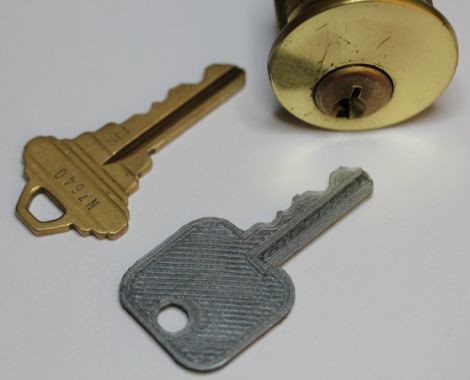
The goal of his project was to create working replicas of house keys by simply using the code imprinted at the factory. He purchased a handful of used lock sets from eBay, then carefully measured the keys with a ruler and calipers to get the blank dimensions just right. After that was done, he looked around online and was eventually able to create an OpenSCAD model using a chart of pin depth specifications he located. By changing the last line in the model’s code he can print any coded key. For keys lacking a code, he can manually measure the height of each bit and print replicas that way as well. Once printed, he says that they keys are strong enough to turn most locks he has come across, including deadbolts.

This is undoubtedly a neat project in its own right, though we would be interested to see if someone could get it paired with a program like SNEAKEY to generate bit measurements by sight alone.