Kindle Terminal With Secret Key-press Activation

[Luigi Rizzo] has been working on some hacks for his 3rd generation Kindle. There is already a Python based terminal emulator called AjaxTerm but he wanted a lightweight standalone so he reimplemented the program in C. The 100k binary monitors the keyboard, launching the terminal emulator when it detects a Shift-T sequence. It also uses alternative key mapping to fill in for some of the keys the Kindle’s keyboard is missing.

We haven’t seen a whole lot of Kindle hacking since it was hacked to run Ubuntu. Seems like this terminal emulator is a useful and unobtrusive hack to try out on the beloved reader.

Bluetooth Temperature Module

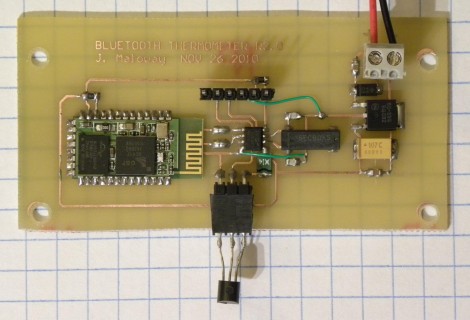
Wanting to know the outside temperature, [Jamie Maloway] built his own temperature sensor that can be read with a Bluetooth device. Let’s take a tour of the hardware above from right to left. There’s a linear voltage regulator with two filtering caps and a terminal block to attach a 9V battery or other power source. Next there’s an 8 MHz crystal and it’s capacitors, followed by a programming header on top and a 1-wire temperature IC, the DS18B20 we’re all familiar with hanging off the bottom. These both connect to the 8-pin PIC 12F675 that drives the system, and transmits using a Bluetooth module from Sure Electronics. Since this is using a serial protocol and transmitting ASCII data, it can be read using an automated script, or simply by using a terminal program.

Now, who’s going to be the first to get rid of the battery and leech off of the mains through inductance?

Segfault: Balancing Transport Using A Dozen Op-amps

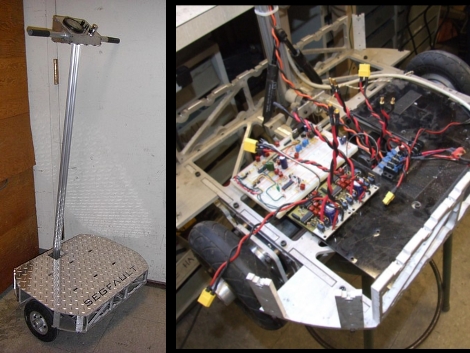
The Segfault is a balancing transport similar to a Segway, but it uses analog comparators instead of digital circuitry. On board you’ll find no less than twelve LMC6484 op amps. They take signals from the gyroscope and the accelerometer, balance and filter them, then drive the motor h-bridges accordingly.

[Charles], the guy behind the Segfault, is also the one responsible for DeathBlades. As with that project he does just as well at documenting as he does at fabrication. Take some time to enjoy his posts associated with this two-wheeled-wonder (especially the build process) and then watch in the video after the break.

Continue reading “Segfault: Balancing Transport Using A Dozen Op-amps”

EEG The Locomotion

The use of brainwaves as control parameters for electronic systems is becoming quite widespread. The types of signals that we have access to are still quite primitive compared to what we might aspire to in our cyberpunk fantasies, but they’re a step in the right direction.

A very tempting aspect of accessing brain signals is that it can be used to circumvent physical limitations. [Jerkey] demonstrates this with his DIY brain-controlled electric wheelchair that can move people who wouldn’t otherwise have the capacity to operate joystick controls. The approach is direct, using a laptop to marshall EEG data which is passed to an arduino that simulates joystick operations for the control board of the wheelchair. From experience we know that it can be difficult to control EEGs off-the-bat, and [Jerky]’s warnings at the beginning of the instructable about having a spotter with their finger on the “off” switch should well be followed. Maybe some automated collision avoidance would be useful to include.

We’ve covered voice-operated wheelchairs before, and we’d like to know how the two types of control would stack up against one another. EEGs are more immediate than speech, but we imagine that they’re harder to control.

It would be interesting albeit somewhat trivial to see an extension of [Jerkey]’s technique as a way to control an ROV like Oberon, although depending on the faculties of the operator the speech control could be difficult (would that make it more convincing as an alien robot diplomat?).


Lego Machine Predicts Future Eclipses

Hidden behind the white face plates of this machine are racks of gears that make up a replica of one of the oldest known mechanical computers. This is a working model of the Antikythera mechanism made from Lego pieces. In the video, which you absolutely can’t miss after the break, The machine is disassembled into its various components. Each mechanical unit takes advantage of gear ratio combinations to perform numerous levels of mathematical functions in order to display the date and time that future celestial events will occur.

The background information on the original device reads like the script for a sequel to The Goonies. Believed to date back to 100-150 BC, the stone bronze mechanism was recovered from a shipwreck around the turn of the twentieth century. The use of x-ray analysis helped to unlock the functions and confirm the theories of its operation.

Part of what makes this so interesting is the historical connection. But the production quality of the video (which to be fair, seems to be an advertisement) really brings home how complicated this process is. Now it’s time for us to watch the video a few more times, sketching out the gearing to see that this works as they say it does.

Want more of the Antikythera mechanism? Check out the model built by [Tatyana van Vark].

Continue reading “Lego Machine Predicts Future Eclipses”

Skillet Reflow Controller

Using an electric skillet to reflow surface mount circuit boards is a popular alternate use for those kitchen appliances. The real trick is monitoring and controlling the temperature. [Mechatronics Guy] built his own skillet temperature controller using a thermistor, a solid state relay, and an Arduino.

He was inspired by [Ladyada’s] work which used a servo to adjust the temperature dial on the skillet’s power supply. This started by attaching the thermistor to the bottom of the skillet using JB weld. since this area will be heating up he also attached a terminal block for connecting the feed wires as the heat would melt any solder joints. Those wires travel back to a control box housing the Arduino and solid state relay. To gain finer control over the heating element the relay is switched on and off, resulting in low-frequency Pulse Width Modulation, which should help maintain a consistent temperature better than just turning the temperature dial on the cord.

Pair this up with the vacuum tweezers hack and you’re on your way to a surface mount assembly line. If you want to see this process in action check out this post. It goes from stenciling, to populating, to reflowing in a toaster oven.

[Thanks Rob]

ATX Psu Turned Into An Adjustable Voltage Bench Supply

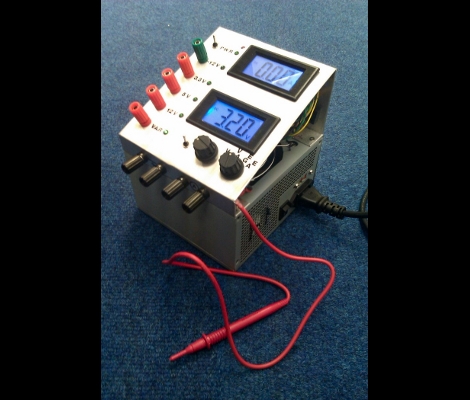
Here’s a fancy way to convert an ATX powers supply into a bench supply. [TG] didn’t just cut off the motherboard connector and add banana plugs, but improved the functionality. Right off the bat you’ll notice that he’s added a control panel. There is an Ammeter and Ohmmeter to let you know what the unit is putting out. He added an MIC29152WT adjustable voltage regulator so that he’s not limited to the fixed voltages of the psu. As a final touch he added an external voltage probe which can be used with the flick of a switch. It’s no replacement for a proper bench supply, especially since it doesn’t have adjustable current limiting, but it’s a nice improvement upon previous psu hacks.